First published:-
1924
Star rating:-

Read in:-
December, 2014
Make no mistake. This, to me, will always be Forster's magnum opus even though I am yet to even acquaint myself with the synopses of either Howards End or Maurice. Maybe it is the handicap of my Indian sentimentality that I cannot remedy on whim to fine-tune my capacity for objective assessment. But strip away a colonial India from this layered narrative. Peel away the British Raj too and the concomitant censure that its historical injustices invite. And you will find this to be Forster's unambiguous, lucid vision of humanity languishing in a zone of resentful sociocultural synthesis, his unhesitant condemnation not merely of racism, casteism, religion-ism and what other noxious, vindictive 'ism's we have had throughout the history of our collective existence but of the fatalistic human tendency of rejecting a simple truth in favour of self-justifying contrivances.
Yes there's the much hyped 'crime' analyzed in the broader context of presupposed guilt and innocence . There's the issue of race, class and privilege factoring into the ensuing judicial process. The ripples of the eventual fallout of this mishap disrupt the frail status quo that all parties on either side of the race divide were tacitly maintaining so far and pose crucial existential questions before people of all communities.
Then there are hypocritical Englishmen who cannot choose between preserving the sanctity of the Empire's administrative machinery and upholding their own prejudices. And hypocritical Indians who righteously accuse the Englishmen of institutionalized hatred while stringently maintaining their own brand of intolerance. But greater than the sum of all these thematic veins is the connecting thread of Forster's sure-footed, measured prose which explores not only the inner lives of the central characters but tries to penetrate the heart of a nation-state in the making.
The India depicted here is a foreign country to me - a time and a place yet to be demarcated irreversibly along lines of communal identities that are presently dominating our political rhetoric. It is of little appeal to the newly arrived umpteenth Englishman but, nonetheless, presents itself as an amalgamation of unrealized possibilities. Not once did my brows knit together in frustration on the discovery of any passage or line even casting a whiff of Forster's bias against the people or the land. My senses were stretched taut all the time in an effort to detect any. Sure, Dr. Aziz is a little infantilized and his importance is sometimes reduced to that of a plot device used for manufacturing the central conflict while Adela Quested, Mrs Moore and Mr Fielding appear before a reader as upright individuals who stand for the truth. The other Indian characters seem to be defined by their general pettiness. But these imperfect characterizations can be more than forgiven in the light of what Forster does accomplish.
The song of the future must transcend creed.
There are times when the narrator's voice dissects the drama unfolding against unfamiliar Indian landscapes with a kind of fond exasperation and times when it dissolves into a withering regret for the way the engines of civilization continue to trundle along towards some catastrophic destiny without ever pausing for the purpose of self-assessment. And it is the profound clarity of Forster's worldviews and his sensitivity and forthrightness in deconstructing the enigma of the 'Orient' that elevates his writing even further.
Perhaps life is a mystery, not a muddle; they could not tell. Perhaps the hundred Indias which fuss and squabble so tiresomely are one, and the universe they mirror is one.
It's not the 'handicap of my Indian sentimentality' after all. Forster sought to extract the kernel of truth buried underneath layers of artifice and his craft could successfully flesh out the blank spaces between that which can be expressed with ease. Those are always worthy enough literary achievements in my eyes.

First published:-
1998
Star rating:-

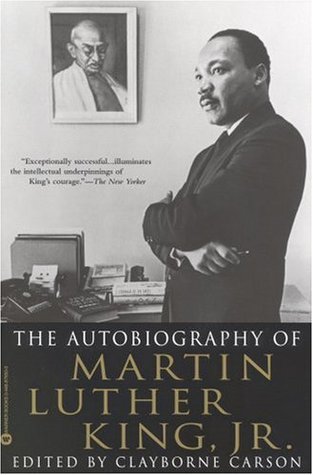
I had to keep reminding myself that it's not the civil rights movement I am rating and reviewing, because the spectrum of legitimate excuses, let alone justifications, which could explain the withholding of a star or two is rather limited. It comes as a kick to the gut every time a young, unarmed Clifford Glover or a Travyon Martin or a Michael Brown is shot for no valid reason and the realization sinks in that the process of integration which was initiated by Lincoln some 150+ years ago and furthered by Martin Luther is yet to reach its completion. So the essence of this book and MLK's doctrine of nonviolent agitation are now relevant more than ever.
In a way this is Martin Luther's own account of the movement he helped steer in a direction which not only sought to free an entire community from socioeconomic and political servitude but prevented America from becoming synonymous with the ultimate hypocrisy of all - preaching the infallibility of human rights abroad (by waging wars against Communist totalitarianism) but carrying on with its tacit agenda of institutionalized discrimination back home.
"I am convinced that if we are to get on the right side of the world revolution, we as a nation must undergo a radical revolution of values. We must rapidly begin the shift from a thing-oriented society to a person-oriented society. When machines and computers, profit motives and property rights, are considered more important than people, the giant triplets of racism, extreme materialism, and militarism are incapable of being conquered."
How the spirit of rebellion - which found expression for the first time with the Montgomery Bus Boycott in '55 (unwittingly started by Rosa Parks' act of denying her occupied seat to a white passenger) - trickled into the hearts of oppressed millions in Albany, Georgia, Birmingham, Alabama, Florida, Chicago, Boston, and Washington culminating in the passage of the landmark Civil Rights Act of 1964, is recounted by King himself.
That aside, there's a brief autobiographical sketch patched together from the fragments of writings gathered from the Stanford University archive by Clayborne Carson. Excerpts from King's speeches (sometimes even the full text) also make appearances in between the accounts of all the non-violent movements of civil disobedience he gave leadership to.
To put it more accurately, this is less of an autobiography (since King didn't live long enough to write one) and more like a montage of every single written document or important oratory piece which King left behind. So lucidly written are these that Carson's work must have been reduced to simple editing and piecing together a coherent narrative out of the vast amount of material at her disposal.
And yet there are such glaring mistakes here which marred my reading experience. Consider this excerpt from King's personal writings after his visit to India in '59 which cemented his faith in the inviolability of civil disobedience as an effective tool to usher in socioeconomic and political change -
"On March 1 we had the privilege of spending at the Amniabad ashram and stood there at the point where Gandhi started his walk of 218 miles to a place called Bambi."
It's not Amniabad. In all probability, it's the Sabarmati ashram in Ahmedabad King is talking about, while the historic walk was to 'Dandi' - a coastal village in Gujarat (the state our present PM hails from). Not Bambi, the iconic Disney deer.
Even if it was a memory lapse on King's part or a sad apathy for geographical names, as a King scholar looking to publish a work of monumental importance Carson should have been more vigilant for inconsistencies such as the above, especially since Gandhi gets mentioned several times by virtue of his being King's role model.
(Some quick googling led me to the unhappy discovery that the Stanford archive still retains the unedited, therefore, incorrect information derived from the original sources. I can understand the significance of preserving King's writings exactly as he authored them but the insertion of incorrect facts diminishes the integrity of this work.)
Also occasionally 'Gandhi' is spelled as 'Ghandi'. (Aaarrrrggghhhhhh!)
In addition to these turn-offs, nearly all of King's speeches are so chock full of archetypal metaphor after metaphor that I felt it weakened the gravitas of the narrative. Perhaps, they would have been better off being included in shortened formats. The fact of God's mercy and benevolence being invoked (quite natural since King was a pastor) in every alternate sentence also served as an effective irritant. These are undoubtedly the primary reasons why it took me a whole month to finish reading this.
But these causes of botheration aside, there's plenty of good to be found in this compilation. Like the way MLK expresses his disappointment with 20th century capitalism in a letter addressed to his wife, Coretta -
"...I am not so opposed to capitalism that I have failed to see its relative merits. It started out with a noble and high motive, viz., to block the trade monopolies of the nobles, but like most human systems it fell victim to the very thing it was revolting against. So today capitalism has out-lived its usefulness. It has brought about a system that takes necessities from the masses to give luxuries to the classes."
or his critique of the Vietnam War and correlation drawn between American militarism and the dangerously skewed nature of race relations in the deep south-
"I do not believe our nation can be a moral leader of justice, equality, and democracy if it is trapped in the role of a self-appointed world policeman."
The absence of that missing star, thus, should be attributed to my personal aversion to factual inaccuracies, overused metaphors and bad analogies. Otherwise no rating system in existence can measure MLK's significance in American history and all that he stood for.
First published:-
2000
Star rating:-
 Some books are very obviously flawed, contrived in ways which slow down the reader's progress and heavily tax his/her ability to dredge up empathy over the headache-inducing frenzy of loaded work-weeks. And yet these narratives are so divine in their earnestness, so far-reaching in their scope, that you are filled with this overwhelming, earth-shattering zeal to shower them with a holy love and not let even a drop of your skepticism dilute your admiration for the writer's boldness. Your cowardice and inaction dictate you honor his unstated wish and this is the least you can do anyway. Embrace it all - the two-faced treachery perpetuated by the torchbearers of civilization, the endless cycle of degradation and corruption and the myriad sorrows of all the characters which bleed into its pages. Take one swig after another from the truth flask until you have been purged of all your self-indulgent guilt-trips and left with nothing but a crushing hopelessness which devours all other emotions with a vindictive fury.
There's us, cocooned in the warm illusion of security, dissecting the politics of injustice from our ivory towers, wholly in denial of our bubble of happiness feeding off the despair of others. In an effort to scramble toward whatever glamourous concept of affluence it is we consider salvation, we do not see the charred wreckage of lives strewn all around.
There's the woman of flesh and bone who becomes a grotesque assimilation of mere genitals, who can only be an abstract embodiment of the abuse with no human face - a walking, breathing cunt for hire whose existence you acknowledge only when you require its use. Every once in a while she leaves crack-addicted babies with no fathers in the maze of foster care or dumps them like inanimate blobs of flesh in seedy abortion clinics. She only lives in those documentaries harbouring Oscar-nomination ambitions, at the precipice of our segregated utopias merging with the abyss of the Tenderloins of the world. And the sanctimonious laws state with conviction, that the Tenderloins and the red light areas do not exist.
There are the hobos, the panhandlers, the bums, the destitute - not allowed to be anything other than victims of their own ineptitude, worthy of a stray sympathetic glance and a few seconds of pity, to be religiously warded off our vaunted inner sanctums. There is Henry Tyler, a pathetic loser bearing the Mark of Cain, wallowing in eternal self-pity, choosing to live as a homeless man to find his Queen, his antidote to a desiccating loneliness. And then there's the Queen of the Whores with her magical powers and her crack pipe - just an emblem, a protector, a redeemer, a guardian angel, a modern day Jesus - and law-abiding respected founder of 'Feminine Circus' Jonas Brady, with his multi-million dollar franchise of selling men the right to rape, torture, and mutilate disabled girls, her nemesis.
They are all actors in an absurd pantomime. They are all real.
'Part biblical allegory and part skewed postmodern crime novel', the blurb announces with relish. But that doesn't even skim the surface of this tome.
I call this Vollmann's gift to the perpetual outcasts of society, the ones we have pushed so far beyond the edge bit by bit in our own mad dash for the center that they exist in a kind of parallel netherworld where all humanly concerns are put to rest, where violence and deprivation are the order of the day. I call this his sincerest attempt at chronicling their stories the way they may have approved of, however alien to our feral cravings for taint-free reputations, routine and fake dignity, however repulsive to our faux-fragile sensibilities. I call this a searing critique of the hypocrisy of the ones holding the reins of the civilized world, who would sputter with mock indignation when asked to legalize prostitution.
However small or insignificant, I call this book an act of redemption.
First published:-
2006
Star rating:-
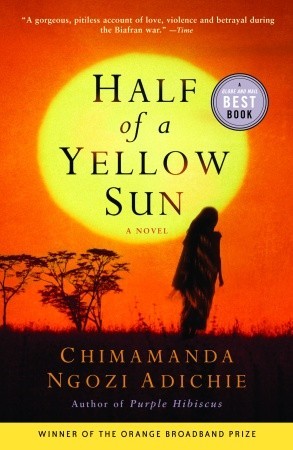
 It came to me as an epiphany as I barreled through the last few pages of this book, blanketed in my Sunday evening lethargy, marveling at Adichie's graceful evocation of a forgotten time and place and feeling the embarrassment of having known nothing about the Biafran war, that somewhere in the Gaza strip the maimed bodies of children must lie strewn amidst the debris of their former lives while vicious debates rage on twitter in which people pick a side - Israel or Hamas - to defend from criticism. As if that's what matters.
Somewhere at this very moment there may be a terror-stricken, weeping child, fleeing to find cover, unaware of what she is running from, unaware of the finality of death, shielded by the caprices of the same history she is living, perhaps. Someday she may grow up well to become another Chimamanda to write the story which is hers to tell, and time, circumstances, and health permitting, I am going to be reading that book and be reminded of the umpteenth 'war' that not even my generation of enlightened, Nobel-peace-prize winning heads of state did enough to prevent, the damage that could have been preempted, and the children who could have grown up to carry the weight of civilization some day but didn't.
The farce of this relentless cycle of mayhem, killing, pillage, rape, and starvation will hit us time and again and yet leaders of the first world will continue to look dapper in their crisp suits and appear dignified while justifying their sale of high-tech weapons to warring parties because revenue is to be earned from the spilling of blood. For the sake of self-made demarcations, for the sake of that ridiculous nonentity called national pride, for the sake of righting wrongs done in the past we'll bury our children and future in mass graves and commit more wrongs.
This book deserves 4 stars in my eyes. It's not a flawlessly written work with its frequent straying into the territory of melodramatic personal relationships and cliched characterization and Adichie's writing seems to lack polish in places. But in no way does that stop this from being a highly important work of fiction that the annals of literature ought to acknowledge with a gleaming appraisal.
This is the past transcending the barriers of time to appear before us in a surely pale imitation of its true grotesqueness. This is Adichie leading us to history of a corner of the world we only associate with food programs, the UNHCR, unstable governments and inexorable ethnic conflicts. This is Adichie telling us that history ignored isn't history blotted out.
I didn't know Biafra at all; there are not enough books on Biafra (as confirmed by Goodreads and Google Books), because only those horrors of war survive oblivion which are fortunate enough to receive the world media's stamp of approval. Not all death and devastation caused by 'civil wars' are worthy of the glory of 'crimes against humanity' like Nigeria's smooth war tactic of starving Biafran children with tacit British support wasn't.
"Starvation propelled aid organizations to sneak-fly food into Biafra at night since both sides could not agree on routes. Starvation aided the careers of photographers. And starvation made the International Red Cross call Biafra its gravest emergency since the Second World War."
But there was a Biafra. Not the transient existence of the nation represented by half of a yellow sun but the reality of the people who, in the paroxysms of misguided idealism, picked the losing side in a war.
Chimananda's Olanna, Ugwu and Richard, all of whom weave their way in and out of manifold conflicts of morality, identity, and survival, serve as our guides in this landscape of kwashiorkor-plagued children with pot bellies while trying to make sense of the muddle of mutual Hausa-Yoruba-Igbo animosity. And along with them the reader navigates the maze of wartime barbarity, political allegiances, and interpersonal relationships with a growing sense of unease and uncertainty - who are the ones truly responsible? who are the perpetrators? who are the victims? what was the war for and what did it achieve?
"Grief was the celebration of love, those who could feel real grief were lucky to have loved. But it was not grief that Olanna felt, it was greater than grief. It was stranger than grief."
In the end any such attempt at such neat compartmentalization makes little difference to the truth of lives destroyed in a fit of murderous passion. In all likelihood, there will be more Biafras and Srebrenicas and Rwanda-Burundis and Syrias and Gazas as there will be the burden of future tragedy and loss to be borne by hapless survivors. But there's the small assurance that there will be the Chimamanda Ngozi Adichies of the world to give a human face to the solemn formality of statistics every time.
First published:-
1999
Star rating:-

There are parts of this book fully deserving of unadulterated love and veneration, worthy of 4 stars in the least. The fact that the real India, Jamaica and Bangladesh are recreated here and not the imagined India, Jamaica and Bangladesh of white writers too reluctant to put in the requisite amount of research for getting the most inconsequential tidbits right has much to do with it. In addition, Zadie Smith succeeds in keenly evoking their history, language, cultural ethos, the stench of their festering old wounds inflicted by an undo-able past, and their bizarre hypocrisies making the leap across land and oceanic borders into alien territory, exempted from being dissected by the scalpel of 'western reason' in the name of minority rights.
There's the undeniable truth of centuries of conditioned servility, hatred of the power which established the ground rules of the abusive relationship called colonialism, and the unfathomable responsibility of bearing the burden of yesterday.
"[] they can't help but reenaact the dash they once made from one land to another, from one faith to another, from one brown mother country in to the pale, freckled arms of an imperial sovereign."
There's the Bengaliness of the family to be religiously guarded against the sallies of Western liberalism; imminent dilution of the much treasured Bengali DNA in the gene pool staved off at all costs. And there's war to be waged on foreign territory - for another inch of land, another notch up on the dignity scale, for yet another step of the socioeconomic ladder. Whenever stung by the prick of casual racism, whenever thwarted, they will go back to their institutionalized tendencies of seeing things in black and white and studiously avoiding mentions of a gray area; they won't think twice before disregarding their favorite Gandhiji's famed 'An eye for an eye will make the whole world blind.' They will seek out the greener pastures of first world optimism but resist synthesis, tugging at the roots of old grudges again and again so that the present and the now can be drawn and quartered on the altar of history.
"And then you begin to give up the very idea of belonging. Suddenly this thing, this belonging, it seems like some long, dirty lie...and I begin to believe that birthplaces are accidents, that everything is an accident."
But then there are the 'just-roll-with-it' parts which deserve no more than 2 stars - the cocksure and smug tone in which the narrator recounts this multi-generational saga of families caught in the chaos of modern day materialism vs heritage, the unrealistic, often two-dimensional characterization and the zany Britcom feel to the episodes which warrants a suspension of disbelief and gives rise to the nagging suspicion that this was written with the idea of a film or tv series adaptation in mind.
As much as Smith's light-hearted, tongue-in-cheek, clever mockery of roots and righteous reliance on said roots for existential validation is absolutely legitimate and spot-on, it is awfully disingenuous to think roots can and should be so easily discarded. Assimilation requires time and the immigration conundrum will never be felt as acutely by second generation immigrants (like Smith herself) as by their progenitors. This is where I prefer Jhumpa Lahiri's narrative voice (her later works) over Smith's - no inflection of moral and intellectual superiority, no pronouncing of judgement on flawed choices but a restrained attempt at humanizing all characters.
Since the 4-star and 2-star ratings are equally bona fide in my eyes, a 3-star it is. More so because I can't remember the last time a woman writer of contemporary literary fiction made me laugh so hard.
First published:-
2011
Star rating:-

"For after the rain, when with never a stain
The pavilion of Heaven is bare,
And the winds and sunbeams, with their convex gleams,
Build up the blue dome of Air
I silently laugh at my own cenotaph
And out of the caverns of rain,
Like a child from the womb, like a ghost from the tomb,
I arise, and unbuild it again." - P.B. Shelley
The heron preens itself majestically, perched delicately at the edge of the pond, having found the familiarity of a home at last after miles of mateless flight. Gold-flecked koi fishes dart surreptitiously just below the surface, disrupting the lotus leaves. Wisps of rain-bearing clouds and the mountains meld into each other's embrace in a rare moment to become a mist-robed goddess and render the vista an acute resemblance with aukiyo-e painting, a charming illusion not even a discerning eye can remain immune to. Unwilling to pay the dues exacted by aphasia, Yun Ling hears the fading whispers of times gone by - unspeakable horrors etched across the soft palate of her consciousness she'd dearly like to forget and fond remembrances of the ones who sustained the flame of empathy in their hearts while the symphony of death and devastation reached its crescendo all around the Malay peninsula. The beautiful and fragile landscape of Yugiri lies forgotten in the wake of Aritomo's perplexing disappearance, but his decrepit, untended garden stands as a testimony to his lifelong devotion to a dying art form, to his solemn resolve of remaining humane at a time when savagery was the norm.
One war replaces another as the ruthless Communist guerrillas commence a new reign of terror at the end of the Japanese Occupation. Peace remains that idealized mirage in a desert, forever out of reach. The prospect of succumbing to an acute hatred of the ones who caused her misery tempts, but Yun Ling struggles to hold on to her sanity and conscience in the grey abyss trapped between light and dark. Her faith in Aritomo wavers time and again but she lets her skin become the last canvass of his horimono art anyway.
Did Aritomo's loyalty lie with Emperor Hirohito all along? Or had he simply ignored the obligations imposed by notions of race, gender, skin color, and nationality to respond to that primordial voice of reason every time it had called out to him to do the right thing? Will Yun Ling ever be able to forgive herself for surviving the atrocities that claimed her sister's life? Will Yun Hong find the peace and dignity in death that she was denied as a 'comfort woman' at the hands of her Japanese captors?
In her twilight years, Yun Ling realizes that these questions will continue to ricochet off the walls of her consciousness time and again until the day she breathes her last. But she is no longer haunted by their echoes. The war had claimed victims on all sides and nearly every one was complicit in the collective barbarity of it all. Her festering psychological wounds will never truly heal but she finds contentment in calm acceptance of this baffling duality of life - the juxtaposed coexistence of kindness and cruelty, love and loathing, memory and oblivion, the human capacity for creation and destruction.
"Are all of us the same, I wonder, navigating our lives by interpreting the silences between words spoken, analysing the returning echoes of our memory in order to chart the terrain, in order to make sense of the world around us?"
Reconciled to history's ironies, Yun Ling now knows that the world will forever rotate on its axis of disastrous decisions and terrible consequences for all. The relentless flow of time will weather away all the damage that had seemed indelible once. Remembering Aritomo's words, she will cling to a greater purpose with every last bit of strength if and when the cycle of madness starts all over again. Because nestled in the heart of the mountains in Tanah Rata lies the frayed dream of her refuge from the brutalities of the outside world - the slumbering garden of evening mists which patiently waits for her to awaken it to the magical touch of life once again.
First published:-
2000
Read in:-
June, 2014
Star rating:-
 Not until recently had I emerged out of the rock I was living under and located the @everydaysexism twitter account. Keeping an eye on their retweets for a little less than two weeks enabled me to discover that women are not only forced to endure the lecherous male gaze (often called 'stare rape' these days) on public transportation, made the object of innuendo-laced, denigrating remarks since puberty but also masturbated at in public without their consent (not even women over 60 had been spared) . How blissfully ignorant I was of this last facet of everyday sexual harassment! I went on a kind of mad rampage immediately, flooding my timeline with a deluge of tweets on the subject, appealing to more of my followers to follow the everyday sexism account. A day later when I had checked back in eagerly in the hopes of noticing any visible change - NOTHING. Not even one person among my followers (I have nearly 1600 which maybe just a handful but it's not a very teeny number either) had honored my request apart from the 3 who were already following them - all of them women or women's issues related accounts.
It was then that I realized, 'feminism' in the 21st century is actually like a hip, new item of home decor that you place on a wall cabinet among the other borrowed, trendy opinions you profess as personal philosophy, then forget about. Whenever some horrendous instance of brutality against a woman makes the morning news headlines, everyone's 'tch-tch-ing' fake concern for civilization resurfaces, spills over into the realm of their office lunch hour debates and after a while dies a natural death. Then they go back to the comfort of their tweleb status by posting the same old 'jokes' about dumb blondes, unreasonable wives, sluts, 'cunts', boobs and what have you, each of which are guaranteed to get at least 20+ retweets.
Lulz just chill, we're all kidding here, getting our kicks out of reinforcing the same old stereotypes that have done considerable damage to society since the dawn of time. No harm done.
It is this same all-pervading reluctance of acknowledging the efficacy of a concept like feminism as a panacea for sexism, violence and all the other concomitant shit women face every single moment of their lives that forms the backbone of Bell Hooks's book.
She merely chooses to use 'white supremacist capitalist patriarchy' as a refrain so as to hammer this information into our brains. Yes the recurrence of this phrase gets dull after a while, yes it is somewhat annoying but no it is not irrelevant. Especially since Bell Hooks seems to support the branch of feminism which brings the concept of equality for everyone (including homosexuals) in all walks of life - sexual, economic, social and religious - under its envelope.
She summarizes the inception and journey of the feminist movement through the decades - how it made a first appearance in the U.S. in the 60s with the waves of bra-burning (she is not against bra-burning btw), angry women who had major grievances against a domestic arrangement where they held little to no power, how initially they believed 'feminism to be the theory and lesbianism the practice', how it has undergone gradual improvement to evolve into the polished academic discipline that it is today, how it was seen as an anathema in the past and how it continues to face a steadily growing list of challenges - apathy of mass media being a major one. She deftly interweaves feminism with the idea of politics, class struggle, physical beauty, love, religion, marriage, reproductive rights, parenting, masculinity and race to present before us a realistic picture of what truly internalizing its precepts can mean for us and our future.
But all the conventionally known preachings of the book aside, she makes another very pertinent point about stripping the verbiage of jargon from all the academic work on feminism to make them more accessible to students and laymen alike, and working together to raise awareness of how feminism isn't inherently 'anti-men' or 'anti-religion' or even simply restricted to serving the interests of women in civilization, how feminism is for everybody.
"Today in academic circles much of the most celebrated feminist theory is written in a sophisticated jargon that only the well-educated can read. Most people in our society do not have a basic understanding of feminism; they cannot acquire that understanding from a wealth of diverse material, grade school-level primers, and so on, because this material does not exist. We must create it if we are to rebuild feminist movement that is truly for everyone."
To come to the negatives, there are almost none except the monotonous drone in which Hooks drives home her points which makes the reading experience little less than enjoyable, the drabness of her prose and the way her repeated references to her own writings reek of self-importance. And to further account for that missing star, I have this teeny niggling doubt about her defining acts of 'domestic violence', even those carried out by women against other women and children, as'patriarchal violence'. She reckons some women have been so rigorously conditioned by the patriarchal world order based on principles of domination through violence and other acts of intimidation, that they re-enact the same in their daily lives while dealing with people inferior in status to themselves. Which I agree with but my limited knowledge of the world and its assorted contradictions tells me it's not just the men. Some primeval inclination towards violence and skewing the power balance in any relationship is embedded in the human psyche in general, irrespective of sex.
But that aside, the overarching message one gets from Hooks's outlook is that the traditional notions of 'manhood' and'masculinity' have to be flushed down the toilet for feminism to even have a chance at victory. And there's no second guessing it.
First published:-
1962
Read in:-
May, 2014
Star rating:-
 A university professor had once expounded on the supposed conflict between history and literature, the former bemoaning the irrelevance of the latter when it comes to tracing the contours of reality while the latter countering this accusation by deploying the well-known defense of 'there's no one way of looking at the truth'.
Indeed. Why restrict ourselves to just the one way and the one reality? Why overlook the truth of infinite permutations and combinations of each eventuality and each one of them, in turn, forking off into myriad possibilities ad infinitum? Why seek neat compartmentalization of two disparate disciplines and prevent their intermingling to create new streams of thought? Why believe mathematics and literature to be so fundamentally apart that there can be no blending together of both without the results being distorted beyond intelligibility?
The very fact that the known limits of what's considered intelligible are being breached every moment, has its roots in the reluctance of labyrinthine minds like Borges' to follow linear pathways.
Mysticism, mathematics, arcana, philosophy, and literary criticism. A perfect blurring of the boundaries between fact and fiction leading to the creation of an entirely new entity which challenges the normative narrative form. And a moment of perfect lucidity arising out of a churning of all these elements. Where our imaginations come to a staggering halt, Borges' begins.
I do not wish to squeeze out every last drop of meaning from these complex interpolations of a known truth into discrete bits of hitherto unknown logical conclusions by googling every reference I did not get. Instead I delight in Borges' perfectly synchronized demolition of all and any conventions associated with writing with an authorial preeminence, I gaze enthralled at the vision of clarity being birthed out of pure chaos.
"In a birdless dawn the magician saw the concentric blaze close round the walls. For a moment, he thought of taking refuge in the river, but then he knew that death was coming to crown his old age and absolve him of labors. He walked into the shreds of flame. But they did not bite into his flesh, they caressed him and engulfed him without heat or combustion. With relief, with humiliation, with terror, he understood that he too was a mere appearance, dreamt by another."
I let my mind latch onto his even if for a little while and let it guide me into realms where only the divinity of thought reigns supreme in its many manifestations.
And, for now, that is enough.
__
P.S.:-It's good to know where David Foster Wallace acquired his irksome yet awe-inspiring footnoting habit from.