Showing posts with label Magic-Realism-Surrealism. Show all posts

Wednesday, June 11, 2014

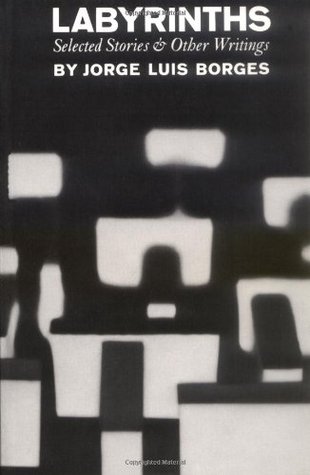
Review: Labyrinths: Selected Stories & Other Writings by Jorge Luis Borges


First published:-1962

Read in:- May, 2014

Star rating:- 

A university professor had once expounded on the supposed conflict between history and literature, the former bemoaning the irrelevance of the latter when it comes to tracing the contours of reality while the latter countering this accusation by deploying the well-known defense of 'there's no one way of looking at the truth'

Indeed. Why restrict ourselves to just the one way and the one reality? Why overlook the truth of infinite permutations and combinations of each eventuality and each one of them, in turn, forking off into myriad possibilities ad infinitum? Why seek neat compartmentalization of two disparate disciplines and prevent their intermingling to create new streams of thought? Why believe mathematics and literature to be so fundamentally apart that there can be no blending together of both without the results being distorted beyond intelligibility? 

The very fact that the known limits of what's considered intelligible are being breached every moment, has its roots in the reluctance of labyrinthine minds like Borges' to follow linear pathways. 

Mysticism, mathematics, arcana, philosophy, and literary criticism. A perfect blurring of the boundaries between fact and fiction leading to the creation of an entirely new entity which challenges the normative narrative form. And a moment of perfect lucidity arising out of a churning of all these elements. Where our imaginations come to a staggering halt, Borges' begins. 

I do not wish to squeeze out every last drop of meaning from these complex interpolations of a known truth into discrete bits of hitherto unknown logical conclusions by googling every reference I did not get. Instead I delight in Borges' perfectly synchronized demolition of all and any conventions associated with writing with an authorial preeminence, I gaze enthralled at the vision of clarity being birthed out of pure chaos. 

"In a birdless dawn the magician saw the concentric blaze close round the walls. For a moment, he thought of taking refuge in the river, but then he knew that death was coming to crown his old age and absolve him of labors. He walked into the shreds of flame. But they did not bite into his flesh, they caressed him and engulfed him without heat or combustion. With relief, with humiliation, with terror, he understood that he too was a mere appearance, dreamt by another."

I let my mind latch onto his even if for a little while and let it guide me into realms where only the divinity of thought reigns supreme in its many manifestations. 

And, for now, that is enough.


__

P.S.:-It's good to know where David Foster Wallace acquired his irksome yet awe-inspiring footnoting habit from.


   photo C136E66569D294E4D5DA2D8124D4FF69.png

Tuesday, February 18, 2014

Anaïs Nin, my beloved witch

Anaïs Nin has been a favorite author for a while now. So today I'll just use this space to review two of her books at one go:-
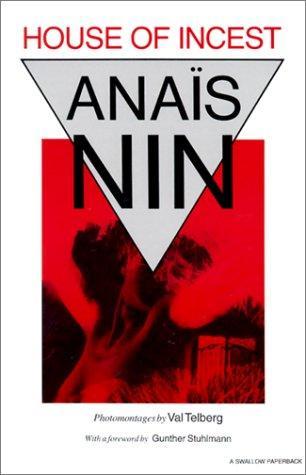
House of Incest


First published:- 1936 (Nin's first work of fiction)

Star Rating:-

What do they say about pretty words strung together into passages pregnant with symbolism and implications, some of them beyond the grasp of a dilettante like me? How do they compartmentalize Anaïs Nin's writing? 
'Erotica' they like to call it, perhaps, putting focus on the sexual imagery Nin invokes with the flair of her pen. 

But I would rather not enclose Nin's genius inside the banal prison of a genre like erotica. Her words, like splotches of the most exotic water color, coalesce into an abstract painting of such acute beauty that one can only stare at the phantasmagorical picture that forms in front of the mind's eye, with a deep sense of wonderment. 

Her words are magic. Her words instill life into the seemingly lifeless form of a road stretching ahead. Her words transform a taboo subject like incest into a fathomable, even an acceptable reality of our existence and temporarily divorce us from the social conventions, of the material world, as we know them. Her words whisk us away to a secluded, floating world where only surreal landscapes of Nin's imagination sprawl far and wide in all their majestic splendour. And the reader can only be a besotted traveller enjoying a one-of-a-kind sojourn - soaking up all the incomprehensible loveliness of Nin's prose in small bursts.

"I felt only the caress of moving - moving into the body of another - absorbed and lost within the flesh of another lulled by the rythm of water, the slow palpitation of the senses, the movement of silk..
Loving without knowingness, moving without effort, in the soft current of water and desire, breathing in an ecstasy of dissolution.
I awoke at dawn, thrown up on a rock, the skeleton of a ship choked in its own sails."


Her words accord a kind of literary immortality to so many hackneyed humane emotions and sentiments.

"But Jeanne, fear of madness, only the fear of madness will drive us out of the precincts of our solitude, out of the sacredness of our solitude. The fear of madness will burn down the walls of our secret house and send us out into the world seeking warm contact. Worlds self-made and self-nourished are so full of ghosts and monsters."


Her words are exquisite poetry. 

____

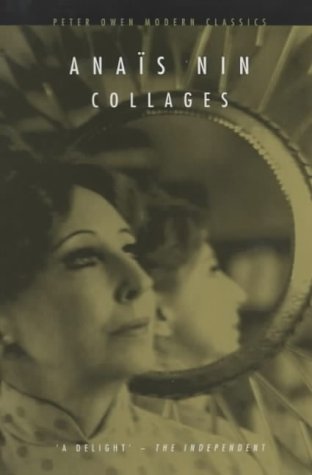
Collages


First Published:-1964

Star Rating:-


Anaïs Nin is my beloved witch, capable of making the nebulous frontiers between imagination and reality dissolve away into oblivion with one well-maneuvered flourish of her metaphorical pen, her personalized magic wand. Or I see her in my mind's eye, as a lovely but shabbily dressed seamstress, patiently weaving a patchwork quilt of exquisite beauty out of the gossamer strands of time. 

Does art imitate life or does the opposite hold true? 
Where does life begin? Where does it end? What lies in between? What does it all mean?
Anaïs Nin attempts to answer these hazy, unanswerable questions by giving us a snapshot of the perpetual movement of time and the phantasmagorical spectacle of humanity caught in its web, establishing without a doubt that there's no end, no beginning and no middle. Life is ad infinitum.

Dreams and reality collide in her writing, exploding in a dazzling array of fireworks illuminating the obscure part of our consciousness, giving us brief flashes of the realm in which the ultimate truth lies cocooned in the protective covering of the mundane, slumbering peacefully - the truth about life and beauty, love and lust, happiness and grief, the extraordinary and the common.

Collages is exactly what its title implies and much more than what our feeble imaginations can conceive upon the utterance of this word. It is not about a nation or a set of natives, a single protagonist or many, one life event or a set of discrete occurrences. Anaïs Nin renders perfect delineation unnecessary, makes clearly visible lines of divide vanish without a trace. Instead, vignettes, eerie and abstract, tangible and solid, merge and fall into each other, clumsily yet seamlessly, to create a surreal painting, a collage of the human consciousness holding the random admirer in thrall, glaringly all-encompassing in its wild, colorful abandon even though the viewer strives to make sense of it. But isn't life just like this baffling, bizarre work of art that Anaïs Nin begets? Comprehension stays forever out of reach. Even when we feel it floats mid-air at arm's length, attempts at trying to grasp it remain thwarted.

As Renate pours her beautiful, meaningless dreams into her empty canvasses, falls in and out of love with Bruce, drifting through space and time, touching the lives of many we get an impression of life's fluid grace and its capacity of encasing the infinite. The diseased, old man who shuns the company of his loved ones, preferring to live in a cave by the sea with a few seals as companions, the heart-broken French consul's wife who grieves for her broken marriage and vindictively contemplates finding a Turkish lover, the clairvoyant film critic who describes for Renate the scenarios written by struggling writers which never saw the light of the day, Nobuko who fights to free herself from the suffocating, rigid civility of the Japanese way of life - these are but a handful among the many myriad shades and facets of humanity shuttling in and out of Renate's life causing vague but perceptible upheavals. The quietly floating gondolas of Venice, the ochre-hued sand dunes of an African desert, the peaks of Peru and palaces of Marrakesh, upscale avenues of New York and streets of Arcadia, California all make fleeting appearances in this stunning collection of interlinked snippets, dismantling in the process all man-imposed barriers between nations and cultures and presenting to the reader an eerily arresting picture of life in all its glory and imperfection.

I don't care about Anaïs Nin being mostly recognized as a writer of literary erotica since I beg to differ on the subject of this categorization. I don't care about the fact that she shared an incestuous relationship with her father. But what I definitely care about is discovering and appreciating more of her splendidly assembled collages.


   photo C136E66569D294E4D5DA2D8124D4FF69.png

Sunday, November 24, 2013

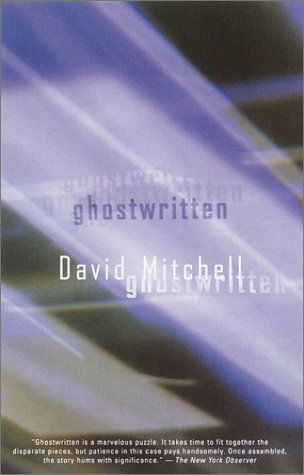
Review : Ghostwritten by David Mitchell

First published:-August 19, 1999
Star Rating:-

"I wonder what happened to him, I wonder what happened to all of them, this wondering is the nature of matter, each of us a loose particle, an infinity of paths through the park, probable ones, improbable ones, none of them real until observed whatever real means, and for something so solid matter contains terrible, terrible, terrible expanses of nothing, nothing, nothing..."

Ordinary human lives, sometimes crisscrossing, sometimes briefly touching, sometimes swiftly passing each other by through the fabric of space and time, creating imperceptible ripples on the surface of some invisible lake of our collective consciousness that eventually lead up to an event of cataclysmic significance....

Everything considered, Ghostwritten is an imperfect masterpiece. In the sense it makes its far-reaching ambitions of being viewed as a tour de force of its generation apparent at the onset but when one sets about to allow oneself keener examination of all its narrative intricacies, it smacks of amateurishness. If, at its best, Ghostwritten is a fascinating meditation on the hollowness of human lives, human fallacies, urban alienation, intertwined fates and our unslakable thirst for validation in the 21st century then at its worst it is a rather complicated mess of styles and themes usually identified with two masters of the craft - Calvino and Murakami. I'd, thus, refrain from calling it masterful and call it the work of a master in the making instead.

There is something so blatantly Murakami-esque about this book, that I am tempted to label Mitchell as Murakami Lite and this is supposed to serve more as a mild chiding rather than approbation of any form. It is like Murakami's ghost (excuse the unintended pun) continuously haunts Mitchell's characters and their lives, his voice reverberating in their unvoiced musings, innermost stream of thoughts, conversations and his invisible presence subtly influencing the magical-realist aspects of the book. So much so there's even a minor character who fleetingly mentions spotting his own doppelganger on the streets of London one day. I almost began anticipating the appearance of talking cats or strange sheep men after this point, although thankfully none were found in the end. 
But regrettably enough, this book failed to give me any of those goosebumps-inducing moments of pure intrigue which I have often come to categorize along with the effects produced by Murakami's surrealistic vignettes. 

It is also quite obvious Mitchell has distilled the essence of Calvino's Invisible Cities into his own deconstruction of modern day cities like Tokyo, Hong Kong, St Petersburg, London and New York in a 20th-21st century set up. The concept of islets of human existence huddled together in their own miniature niches, disparate yet suffering from similar fates, their ideas of the city they dwell in coalescing clumsily to impart the city its true identity, comes into play here but not under the guise of Calvino's beautifully rendered symbolism. 

Prior to picking up this book, I had heard so much about Mitchell and the widespread adoration he enjoys especially among my Goodreads friends, I was expecting something life-altering and unforgettable. And despite the narrative sweep and all-encompassing nature of the subjects Mitchell touches upon here, Ghostwritten seems to be neither of the aforementioned. At least not in my opinion. And as the novelty of the interconnection among the short story length snippets wears off with the gradual progress of the narrative, the lack of finesse in Mitchell's writing becomes all the more prominent.

"God knows darn well that dabbling in realpolitik would coat his reputation with flicked boogers."
(Ugh?)
Inclusion of quite a few crude metaphors like the one above just felt jarring to the overall tone of the novel.

I hope Cloud Atlas is more accomplished.


 photo C136E66569D294E4D5DA2D8124D4FF69.png

Saturday, October 12, 2013

Review: The Wind-Up Bird Chronicle by Haruki Murakami

If I were to use only one word to describe this book, I would type the word 'brilliant' a million times with each letter in CAPITALS and fill up the entire word length of this particular space.

In all its sensitivity, emotional depth and keen understanding of the complications of the human mind, this is a stellar work of literature and a tour de force in itself. I cannot go ahead and say it is Murakami's magnum opus (it is not his longest novel), since I haven't finished with all his translated works and besides he is only 63 and I expect him to keep writing books for as long as it matters, each one better than the last. But I'm forced to admit that of the 7 Murakami books I have had the fortune to read so far, this one stands out as the most gripping, most cerebral yet compassionate commentary on loneliness and human misery. 

In this particular novel, Murakami stitches together a handful of seductively beautiful vignettes to form a magnificent larger than life image, that does not only represent a story of a particular individual but recounts the tales of many. Seemingly unconnected at first, these numerous subplots coalesce together in a solid clincher of an ending - a humongous task but performed with elan by the masterful surrealist.

It is a story of a marriage which is falling apart slowly but steadily, a moving depiction of the horrors inflicted on humanity during Japan's occupation of Manchuria and the forgotten battle of Nomonhan, a mystery thriller, an exploration of the inherent darkness within each one of us and a man's path to self discovery all combined into one.

Newly out of work, Toru Okada is leading a peaceful life with his wife Kumiko when his carefully organized world starts to crumble bit by bit. His wife goes missing without a hint, the sociopathic brother-in-law he despises with a passion is emerging as a compelling figure in Japanese politics and he begins encountering queer characters one after the other, each of whom seem to be twisted individuals but guide him towards solving the mystery of his wife's sudden disappearance. And thus begins a most intriguing tale of Okada's journey through an intricate labyrinthine path stretching across time and space, the real and the surreal, where he goes through a set of bizarre but enlightening experiences.

It is difficult for me to say anything more about the plot simply because it is impossible to summarize a Murakami novel or to express all the emotions a reader goes through in such a short review. Honestly I could write a whole damn book if I'm to review every aspect of one particular Murakami novel.

All this time I had subconsciously developed an intense desire of knowing Murakami's opinions on Japan's infamous role in World War II. This book surprised me pleasantly by giving me exactly that and I'm not disappointed with his view. 
Instead of taking a stand, Murakami describes a few scenes of extreme violence with precision and calculated neutrality and pushes the reader to form his/her own opinion. He does not try to absolve the Japanese of the unmentionable crimes they committed against the Chinese but at the same time offers a very human perspective of the trail of death and devastation. For example, when a Japanese veterinarian, serving as the director of a zoo in Manchukuo is being made to watch the gruesome killing of 4 Chinese rebels with bayonets, Murakami sums up his feelings in the line:-

'He became simultaneously the stabber and the stabbed.'
I don't think he could have created a more moving picture of the ruthlessness of war or the unimaginable horrors it spawns. If the Japanese were ruthlessly brutal, so were the rest - the Soviets, the Mongols and every single human being who killed or tortured another in the name of war. He also hints at the accountability of those at the helm of matters, seated somewhere in their immaculately decorated offices, dressed in dapper suits, making decisions which alter the course of humanity for the worse and bring about disastrous consequences for the rest to face.

This is perhaps the only Murakami novel which has a very strong element of mystery at heart and which ends with a satisfactory resolution of sorts. 


Final rating :- 5 stars and no less. Hell, I could've given it a 10 stars out of 5 if possible.

P.S:- So Murakami didn't win the Nobel this year either, but that's okay because in the heart of every devoted Murakami lover, he has been given the Nobel a million times over already.


 photo C136E66569D294E4D5DA2D8124D4FF69.png

Tuesday, October 8, 2013

Review : Orlando by Virginia Woolf

The most prudent way to review a Virginia Woolf book, perhaps, would be to write 'READ THIS  BOOK. IT'S STUPENDOUS. GENIUS. AMAZING. WHY HAVEN'T YOU READ THIS YET?' and leave it at that. Because not only does this relieve you of the responsibility of casting about for appropriate words to serenade Woolf but also because you know no review in the world does justice to the sheer magic that she is capable of creating with words.
But since I have a thing for self-flagellation (not really) I wish to undertake precisely this mammoth task of writing about Orlando.

After having closed the book and put it aside, the first predominant emotions are that of being overwhelmed by the all-encompassing nature of its inherent themes, then awestruck, then of being very close to tears.
One is compelled to sit quietly in a corner, still under the heady influence of Orlando's poetic stream of thoughts, and brood over all the discrete human sentiments, actions and events that make up life as we know it, letting precious minutes trickle by.

Our hero-heroine, Orlando, seems not only to be a representation of the human spirit, a union of yin and yang in all its imperfect glory, but also a lasting testament to the perpetual flow of time. His-her pronouncements sound almost like a chorus of voices, echoing all the dichotomies that characterize our existence and the transience of our emotions.
Orlando begins the journey of life as a man of wealth and social standing in Elizabethan era England, comfortable in the skin of his vanity, amorous in his dalliances with women. And the book ends on 11th of October, 1928, in modern England where Orlando is a married woman, a mother, an accomplished writer and finally at peace with life's many ironies and caprices. I will refrain from going into all that takes place between these two distant points in time because for that one can always read the book.

It will suffice to say that Orlando swings back and forth between craving and shunning love, between pursuing his-her literary interests and trivializing the urge to write, between seeking the august company of men of letters like Pope, Addison and Swift and then belittling them. And even though hundreds of years pass by as Orlando goes through the many myriad experiences that life had in store for him-her, it seems like everything has remained essentially the same. The reader is struck by a sense of passivity in motion, of an enduring constancy even though the sights and sounds and scenarios, that Orlando flits through, keep varying.

Thus in a way Orlando is not different from Woolf's other works just because of the noticeable absence of a stream of consciousness(which, again, is not totally absent here) but because here, she attempts to grasp at an amorphous entity like time and enclose it within the pages of this gem. And I am mightily pleased to say that she pulls it off with an elan, one associates only with her.
What makes Orlando really stand out among other VW works is the dual gender of its protagonist. Orlando keeps oscillating between his-her manly and womanly bearings and towards the very end, what nullifies the differences between the sexes is his-her humanity, his-her detachment from the material world and a crossover into the realm of the spiritual.

"The whole of her darkened and settled, as when some foil whose addition makes the round and solidity of a surface is added to it, and the shallow becomes deep and the near distant; and all is contained as water is contained by the sides of a well. So she was now darkened, stilled, and become, with the addition of this Orlando, what is called, rightly or wrongly, a single self, a real self."

The narrative does seem a bit disjointed at certain points, especially when Woolf foregoes conventions and goes into intricate detailing of events which seem of little importance in the greater scheme of things or inserts her witty observations on society's prejudices concerning women, chastity and more.

"Orlando, who was a passionate lover of animals, now noticed that her teeth were crooked and the two front turned inward, which, he said, is a sure sign of a perverse and cruel disposition in women, and so broke the engagement that very night for ever." 
"I am she that men call Modesty. Virgin I am and ever shall be. Not for me the fruitful fields and the fertile vineyard. Increase is odious to me; and when the apples burgeon or the flocks breed, I run, I runl I let my mantle fall. My hair covers my eyes, I do not see. Spare, O spare!"
 "Truth come not out from your horrid den. Hide deeper, fearful Truth. For you flaunt in the brutal gaze of the sun things that were better unknown and undone; you unveil the shameful; the dark you make clear, Hide! Hide! Hide!"

See what I mean? This is probably Woolf at her funniest and wittiest. So not a single sentence or passage can be devalued even though it may appear a little out of place or slow down the progress of the narrative.

In essence, Orlando is a summation of all the irrepressible instincts of both the man and woman - their quest for knowledge, their search for meaning in chaos, their feelings of inferiority aroused by the vastness of the universe and their desire to find an eternity trapped within their brief lifetimes.

5 out of 5 stars.

 photo C136E66569D294E4D5DA2D8124D4FF69.png
Related Posts Plugin for WordPress, Blogger...