Showing posts with label Review - Non Fiction. Show all posts

Friday, February 19, 2016

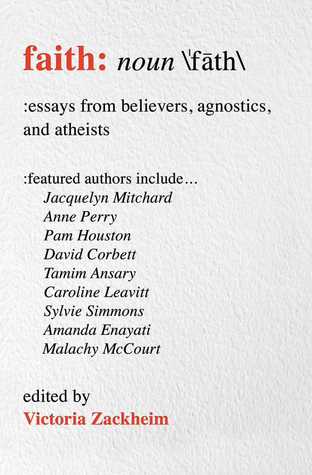
Review: Faith: Essays from Believers, Agnostics, and Atheists (edited by Victoria Zackheim)

First published:- February, 2015

Star rating:-

2.5/5

There was a time when I was still an optimistic seeker of doctrinal wisdom blissfully entertaining the certainty that there would at least be one religious doctrine fashioned by humans in the whole wide world which would not delight in depriving members of one half of the human race of any political and social standing. I was naive then. My ardor in this regard cooled considerably once I came across information that even Buddha helpfully classified seven kinds of wives (as recorded in the Anguttara Nikaya found within the Sutta Pitaka) of which the wife who meekly takes a beating from her husband, never argues back and remains as slavish as possible is defined as the ideal one. 

So is there any organized religion in the world which does not cheerfully preach, propagate and advocate misogynistic ideas and practices? If there is, do let me know. Meanwhile, I delight in evolving my personal belief systems to deal with pangs of short-term nihilism and remaining as religion-free as possible even though, to my dismay, every time I'm required to fill a government-printed form, I am hard-pressed to tick the 'Hindu' box. 

Organized religion has all the elements of organized crime, except for compassion. If you offend a crime boss who has no compassion, he will have you beaten up and sometimes killed. If the crime boss wants you to go to hell, he will have you killed after you have committed a sin so you have had no time to repent (i.e. you get yours as you leave a whorehouse or have just eaten pork, or have neglected to kill a female relative who has disgraced the family). Organized religion, however, does show some compassion. Still, in my mind, crime bosses and the guy called God have a lot in common: revenge, rage, and punishment are essential to their mission.

I requested this collection on Netgalley expecting to discover other, disparate ways of viewing faith and institutional religion and maybe challenging discussions on the intersection between religious philosophy and recent developments/intelligent speculation in the domain of astrophysics and the cosmo-sciences but nope. Instead what I got was a collection of maudlin musings on life and its trials and tribulations. It doesn't help either that most of the writers were raised in a Judeo-Christian tradition which means most of the articles lose their sheen of novelty after a while with similar anecdotes of childhood rites of initiation into a state of knowledge about organized religion re-appearing time and again. Catholic school, baptism ceremonies, obsession with collecting Virgin Mary statues, bar mitzvah experiences, traumatic memories of having to endure indoctrination at an early age and so on and so forth. A majority of the believers narrate experiences of dealing with life-threatening situations and losing loved ones to cancer and other terminal illnesses which is perfectly understandable because nobody really seeks out 'God' unless hardships and despair wrestle their way into life but after a while these reminiscences just wore me out. 
And then there are the more ridiculously cringe-worthy interpretations of faith - one contributor literally going on and on about her miserable love life and the fact that no man wants to be with her for the long haul. 

For believers, Faith is a remedy; for atheists, it's a smoke screen obscuring as shameful the essence of being human: our fallibility.

The only essays which made any impression were by Tamim Ansary, Amanda Enayati, and Aviva Layton. All of them are secular humanists/decriers of institutional religion of course but that does not mean their writings do not showcase a keen interest in giving the benefit of the doubt to all sides of the debate. Ansary, who identifies as a secular mystic, refreshingly does not go into saccharine-flavored tales of personal woes and triumph, instead choosing to recount a simple anecdote about a few moments spent in the heart of nature with his youngest daughter which helped him appreciate the fact that to be alive, for however brief a blink in the unending spiral of time, is to be close to the mystery of all creation. Amanda Enayati's touching piece documents her tryst with a most harrowing period in the history of Iran in an almost Marjane Satrapi-ish fashion except her voice is devoid of the latter's signature humor. Another plus was getting to know about the surprisingly liberal tenets of the Bahá'í faith, a minority monotheistic sect whose members were ruthlessly persecuted during the Iranian Revolution of '79. Aviva Layton's ruminations held nothing special unless one counts her wonderfully unsentimental description of the aftermath of personal loss and her logically argued repudiation of superstitious ideas about heaven and hell.

To conclude, it's not like all the other remaining essays were completely unpalatable or anything but the very fact that I scarcely remember anything about them speaks for itself.


__

Also posted on Goodreads & Amazon.


 photo C136E66569D294E4D5DA2D8124D4FF69.png

Sunday, September 21, 2014

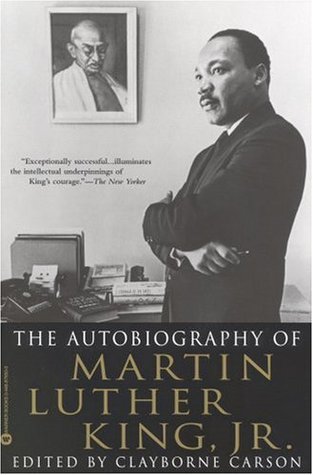
Review: The Autobiography of Martin Luther King, Jr. by Martin Luther King Jr.

First published:- 1998

Star rating:-

I had to keep reminding myself that it's not the civil rights movement I am rating and reviewing, because the spectrum of legitimate excuses, let alone justifications, which could explain the withholding of a star or two is rather limited. It comes as a kick to the gut every time a young, unarmed Clifford Glover or a Travyon Martin or a Michael Brown is shot for no valid reason and the realization sinks in that the process of integration which was initiated by Lincoln some 150+ years ago and furthered by Martin Luther is yet to reach its completion. So the essence of this book and MLK's doctrine of nonviolent agitation are now relevant more than ever. 

In a way this is Martin Luther's own account of the movement he helped steer in a direction which not only sought to free an entire community from socioeconomic and political servitude but prevented America from becoming synonymous with the ultimate hypocrisy of all - preaching the infallibility of human rights abroad (by waging wars against Communist totalitarianism) but carrying on with its tacit agenda of institutionalized discrimination back home. 
"I am convinced that if we are to get on the right side of the world revolution, we as a nation must undergo a radical revolution of values. We must rapidly begin the shift from a thing-oriented society to a person-oriented society. When machines and computers, profit motives and property rights, are considered more important than people, the giant triplets of racism, extreme materialism, and militarism are incapable of being conquered."

How the spirit of rebellion - which found expression for the first time with the Montgomery Bus Boycott in '55 (unwittingly started by Rosa Parks' act of denying her occupied seat to a white passenger) - trickled into the hearts of oppressed millions in Albany, Georgia, Birmingham, Alabama, Florida, Chicago, Boston, and Washington culminating in the passage of the landmark Civil Rights Act of 1964, is recounted by King himself.
That aside, there's a brief autobiographical sketch patched together from the fragments of writings gathered from the Stanford University archive by Clayborne Carson. Excerpts from King's speeches (sometimes even the full text) also make appearances in between the accounts of all the non-violent movements of civil disobedience he gave leadership to. 

To put it more accurately, this is less of an autobiography (since King didn't live long enough to write one) and more like a montage of every single written document or important oratory piece which King left behind. So lucidly written are these that Carson's work must have been reduced to simple editing and piecing together a coherent narrative out of the vast amount of material at her disposal.

And yet there are such glaring mistakes here which marred my reading experience. Consider this excerpt from King's personal writings after his visit to India in '59 which cemented his faith in the inviolability of civil disobedience as an effective tool to usher in socioeconomic and political change -
"On March 1 we had the privilege of spending at the Amniabad ashram and stood there at the point where Gandhi started his walk of 218 miles to a place called Bambi."

It's not Amniabad. In all probability, it's the Sabarmati ashram in Ahmedabad King is talking about, while the historic walk was to 'Dandi' - a coastal village in Gujarat (the state our present PM hails from). Not Bambi, the iconic Disney deer. 

Even if it was a memory lapse on King's part or a sad apathy for geographical names, as a King scholar looking to publish a work of monumental importance Carson should have been more vigilant for inconsistencies such as the above, especially since Gandhi gets mentioned several times by virtue of his being King's role model. 
(Some quick googling led me to the unhappy discovery that the Stanford archive still retains the unedited, therefore, incorrect information derived from the original sources. I can understand the significance of preserving King's writings exactly as he authored them but the insertion of incorrect facts diminishes the integrity of this work.)
Also occasionally 'Gandhi' is spelled as 'Ghandi'. (Aaarrrrggghhhhhh!)

In addition to these turn-offs, nearly all of King's speeches are so chock full of archetypal metaphor after metaphor that I felt it weakened the gravitas of the narrative. Perhaps, they would have been better off being included in shortened formats. The fact of God's mercy and benevolence being invoked (quite natural since King was a pastor) in every alternate sentence also served as an effective irritant. These are undoubtedly the primary reasons why it took me a whole month to finish reading this. 

But these causes of botheration aside, there's plenty of good to be found in this compilation. Like the way MLK expresses his disappointment with 20th century capitalism in a letter addressed to his wife, Coretta -
"...I am not so opposed to capitalism that I have failed to see its relative merits. It started out with a noble and high motive, viz., to block the trade monopolies of the nobles, but like most human systems it fell victim to the very thing it was revolting against. So today capitalism has out-lived its usefulness. It has brought about a system that takes necessities from the masses to give luxuries to the classes."

or his critique of the Vietnam War and correlation drawn between American militarism and the dangerously skewed nature of race relations in the deep south-
"I do not believe our nation can be a moral leader of justice, equality, and democracy if it is trapped in the role of a self-appointed world policeman."

The absence of that missing star, thus, should be attributed to my personal aversion to factual inaccuracies, overused metaphors and bad analogies. Otherwise no rating system in existence can measure MLK's significance in American history and all that he stood for.


   photo C136E66569D294E4D5DA2D8124D4FF69.png

Sunday, August 3, 2014

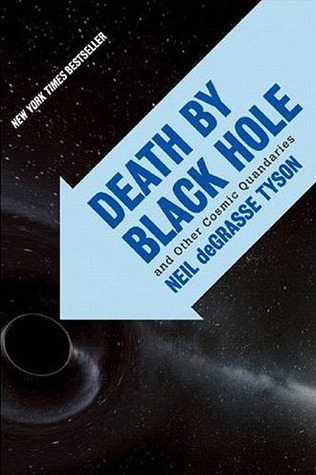
Review: Death by Black Hole and Other Cosmic Quandaries by Neil deGrasse Tyson

First published:- 2006


Star rating:-


Neil deGrasse Tyson is a force to reckon with. 


description

But he is not Carl Sagan. 

While Sagan must have smiled down kindly on your meek acknowledgement of ignorance regarding, say, black holes, Tyson will have most probably given you the stink eye or aimed a sarcastic jibe at your apathy, before proceeding to explain why black holes still remain a topic of much speculation in the community of astrophysicists worldwide.

Tyson does not pull any punches in this collection of essays while slamming the news media, who more often than not, come off as ill-informed hacks doing a shoddy job of reporting facts in the field of space science, forever (stupidly) claiming how scientists are baffled by so-and-so new developments. 
"Scientists cannot claim to be on the research frontier unless one thing or another baffles them. Bafflement drives discovery."

Or snidely commenting on the Hollywood exercise of producing multi-million dollar sci-fi films which badly butcher the scientific aspects of such ventures by inserting factually incorrect observations in scenes and dialogues. (there's a brilliant anecdote concerning James Cameron's 'Titanic' in this regard and the Contact film gets an honorable mention for its adherence to proper science if one overlooks a minor gaffe)
"I am glad that, in the end, the humans win. We conquer the 'Independence Day' aliens by having a Macintosh laptop computer upload a software virus to the mothership. [] The entire defense system for the alien mothership must have been powered by the same release of Apple Computer's system software as the laptop computer that delivered the virus."

Or criticizing the mad dash for extending the frontiers of space science during the Cold war years, when the spirit of scientific inquiry was sidelined in favor of a dangerous game of political one-upmanship, a kind of puerile assertion of 'our scientists are better than yours'. Or openly chastising revered names from ancient Greece like Aristotle whose inaccurate assumptions about the unchanging nature of stars and the geocentric universe helped the Catholic Church in propagating falsities for centuries with impunity. (He doesn't even spare Newton forGod's Higgs Boson's sake who, unable to satisfactorily explain the ordered behavior of the solar system despite the many often conflicting gravitational forces at work, had cited God's need to step in to correct things in his famed 'Principia')

While Sagan may have adopted a more benign, less aggressive tone in course of addressing issues of religious dogma being at loggerheads with scientific reasoning and aversion to science and mathematics among the general populace, NDT takes the approach of pure, unadulterated logic and demolishes one popular misconception after another (for e.g.:-the North Star is not the most brilliant star in the night sky or how everything that goes up doesn't come down) with a brute force which I am certain will not sit well with some sensitive readers who are easily offended. 

Being born in a country whose space research organization head performs pujas and makes ritualistic offerings prior to launching a 'Mission to Mars', I can't say I fault NDT's acerbic tone or his distaste for those who are hell-bent on unifying science and religion without even realizing that finding common ground between both is akin to attempting to exceed the velocity of light.

But if NDT lacks Sagan's sage-like demeanour and his rich, authorial voice (Sagan's prose is much more refined no doubt), his excellent sense of humor almost compensates for their absence - 
"The good thing about the laws of physics is that they require no law enforcement agencies to maintain them, although I once owned a nerdy T-shirt that loudly proclaimed, "OBEY GRAVITY."
"The only people who still call hurricanes 'acts of God' are the people who write insurance forms."
(and Michele Bachmann, just saying)

And occasionally there's a sop thrown in for the literary-minded (particularly the postmodernist fiction lover) - 
"The physicist Murray Gell-Mann, who in 1964 proposed the existence of quarks, and who at the time thought the quark family had only three members, drew the name from a characteristically elusive line in James Joyce's Finnegans Wake:'Three quarks for Muster Mark!'"

The more frivolous aspects of the essays aside, among the astrophysics-related topics NDT centers his discussions around, the ones which were relatively new to me are the concepts of hypernovae, gamma ray bursts, dark matter and dark energy, the uncertainty surrounding the string theory and the probability of the annihilation of Earth through ill-fated, cosmic encounters with errant asteroids, the unavoidable, impending collision of our galaxy with the Andromeda galaxy which is the nearest one heading towards us at a speed of more than 100 kilometers per second.

description
The Andromeda Galaxy

Since this is a collection of 42 essays which were published in the 'Natural History' magazine, some repetition of concepts and names creeps in occasionally but that merely helps you refresh memories of what you just read a few pages back, not exactly a shortcoming I am keen to quibble over. 

4 stars, because Tyson seems a little too bitter about artists who exercise 'artistic license' to distort certain astronomical facts in their paintings. Besides I am certain there is a lot of 5-star-worthy goodness in the rest of NDT's works left for me to discover in the future.


   photo C136E66569D294E4D5DA2D8124D4FF69.png

Monday, July 21, 2014

Review: Skylight: Poems by Carol Muske-Dukes

First published:-1981

Republished:- By Open Road Media on June 10, 2014

Star rating:- 

One of my pet gripes with poetry is on full display in this poet's works - losing so much of time re-reading lines, fishing out implications from the layers of metaphor thrust upon allusion thrust upon circumlocution that in the battle between the reader's enthusiasm for emotionally connecting with the verses and sheer exasperation, exasperation wins. 
Poetry is meant to be savoured - the rhythm, the flow, the delicate alignment of pretty words combined with some semblance of purpose all taken in together - and not decrypted like some hidden code through multiple readings. It doesn't matter if the occasional pair of lines succeed in concealing their intent, their true significance, perhaps, too exclusive to the poet's inner life or too obscure to aid our understanding. But there should be a limit to this sort of penchant for inserting excessive imagery and hyperbole.

Don't take my complaints too seriously though. Finding poetry that hits just the right note is actually like finding the right shoe fit and hence the criteria that go into its determination will differ from reader to reader. Besides I had problems with only a few of the poems. Most of the remaining ones are exceptionally well-written and make their points with so much subtlety that you are more likely to miss them unless you keep your eyes peeled. 

I had no idea Carol Muske-Dukes (former Poet Laureate of California) had such a good knowledge of Indian history and an even firmer grasp over our cultural sensibilities. (Color me impressed) 
Her 'Ahimsa' on the Jallianwala Bagh massacre (which is still regarded as one of the most barbaric things done to us by the British and which caused Tagore to reject his knighthood) is elegiac and deeply philosophical.

"Say you walked in the shadowy garden
in Amritsar, before night descended,
tried to imagine the massacre, that crazy saint
Gandhi and the people on their knees to a god
less civilized than he. You would
disagree, agree....
violence teaches nothing."

While 'War Crimes', a reflection on rape (a subject which Adrienne Rich versifies with more finesse, no doubt, in her Diving Into the Wreck) is wrenching and cerebral. 

"...that the great nerve
which runs from head to pelvis
which makes us courteous
shy
scrupulous
makes us touch another with gentleness
would tremble
till it was plucked
held in the pliers
then in the fire
shriveling in that little violence
of heat and light
which in another form
we often refer to
as love."

The variation in her themes is another noteworthy aspect of her range as a poet - subjects from abuse of young children, a daughter's view of her painter father, a child with a stuttering problem, an opium addict mourning the loss of his wife/lover, real estate, to the last set of poems which seem to be meditations on grief make appearances in this collection.

No points for guessing that the poems on India-related subjects, an old man in Benares carrying his dead wife in his arms to her pyre, the one on sexual violence and androgyny are my favorites from the collection. Yes I am predictable like that.


**I received an ARC from Open Road Integrated Media via Netgalley**

_____

Also posted on Goodreads and Amazon.

   photo C136E66569D294E4D5DA2D8124D4FF69.png

Thursday, July 17, 2014

Review: Feminism is for Everybody by Bell Hooks

First published:-2000

Read in:- June, 2014

Star rating:-

Not until recently had I emerged out of the rock I was living under and located the @everydaysexism twitter account. Keeping an eye on their retweets for a little less than two weeks enabled me to discover that women are not only forced to endure the lecherous male gaze (often called 'stare rape' these days) on public transportation, made the object of innuendo-laced, denigrating remarks since puberty but also masturbated at in public without their consent (not even women over 60 had been spared) . How blissfully ignorant I was of this last facet of everyday sexual harassment! I went on a kind of mad rampage immediately, flooding my timeline with a deluge of tweets on the subject, appealing to more of my followers to follow the everyday sexism account. A day later when I had checked back in eagerly in the hopes of noticing any visible change - NOTHING. Not even one person among my followers (I have nearly 1600 which maybe just a handful but it's not a very teeny number either) had honored my request apart from the 3 who were already following them - all of them women or women's issues related accounts.

It was then that I realized, 'feminism' in the 21st century is actually like a hip, new item of home decor that you place on a wall cabinet among the other borrowed, trendy opinions you profess as personal philosophy, then forget about. Whenever some horrendous instance of brutality against a woman makes the morning news headlines, everyone's 'tch-tch-ing' fake concern for civilization resurfaces, spills over into the realm of their office lunch hour debates and after a while dies a natural death. Then they go back to the comfort of their tweleb status by posting the same old 'jokes' about dumb blondes, unreasonable wives, sluts, 'cunts', boobs and what have you, each of which are guaranteed to get at least 20+ retweets. 
Lulz just chill, we're all kidding here, getting our kicks out of reinforcing the same old stereotypes that have done considerable damage to society since the dawn of time. No harm done.

It is this same all-pervading reluctance of acknowledging the efficacy of a concept like feminism as a panacea for sexism, violence and all the other concomitant shit women face every single moment of their lives that forms the backbone of Bell Hooks's book.

She merely chooses to use 'white supremacist capitalist patriarchy' as a refrain so as to hammer this information into our brains. Yes the recurrence of this phrase gets dull after a while, yes it is somewhat annoying but no it is not irrelevant. Especially since Bell Hooks seems to support the branch of feminism which brings the concept of equality for everyone (including homosexuals) in all walks of life - sexual, economic, social and religious - under its envelope. 

She summarizes the inception and journey of the feminist movement through the decades - how it made a first appearance in the U.S. in the 60s with the waves of bra-burning (she is not against bra-burning btw), angry women who had major grievances against a domestic arrangement where they held little to no power, how initially they believed 'feminism to be the theory and lesbianism the practice', how it has undergone gradual improvement to evolve into the polished academic discipline that it is today, how it was seen as an anathema in the past and how it continues to face a steadily growing list of challenges - apathy of mass media being a major one. She deftly interweaves feminism with the idea of politics, class struggle, physical beauty, love, religion, marriage, reproductive rights, parenting, masculinity and race to present before us a realistic picture of what truly internalizing its precepts can mean for us and our future. 

But all the conventionally known preachings of the book aside, she makes another very pertinent point about stripping the verbiage of jargon from all the academic work on feminism to make them more accessible to students and laymen alike, and working together to raise awareness of how feminism isn't inherently 'anti-men' or 'anti-religion' or even simply restricted to serving the interests of women in civilization, how feminism is for everybody.

"Today in academic circles much of the most celebrated feminist theory is written in a sophisticated jargon that only the well-educated can read. Most people in our society do not have a basic understanding of feminism; they cannot acquire that understanding from a wealth of diverse material, grade school-level primers, and so on, because this material does not exist. We must create it if we are to rebuild feminist movement that is truly for everyone."

To come to the negatives, there are almost none except the monotonous drone in which Hooks drives home her points which makes the reading experience little less than enjoyable, the drabness of her prose and the way her repeated references to her own writings reek of self-importance. And to further account for that missing star, I have this teeny niggling doubt about her defining acts of 'domestic violence', even those carried out by women against other women and children, as'patriarchal violence'. She reckons some women have been so rigorously conditioned by the patriarchal world order based on principles of domination through violence and other acts of intimidation, that they re-enact the same in their daily lives while dealing with people inferior in status to themselves. Which I agree with but my limited knowledge of the world and its assorted contradictions tells me it's not just the men. Some primeval inclination towards violence and skewing the power balance in any relationship is embedded in the human psyche in general, irrespective of sex. 

But that aside, the overarching message one gets from Hooks's outlook is that the traditional notions of 'manhood' and'masculinity' have to be flushed down the toilet for feminism to even have a chance at victory. And there's no second guessing it.


   photo C136E66569D294E4D5DA2D8124D4FF69.png

Wednesday, June 11, 2014

Review: Labyrinths: Selected Stories & Other Writings by Jorge Luis Borges


First published:-1962

Read in:- May, 2014

Star rating:- 

A university professor had once expounded on the supposed conflict between history and literature, the former bemoaning the irrelevance of the latter when it comes to tracing the contours of reality while the latter countering this accusation by deploying the well-known defense of 'there's no one way of looking at the truth'. 

Indeed. Why restrict ourselves to just the one way and the one reality? Why overlook the truth of infinite permutations and combinations of each eventuality and each one of them, in turn, forking off into myriad possibilities ad infinitum? Why seek neat compartmentalization of two disparate disciplines and prevent their intermingling to create new streams of thought? Why believe mathematics and literature to be so fundamentally apart that there can be no blending together of both without the results being distorted beyond intelligibility? 

The very fact that the known limits of what's considered intelligible are being breached every moment, has its roots in the reluctance of labyrinthine minds like Borges' to follow linear pathways. 

Mysticism, mathematics, arcana, philosophy, and literary criticism. A perfect blurring of the boundaries between fact and fiction leading to the creation of an entirely new entity which challenges the normative narrative form. And a moment of perfect lucidity arising out of a churning of all these elements. Where our imaginations come to a staggering halt, Borges' begins. 

I do not wish to squeeze out every last drop of meaning from these complex interpolations of a known truth into discrete bits of hitherto unknown logical conclusions by googling every reference I did not get. Instead I delight in Borges' perfectly synchronized demolition of all and any conventions associated with writing with an authorial preeminence, I gaze enthralled at the vision of clarity being birthed out of pure chaos. 

"In a birdless dawn the magician saw the concentric blaze close round the walls. For a moment, he thought of taking refuge in the river, but then he knew that death was coming to crown his old age and absolve him of labors. He walked into the shreds of flame. But they did not bite into his flesh, they caressed him and engulfed him without heat or combustion. With relief, with humiliation, with terror, he understood that he too was a mere appearance, dreamt by another."

I let my mind latch onto his even if for a little while and let it guide me into realms where only the divinity of thought reigns supreme in its many manifestations. 

And, for now, that is enough.


__

P.S.:-It's good to know where David Foster Wallace acquired his irksome yet awe-inspiring footnoting habit from.


   photo C136E66569D294E4D5DA2D8124D4FF69.png

Sunday, May 11, 2014

Review: Home and Exile by Chinua Achebe

First published:- 2000

Read in:- February, 2014

Star rating:-

'The Empire Writes Back' would have been a fitting alternative title for this essay collection. (Achebe doesn't fail to pay a tribute to Salman Rushdie's essay of the same name published in 1982). Because that is what the running theme here is - a reclamation of a land and a culture that was wrested away with brutal force and made a part of an 'Empire' which still insists on viewing that period as one of glory and not characterized by the worst kind of human rights violation ever. And a heralding of the arrival of the African voice in the world literary scene.

Achebe is slowly turning into my personal literary hero. His wry humor, elegant prose, mildly sardonic tone and passion for social justice exude a righteousness that's hard not to defer to. His writings continue to make me question certain pet notions and ideas that are so deeply ingrained in each one of us that they seem like indisputable facts and consequently evade further introspection. My penchant for unconsciously comparing Latin American, South East Asian and African writing to the style, technique and language of the Americans and Europeans I admire and immediately pronouncing judgement on them on the basis of said parameters has to go away now, I realize.
It doesn't matter if African, Asian and other writers of the Commonwealth (Dear god, why do we have that ridiculous redundant grouping still? is it not there for the sole purpose of reminding us that we were once colonies?) have the same degree of grammatical precision and structural integrity to their English prose as their European and American counterparts. It matters that their voices be heard and universally acknowledged and the overlooked truths, their narratives highlight, be analyzed without bias.

Although this collection consists of 3 essays titled 'My Home Under Imperial Fire', 'The Empire Fights Back' and 'Today, the Balance of Stories' it should be considered a single body of work or discourse intended to dispel certain flawed notions about African people who are often derogatorily referred to as 'tribes' and automatically consigned to a lesser category of humanity. 
Achebe begins with his reminiscences on his early years as a young university student in Nigeria, reading literature based on Africa authored mostly by British and European scholars who, of course, liberally manufactured painfully offensive 'facts' regarding the intellectual and anatomical inferiority of his fellow brethren and propagated the theory that European acquisition of their land and sphere of existence was for the sake of their own personal benefit.

This is what Achebe says about the interlinked nature of inherently racist literature of the time (he is sophisticated enough not to use the word 'racist' even once though) and the Atlantic slave trade:-

"I will merely say that a tradition does not begin and thrive, as the tradition of British writing about Africa did, unless it serves a certain need. From the moment in the 1560s when the English captain John Hawkins sailed to West Africa and 'got into his possession, partly by the sword and partly by other means, to the number of three hundred Negroes,' the European trade in slaves was destined by its very profitability to displace trade in commodities with West Africa."

Achebe directs his suppressed ire at Anglo-Irishman Joyce Cary who was regarded as one of the finest novelists of his time and his creation 'Mister Johnson' which Achebe systematically breaks down and interprets as a text strewn with viciously hateful commentary on Africans. Another renowned novelist and polymath who had considerable first hand experience of Africa, Elspeth Huxley, isn't spared either as her criticism of Amos Tutuola's 'The Palm-Wine Drinkard' as a 'folk tale full of queer, distorted poetry, the deep and dreadful fears, the cruelty, the obsession with death and spirits, the macabre humour, the grotesque imagery of the African mind' comes off as an insidious denunciation of all African literature in general. 
Joseph Conrad, predictably, is his next victim. (Criticism of 'Heart of Darkness' seems like a recurrent theme in Achebe's essays)

Quote from 'Heart of Darkness' -

"Well, you know, that was the worst of it-this suspicion of their not being inhuman."

Achebe's deconstruction-

"A more deadly deployment of a mere sixteen words it would be hard to imagine. I think it merits close reading. Note first the narrator's suspicion; just suspicion, nothing more. And note also that even the faint glimmer of apparent charitableness around this speculation is not, as you might have thought, a good thing, but actually the worst of it! And note finally, the coup de grace of double negation, like a pair of prison guards, restraining that problematic being on each side."

Next in Achebe's line of fire is the ever controversial V.S. Naipaul and his lecture titled 'Our Universal Civilization' delivered at the Manhattan Institute and his caustic and downright obnoxious comments on Asian and African readership and cultures. Achebe brings into focus the difference in attitudes between the Indian-origin Naipaul and the famed Indian writer R.K. Narayan by stating how Narayan saw 'a million stories' every time he looked out of his window and not a 'million mutinies' like Naipaul did.

He ends by hailing story-tellers of repute like Nadine Gordimer (for her literary activism in the backdrop of the Anti-Apartheid movement in South Africa), Wole Soyinka, Amos Tutuola and names like Nigerian Cyprian Ekwensi (People of the City), Guinea's Camara Laye (L'Enfant Noir), Cameroon's Mongo Beti, Ferdinand Oyono (Houseboy), Cheikh Hamidou (Ambiguous Adventure) who have lent enormous credibility to the African literary landscape and have led readers all over the world, to take into account the complementary points of view of the people who had been, so far, deprived of a voice.

"Despite the significant changes that have taken place in the last four or five decades, the wound of the centuries is still a long way from healing. And I believe the curative power of stories can move the process forward."


P.S.:-My rating may be upgraded (or downgraded) in the future based on what I glean from a reading of A Bend in the River, India: A Million Mutinies Now and a re-reading of Heart of Darkness.


   photo C136E66569D294E4D5DA2D8124D4FF69.png

Friday, April 4, 2014

Review: Cosmos by Carl Sagan


First published:- 1980

Star rating:-

I wonder what Carl Sagan may have thought of 9/11 and the world in the new millennium, a strife-torn place which is being shaken up and shaken out every moment. I imagine the civil but slightly horrified and slightly bemused tone he may have employed while talking about the Iraq and Afghanistan wars and the antics of the Bush administration which have become such excellent fodder for stand up comedians the world over. And I can almost detect the note of boyish enthusiasm in his voice while he may have spoken of the Higgs Boson and explained the reasons behind the incorrect observation readings of the 'neutrinos being speedier than light particles' experiment that had made the headlines a few years ago.

I can only imagine because he wasn't there to witness these watershed events and he isn't here to offer comment, criticism or share his inexhaustible repository of knowledge with us any longer. His time in the Cosmos had run out within two decades of the publication of this work - a testament to his own belief in the staggering inferiority of our evanescent lifetimes in the scheme of the universe(s). 

"Our familiar universe of galaxies and stars, planets and people, would be a single elementary particle in the next universe up, the first step of another infinite regress."

It would be nice if I could summarize each one of the 13 chapters of 'Cosmos' and give readers the lowdown on our painstakingly slow but rewarding crawl through the fabric of space and time, the civilizational hurdle race towards a finish line which we can neither begin to envision nor fully comprehend yet. 
I could write a review in the conventional format, leaving you with a gentle nudge to read this book as soon as you can.

Or, instead, I could simply write about how, despite being more than 30 years outdated, Carl Sagan's voice of reason rings truer than ever, cutting through the heart of all the din and chaos of our troubled times. I could just tell you how Sagan's deep and abiding love for nature and humanity reverberates in every page of this work and how our scientific endeavours across timelines and geographical boundaries, across the unending void which surrounds us on all sides, symbolize our collective pursuit of knowledge.

"There is no other species on Earth that does science. It is, so far, entirely a human invention, evolved by natural selection in the cerebral cortex for one simple reason: it works. It is not perfect. It can be misused. It is only a tool. But it is by far the best tool we have, self-correcting, ongoing, applicable to everything. It has two rules. First: there are no sacred truths; all assumptions must be critically examined; arguments from authority are worthless. Second: whatever is inconsistent with the facts must be discarded or revised."

The Cold War is a now defunct appendage of our history, the Soviet Union is no more, America has achieved a milestone in its race relations by welcoming its first Black President. But turmoil in the world order persists - the nuclear arms race between the Americans and the Soviets has been replaced by a newer dance of dominance in the Asia Pacific region. The world is as much embroiled in a mesh of steadily growing list of challenges as it was in the past, if not more. Preposterous decrees issued by fanatical outfits, blatant human rights violations, infringement on freedom of speech and expression, diplomatic arm-wrestling, the ever-enthusiastic decriers of science, 'War on Women', the shouts of the global-warming deniers reign supreme still. The players may have changed faces but the game of petty one-upmanship in the arena of global politics still continues unabated.

Which is why Sagan's rousing call for all of mankind to unite under the identity of citizens of the Cosmos and not as citizens of a nation moves me to the core of my being. His recapitulation of our scientific advancements achieved against the tide of adverse circumstances, of the victories won in the face of persecution by religious authority, impresses upon us a sense of urgency - that with the exponential increase in the defense budgets of the global powers, the incentive given to the greatest minds of our times to devote time and energy to unraveling the mysteries of the Cosmos is reduced. As the concept of 'nuclear deterrence' receives a pat on the back, the global arms sales numbers continuing to soar despite hollow promises of arms control, more and more scientists are being engaged in improving weapons technology rather than validating the fact of our existence against the intimidating presence of the stars, galaxies and universes. The NASA budget cuts of recent times are proof of this ignominy.
Is it to this end that the ancient advanced cities like Alexandria, the destroyed civilizations of Ionia and the Aztecs and pioneers such as Eratosthenes, Democritus, Aristarchus, Hypatia, Leonardo da Vinci, Copernicus, Galileo, Johannes Kepler, Tycho Brahe, Christiaan Huygens, Issac Newton and Albert Einstein worked tirelessly for? To further intensify mutual national antagonism and increase our probability of complete self-annihilation?

Sagan thinks not.

"Our loyalties are to the species and the planet.We speak for the Earth. Our obligation to survive is owed not just to ourselves but also to that Cosmos, ancient and vast, from which we spring."

This is why I can't help but agree quite heartily with someone who says 'If I had a religion, I would be a Carl Saganian.'

"If a human disagrees with you, let him live. In a hundred billion galaxies, you will not find another."

If there is only one worldly diktat we must abide by with unquestioning faith, let it be this one.


   photo C136E66569D294E4D5DA2D8124D4FF69.png
Related Posts Plugin for WordPress, Blogger...