Showing posts with label LGBT. Show all posts

Saturday, August 30, 2014

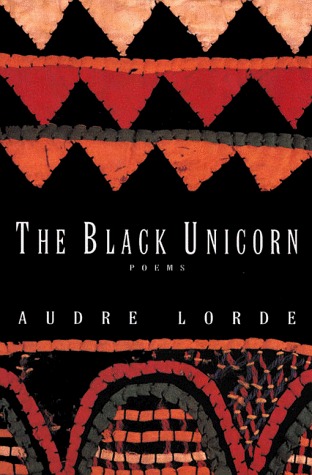
Review: The Black Unicorn: Poems by Audre Lorde


First published:-1978

Star rating:-

These poems are like shards of glass refracting the blurred image of some sombre new insight into the human condition - the agony of love, the pangs of coming to grips with the idea of racial segregation in a world one previously thought had no demarcations, the pervasive pessimism of living as reaffirmed by the morning newspaper, an elegy to the memories of a childhood friend whose time on earth ran out too soon, the melancholic ruminations of a prostitute, the absurdity of children of today being raised like slaughterhouse pigs to be sent to the war-front tomorrow. 
Coming in and out of cities
untouched by their magic
I think without feeling
this is what men do
who try for some connection
and fail
and leave
five dollars on the table.

If the annals of literature are to be consulted, most of these are time-worn subjects which other more renowned poets have regurgitated throughout their distinguished careers, after molding them in accordance with their perceptions of the world and its many idiosyncrasies. And yet Audre Lorde's words, imbued with despondency, regret, hope and fortitude at the same time, tempt you to read them again and again. Her lines flow effortlessly despite their innate simplicity, maintaining an enviable rhythmic symmetry, rendering the reader's tendency to puzzle over esoteric references unnecessary since there are almost none. 
There are a handful of poems here, in praise of the female and androgynous forms of divinity worshipped by the inhabitants of the historical kingdom of Dahomey and the Yoruba people of western Nigeria, which bring to light the oft-overlooked aspects of the cultural ethos of African people. But there's a conveniently provided glossary of African terms at the end to better facilitate complete understanding of these. 

You were not my first death.
but your going was not solaced by the usual
rituals of separation
the dark lugubrious murmurs
and invitations by threat
to the grownups' view
of a child's inelegant pain
so even now
all these years of death later
I search through the index
of each new book
on magic
hoping to find some new spelling
of your name

The implications hidden between her verses do not reinforce a kind of self-obsessed confessionalism as often found in Sylvia Plath or Anne Sexton's works or the heavy-handed inclusion of so many allusions that the poet's urge to communicate is buried under towering ambitions of dismantling poetic conventions. 

Sometimes, her words give the impression of mildly cryptic messages casually scribbled at the back of a notebook, perhaps, while she may have been staring out of her window distractedly. Sometimes, they are her anguished lament, her impassioned protest, wrenched out of her by the brutality of the world or the injustice perpetually dished out to those clinging to the lowermost rungs of the societal ladder for dear life. Her 'Power', one of the most influential and well-known poems from her entire oeuvre, simmers with a righteous rage, intense enough to blow a hole through the edifice of 'white supremacist patriarchy' aside from being a tribute to the memory of young Clifford Glover, a 10-year-old African American boy shot dead by a white cop on duty in South Jamaica, Queens, New York in '73, who was later acquitted by a white-majority jury with a single black female judge.

Today that 37-year-old white man with
13 years of police forcing
has been set free
by 11 white men who said they were satisfied
justice had been done
and one black woman who said
"They convinced me" meaning
they had dragged her 4'10" black woman's frame
over the hot coals of four centuries of white male approval
until she let go of the first real power she ever had
and lined her own womb with cement
to make a graveyard for our children.

Lorde remains one of the few poets in American history who had to contend with the tyranny of conforming to the demands of too many labels conferred on persecuted minorities - black woman in a white man's world, radical feminist, lesbian, civil rights activist. And yet she managed to breach the boundaries of these individual identities by singing in a richly resonant voice whose musicality still holds the power of bridging gaps, relaying the stories of the voiceless and the marginalised, healing the scars left by turbulent times and smoothening out our countless differences across continents and timelines. 
In my eyes, that makes her a hero more than a poet.


____

   photo C136E66569D294E4D5DA2D8124D4FF69.png

Thursday, July 17, 2014

Review: Feminism is for Everybody by Bell Hooks

First published:-2000

Read in:- June, 2014

Star rating:-

Not until recently had I emerged out of the rock I was living under and located the @everydaysexism twitter account. Keeping an eye on their retweets for a little less than two weeks enabled me to discover that women are not only forced to endure the lecherous male gaze (often called 'stare rape' these days) on public transportation, made the object of innuendo-laced, denigrating remarks since puberty but also masturbated at in public without their consent (not even women over 60 had been spared) . How blissfully ignorant I was of this last facet of everyday sexual harassment! I went on a kind of mad rampage immediately, flooding my timeline with a deluge of tweets on the subject, appealing to more of my followers to follow the everyday sexism account. A day later when I had checked back in eagerly in the hopes of noticing any visible change - NOTHING. Not even one person among my followers (I have nearly 1600 which maybe just a handful but it's not a very teeny number either) had honored my request apart from the 3 who were already following them - all of them women or women's issues related accounts.

It was then that I realized, 'feminism' in the 21st century is actually like a hip, new item of home decor that you place on a wall cabinet among the other borrowed, trendy opinions you profess as personal philosophy, then forget about. Whenever some horrendous instance of brutality against a woman makes the morning news headlines, everyone's 'tch-tch-ing' fake concern for civilization resurfaces, spills over into the realm of their office lunch hour debates and after a while dies a natural death. Then they go back to the comfort of their tweleb status by posting the same old 'jokes' about dumb blondes, unreasonable wives, sluts, 'cunts', boobs and what have you, each of which are guaranteed to get at least 20+ retweets. 
Lulz just chill, we're all kidding here, getting our kicks out of reinforcing the same old stereotypes that have done considerable damage to society since the dawn of time. No harm done.

It is this same all-pervading reluctance of acknowledging the efficacy of a concept like feminism as a panacea for sexism, violence and all the other concomitant shit women face every single moment of their lives that forms the backbone of Bell Hooks's book.

She merely chooses to use 'white supremacist capitalist patriarchy' as a refrain so as to hammer this information into our brains. Yes the recurrence of this phrase gets dull after a while, yes it is somewhat annoying but no it is not irrelevant. Especially since Bell Hooks seems to support the branch of feminism which brings the concept of equality for everyone (including homosexuals) in all walks of life - sexual, economic, social and religious - under its envelope. 

She summarizes the inception and journey of the feminist movement through the decades - how it made a first appearance in the U.S. in the 60s with the waves of bra-burning (she is not against bra-burning btw), angry women who had major grievances against a domestic arrangement where they held little to no power, how initially they believed 'feminism to be the theory and lesbianism the practice', how it has undergone gradual improvement to evolve into the polished academic discipline that it is today, how it was seen as an anathema in the past and how it continues to face a steadily growing list of challenges - apathy of mass media being a major one. She deftly interweaves feminism with the idea of politics, class struggle, physical beauty, love, religion, marriage, reproductive rights, parenting, masculinity and race to present before us a realistic picture of what truly internalizing its precepts can mean for us and our future. 

But all the conventionally known preachings of the book aside, she makes another very pertinent point about stripping the verbiage of jargon from all the academic work on feminism to make them more accessible to students and laymen alike, and working together to raise awareness of how feminism isn't inherently 'anti-men' or 'anti-religion' or even simply restricted to serving the interests of women in civilization, how feminism is for everybody.

"Today in academic circles much of the most celebrated feminist theory is written in a sophisticated jargon that only the well-educated can read. Most people in our society do not have a basic understanding of feminism; they cannot acquire that understanding from a wealth of diverse material, grade school-level primers, and so on, because this material does not exist. We must create it if we are to rebuild feminist movement that is truly for everyone."

To come to the negatives, there are almost none except the monotonous drone in which Hooks drives home her points which makes the reading experience little less than enjoyable, the drabness of her prose and the way her repeated references to her own writings reek of self-importance. And to further account for that missing star, I have this teeny niggling doubt about her defining acts of 'domestic violence', even those carried out by women against other women and children, as'patriarchal violence'. She reckons some women have been so rigorously conditioned by the patriarchal world order based on principles of domination through violence and other acts of intimidation, that they re-enact the same in their daily lives while dealing with people inferior in status to themselves. Which I agree with but my limited knowledge of the world and its assorted contradictions tells me it's not just the men. Some primeval inclination towards violence and skewing the power balance in any relationship is embedded in the human psyche in general, irrespective of sex. 

But that aside, the overarching message one gets from Hooks's outlook is that the traditional notions of 'manhood' and'masculinity' have to be flushed down the toilet for feminism to even have a chance at victory. And there's no second guessing it.


   photo C136E66569D294E4D5DA2D8124D4FF69.png

Monday, May 5, 2014

Review: The Color Purple by Alice Walker


First published:- 1982

Star rating:-

Read in: - September, 2013

I give this book 5 stars to spite the myopic David Gilmours and the V.S. Naipauls of the world who think books written by women are irrelevant. I give this 5 stars to make up for the many 1/2/3 star ratings it may receive simply because of Alice Walker's forthright, honest portrayal of unpleasant truths that are often conveniently shoved under the carpet so as not to disturb the carefully preserved but brittle structure of dogma and century-old misconceptions. 
And I award this 5 stars, symbolically on Banned Books Week as an apology for all the cowardly sentiments of the ones who misuse their power by banning books, thereby shutting out many powerful voices which demand and need to be heard.

In my eyes, an author's merit lies not only in their sense of aesthetic beauty, but also in the scope and reach of their worldviews which must reflect in their craft.

Alice Walker's is the voice of one such African American writer that recounts a story which not only breaches the boundaries of an issue like emancipation of women but tries to detect a common pattern in problems plaguing civilizations across continents. She gives us one horrifying glimpse after another into the lives of women ravaged by unspeakable brutalities like rape and abuse, lives searching for meaning and connection and seeking out that elusive ray of hope amidst the darkness of despair. 
And by the end of the narrative, she brings to light with great sensitivity, that misogyny, sexism and blind patriarchal prejudices are as rampantly in vogue in the urban, upscale sphere of American cities as they are in the intractable, untameable African landscapes.

Celie and Nettie. Shug Avery, Sofia and Mary Agnes. Tashi and Olivia. 
All these are but different names and many facets of the same disturbing reality.
If the lives of Celie and Nettie are torn apart by sexual abuse and humiliation from childhood, then Tashi and other unnamed young African girls of the Olinka tribe are victims of genital mutilation and other forms of psychological and physical torture.
If the men of African American families dehumanize the female members to the point of treating them as mere care-givers and sex slaves, then the objectification of African women by the men of their families is no less appalling. And contrary to accepted beliefs, white families in America are just as easily susceptible to misogyny as the African American families are.

But Alice Walker doesn't only stop at opening our eyes to the uncivilized aspects of our so-called civilized world, but also shows us how knowledge of the world and people at large, self-awareness and education can help exorcize such social evils, how it is never too late to gain a fresh perspective, start anew and how empowerment of women eventually empowers society.

Dear David Gilmour, if I were a professor of English literature I'd have taught Alice Walker to my students without a shred of hesitation, because here's an author who may not possess the trademark sophistication of Virginia Woolf's lyrical prose but who, nonetheless, fearlessly broaches subjects many masters and mistresses of the craft may balk at dealing with.

Alice Walker: 5 | David Gilmour: 0


   photo C136E66569D294E4D5DA2D8124D4FF69.png

Tuesday, January 21, 2014

Review : What Was She Thinking [Notes on a Scandal] by Zoë Heller


First published:- June 1, 2003

Star rating:-

Read in:-January, 2013

Notes on a Scandal is a multi-layered story. While keeping up with the pretense of titillating readers with the lurid details of a much older woman's romance with an adolescent boy, it skilfully but subtly exposes the hypocrisy practiced by each one of its characters. How each one of them remained so painfully aware of Sheba's perversions while being stubbornly dismissive of their own. 
Zoe Heller also forces us to rethink what we consider moral and immoral and ask ourselves whether we can really patronize Sheba Hart for what she did.

At the heart of the story is a theme of social deviance but there's also a tender love story at its core, albeit entirely one-sided.
The story of the scandal is narrated from Barbara's point of view who scribbles down whatever she feels about Sheba and her life in her notes while occasionally giving the reader a glimpse into her own sad little existence. Although she may come off as a woman with slightly sociopathic tendencies, keeping tabs on Sheba and meddling with almost every aspect of her life right from the time of their first meeting, one also feels for the profound loneliness she suffers from. She takes pleasure in watching Sheba's picture-perfect family life crumble bit by bit while she waits on the sidelines for a time to arrive when only she will remain by her side. While Sheba, subconsciously dissatisfied with the way her life has turned out to be, gets sucked deeper into the madness brought forth by her own deviance, Barbara observes silently and patiently. Till the time all hell breaks loose and both women-somewhat cut off from the mainstream of society-find a safe haven in each other's company.

A very significant question raised by the author in this book is - whether the supposed victims could sometimes be the culprits themselves? Whether a minor or a teenager can really be capable of manipulating an adult and bend him/her to their own will?
Not that this is an attempt at absolving Sheba of her actions but it's a question worth pondering. 

To sum it up, this is a twisted and complicated tale revolving around relationships which cannot be labelled and the notions of culpability and hence right up my alley. No this does not mean I'm twisted (okay maybe a little) but merely that I love a good conundrum.


   photo C136E66569D294E4D5DA2D8124D4FF69.png

Tuesday, October 8, 2013

Review : Orlando by Virginia Woolf

The most prudent way to review a Virginia Woolf book, perhaps, would be to write 'READ THIS  BOOK. IT'S STUPENDOUS. GENIUS. AMAZING. WHY HAVEN'T YOU READ THIS YET?' and leave it at that. Because not only does this relieve you of the responsibility of casting about for appropriate words to serenade Woolf but also because you know no review in the world does justice to the sheer magic that she is capable of creating with words.
But since I have a thing for self-flagellation (not really) I wish to undertake precisely this mammoth task of writing about Orlando.

After having closed the book and put it aside, the first predominant emotions are that of being overwhelmed by the all-encompassing nature of its inherent themes, then awestruck, then of being very close to tears.
One is compelled to sit quietly in a corner, still under the heady influence of Orlando's poetic stream of thoughts, and brood over all the discrete human sentiments, actions and events that make up life as we know it, letting precious minutes trickle by.

Our hero-heroine, Orlando, seems not only to be a representation of the human spirit, a union of yin and yang in all its imperfect glory, but also a lasting testament to the perpetual flow of time. His-her pronouncements sound almost like a chorus of voices, echoing all the dichotomies that characterize our existence and the transience of our emotions.
Orlando begins the journey of life as a man of wealth and social standing in Elizabethan era England, comfortable in the skin of his vanity, amorous in his dalliances with women. And the book ends on 11th of October, 1928, in modern England where Orlando is a married woman, a mother, an accomplished writer and finally at peace with life's many ironies and caprices. I will refrain from going into all that takes place between these two distant points in time because for that one can always read the book.

It will suffice to say that Orlando swings back and forth between craving and shunning love, between pursuing his-her literary interests and trivializing the urge to write, between seeking the august company of men of letters like Pope, Addison and Swift and then belittling them. And even though hundreds of years pass by as Orlando goes through the many myriad experiences that life had in store for him-her, it seems like everything has remained essentially the same. The reader is struck by a sense of passivity in motion, of an enduring constancy even though the sights and sounds and scenarios, that Orlando flits through, keep varying.

Thus in a way Orlando is not different from Woolf's other works just because of the noticeable absence of a stream of consciousness(which, again, is not totally absent here) but because here, she attempts to grasp at an amorphous entity like time and enclose it within the pages of this gem. And I am mightily pleased to say that she pulls it off with an elan, one associates only with her.
What makes Orlando really stand out among other VW works is the dual gender of its protagonist. Orlando keeps oscillating between his-her manly and womanly bearings and towards the very end, what nullifies the differences between the sexes is his-her humanity, his-her detachment from the material world and a crossover into the realm of the spiritual.

"The whole of her darkened and settled, as when some foil whose addition makes the round and solidity of a surface is added to it, and the shallow becomes deep and the near distant; and all is contained as water is contained by the sides of a well. So she was now darkened, stilled, and become, with the addition of this Orlando, what is called, rightly or wrongly, a single self, a real self."

The narrative does seem a bit disjointed at certain points, especially when Woolf foregoes conventions and goes into intricate detailing of events which seem of little importance in the greater scheme of things or inserts her witty observations on society's prejudices concerning women, chastity and more.

"Orlando, who was a passionate lover of animals, now noticed that her teeth were crooked and the two front turned inward, which, he said, is a sure sign of a perverse and cruel disposition in women, and so broke the engagement that very night for ever." 
"I am she that men call Modesty. Virgin I am and ever shall be. Not for me the fruitful fields and the fertile vineyard. Increase is odious to me; and when the apples burgeon or the flocks breed, I run, I runl I let my mantle fall. My hair covers my eyes, I do not see. Spare, O spare!"
 "Truth come not out from your horrid den. Hide deeper, fearful Truth. For you flaunt in the brutal gaze of the sun things that were better unknown and undone; you unveil the shameful; the dark you make clear, Hide! Hide! Hide!"

See what I mean? This is probably Woolf at her funniest and wittiest. So not a single sentence or passage can be devalued even though it may appear a little out of place or slow down the progress of the narrative.

In essence, Orlando is a summation of all the irrepressible instincts of both the man and woman - their quest for knowledge, their search for meaning in chaos, their feelings of inferiority aroused by the vastness of the universe and their desire to find an eternity trapped within their brief lifetimes.

5 out of 5 stars.

 photo C136E66569D294E4D5DA2D8124D4FF69.png

Saturday, October 5, 2013

Review: Forgive Me, Leonard Peacock by Matthew Quick


Either this book failed to do what it set out to do, or I went in with the wrong expectations. Whatever the cause, Forgive Me, Leonard Peacock did not have any appreciable impact on me.

You see, I read this book hoping to gain some insight into the mind of a school shooter. Someone like Kevin Khatchadourian, just not so inherently evil. I wanted this book to scare me, stun me, make me question, make me think, maybe break my heart a little.

What I did not want this book to do (and what it essentially did) was give me a long list of excuses for why this guy was walking around with a gun in his bag.

Now, I'm not trying to undermine the gravity of the situation here. Leonard has had a tough life; has endured some horrible things. He's depressed and lonely, he's been bullied, and I understand how difficult that is to get through. But isn't that true for a lot of teenagers?? Not everyone lugs a P-38 to school though. Shouldn't there be something more? Something in the way Leonard's mind works? Something to do with the person that Leonard is rather than the circumstances?

The narrative is designed to make you feel sorry for Leonard. I'm afraid that had quite the opposite effect on me - my empathy meter was stuck at zero. This is going to sound highly insensitive but I felt like Leonard was constantly appealing to the sensitive side of me - See how intelligent I am but nobody appreciates me? See how nice a person I am but nobody talks to me? See how profound my questions are but nobody gives a damn? See how none of my friends, and not even my mother, remember my birthday? Doesn't my life suck? Don't you feel sorry for me? Don't you? Don't you? - and all I could do was watch impassively, with the occasional annoyed eye-roll.

There are only a handful of characters other than Leonard but I cannot tell you anything remarkable about them except that they all seem a little extreme. As much as I hope teachers like Herr Silverman exist, he is almost too good to be true. Leonard's mother is way too absent; she has pretty much abandoned her only son and never bothers to return his messages. Asher Beal is... horrible, supposed to be hated. The whats-her-name that Leonard has a crush on is a little too obsessed with Christianity.

Leonard himself never became a real person in my eyes. At the best of times, he was nothing more than a string of adjectives, too different and too disjoint to go together.

Quick's writing is okay but the structure of the book impedes the flow. The footnotes are more like footessays - long, meandering recollections that make you forget you're reading a footnote until you're suddenly pulled back to the main narrative, following which it becomes necessary to re-read a few lines to grasp the context again. Then there are these "Letters from the Future" that, looking back, are probably some of the most poignant moments the book has to offer, but because Quick doesn't bother explaining their importance until it's too late, you read them only with a growing sense of bewilderment, wondering why you're suddenly in the middle of a post-apocalyptic water-world.

The only point where I felt some semblance of an emotional connection was the very last chapter. It's nothing remarkable, but there is this desperation there that really hit me. It was when I wondered if I had it all wrong. Maybe Leonard was never the "shooter" but just another depressed teenager who, tired of fighting the world, had come dangerously close to giving up altogether.

I don't know if I'd recommend this book. If you can empathize with Leonard then maybe you'll love it. I couldn't, so I didn't.

Forgive Me, Matthew Quick. I'm not impressed.


2 out of 5 stars


Thursday, August 22, 2013

Review : Kitchen by Banana Yoshimoto

(Original review posted on Goodreads:- Jan 18,2013)

There's something about Japanese writers. They have the unparalleled ability of transforming an extremely
ordinary scene from our everyday mundane lives into something magical and other-worldly. A man walking along a river-bank on a misty April morning may appear to our senses as an ethereal being, barely human, on the path to deliverance and self-discovery.
There's something profoundly melancholic yet powerfully meaningful about the beautiful vignettes they create. No one else does surrealistic imagery better than Japanese writers.

Kitchen, by Banana Yoshimoto, is no exception to this convention.
Revolving around the theme of dealing with loss, Kitchen focuses on two young women as protagonists and their perceptions of life and death.
It tells us about how recurring personal tragedies shape and reshape our views on life and death, the kind of catharsis we wish for and the mechanisms we often end up resorting to, in order to keep our personal grief from spilling over into our everyday reality.
Kitchen is definitely the not the most ingeniously narrated tale ever. Rather it suffers from the monotony of brief, simple sentences that may not sit well with some readers who love eloquence.
But this simplistic mode of narration, helps it stay true to its original intention, that of recounting the story of ordinary people doing ordinary things yet coming to unexpected realizations about the great quandary of life.

4 out of 5 stars.
Related Posts Plugin for WordPress, Blogger...