Showing posts with label Metafiction. Show all posts

Saturday, September 13, 2014

Review: The Royal Family by William T. Vollmann


First published:- 2000

Star rating:-

Some books are very obviously flawed, contrived in ways which slow down the reader's progress and heavily tax his/her ability to dredge up empathy over the headache-inducing frenzy of loaded work-weeks. And yet these narratives are so divine in their earnestness, so far-reaching in their scope, that you are filled with this overwhelming, earth-shattering zeal to shower them with a holy love and not let even a drop of your skepticism dilute your admiration for the writer's boldness. Your cowardice and inaction dictate you honor his unstated wish and this is the least you can do anyway. Embrace it all - the two-faced treachery perpetuated by the torchbearers of civilization, the endless cycle of degradation and corruption and the myriad sorrows of all the characters which bleed into its pages. Take one swig after another from the truth flask until you have been purged of all your self-indulgent guilt-trips and left with nothing but a crushing hopelessness which devours all other emotions with a vindictive fury. 

There's us, cocooned in the warm illusion of security, dissecting the politics of injustice from our ivory towers, wholly in denial of our bubble of happiness feeding off the despair of others. In an effort to scramble toward whatever glamourous concept of affluence it is we consider salvation, we do not see the charred wreckage of lives strewn all around. 

There's the woman of flesh and bone who becomes a grotesque assimilation of mere genitals, who can only be an abstract embodiment of the abuse with no human face - a walking, breathing cunt for hire whose existence you acknowledge only when you require its use. Every once in a while she leaves crack-addicted babies with no fathers in the maze of foster care or dumps them like inanimate blobs of flesh in seedy abortion clinics. She only lives in those documentaries harbouring Oscar-nomination ambitions, at the precipice of our segregated utopias merging with the abyss of the Tenderloins of the world. And the sanctimonious laws state with conviction, that the Tenderloins and the red light areas do not exist. 

There are the hobos, the panhandlers, the bums, the destitute - not allowed to be anything other than victims of their own ineptitude, worthy of a stray sympathetic glance and a few seconds of pity, to be religiously warded off our vaunted inner sanctums. There is Henry Tyler, a pathetic loser bearing the Mark of Cain, wallowing in eternal self-pity, choosing to live as a homeless man to find his Queen, his antidote to a desiccating loneliness. And then there's the Queen of the Whores with her magical powers and her crack pipe - just an emblem, a protector, a redeemer, a guardian angel, a modern day Jesus - and law-abiding respected founder of 'Feminine Circus' Jonas Brady, with his multi-million dollar franchise of selling men the right to rape, torture, and mutilate disabled girls, her nemesis. 
They are all actors in an absurd pantomime. They are all real. 

'Part biblical allegory and part skewed postmodern crime novel', the blurb announces with relish. But that doesn't even skim the surface of this tome.

I call this Vollmann's gift to the perpetual outcasts of society, the ones we have pushed so far beyond the edge bit by bit in our own mad dash for the center that they exist in a kind of parallel netherworld where all humanly concerns are put to rest, where violence and deprivation are the order of the day. I call this his sincerest attempt at chronicling their stories the way they may have approved of, however alien to our feral cravings for taint-free reputations, routine and fake dignity, however repulsive to our faux-fragile sensibilities. I call this a searing critique of the hypocrisy of the ones holding the reins of the civilized world, who would sputter with mock indignation when asked to legalize prostitution. 

However small or insignificant, I call this book an act of redemption.


   photo C136E66569D294E4D5DA2D8124D4FF69.png

Saturday, June 21, 2014

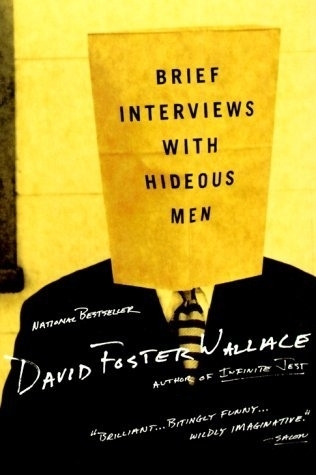
Review: Brief Interviews with Hideous Men by David Foster Wallace


First published:- 1999

Read in:- April, 2014

Star rating:-

To call these meanderings and sub-meanderings of a brilliant mind short stories, will be akin to putting a leash on DFW's creativity with the aid of conventional terminologies and thereby undervaluing the sheer inventiveness on display in this compelling collection. 
In course of my limited venturings into DFW's literary landscapes I have arrived at one crucial inference. That to read DFW is to transgress the very act of simply reading through and discover a newer way to commune with his chain of thoughts, to work your grey matter just a tad bit harder to truly grasp what he has intended for you to understand. And that's an exercise I am all too happy to engage in especially if it sharpens my senses and compels me to achieve a state of oneness with the narrative without sparing a second thought to any of my other parallel reads.
Reading him is like being given the unique opportunity to listen in on one of the greatest minds that ever existed speaking from some imaginary podium and letting that same mind direct my own to follow pathways that it didn't even know existed. It's like making yourself a part of the virtual reality he has recreated through his words and believing in the truth of it without trying to compartmentalize his writing.

Hideous men (and, occasionally, women) and the alarmingly convoluted inner workings of their still hideous minds string this collection together. Some of the 'short stories' are mere snapshots of eponymous interviews of seemingly disturbed individuals, ranging from hippie youths who have devised Machiavellian plans to seduce and subsequently ditch women with psychopathic precision to adolescents with elaborate masturbation fantasies creepy enough to make you involuntarily shudder, while some are little snippets which merely detail the secret inner lives of certain individuals which always remain carefully concealed behind an ingeniously orchestrated charade. Add some metafictional commentary inserted sporadically as footnotes of considerable length, in several of which the author even challenges the potential reader to weird pop quizzes, and you have a hazy idea of what this collection has to offer. But even so, I probably haven't even grazed the tip of the iceberg of DFW's gift for redefining narrative structures. 

Given that I am accustomed to more or less linear narratives, consisting of immaculately crafted sentences which put more emphasis on superficiality of actions and emotions, it is a bit of a surprise to find myself being drawn to a writer who sought to expose the raw core of every pretension. Sometimes while reading I was even tempted to flip a coin to decide whether he was being ironic or simply acknowledging some disturbing reality in a matter-of-fact tone.

"He ruled from that crib, ruled from the first. Ruled her, reduced and remade her. Even as an infant the power he wielded! I learned the bottomless greed of him. Of my son. Of arrogance past imagining. The regal greed and thoughtless disorder and mindless cruelty - the literal thoughtlessness of him."

The man's perspicacity is so palpable in everything he writes and his sincere attempts at perfect reconstruction of thought processes and the true motivations at work behind every human gesture so obvious, that I can't help but be charmed. The 5 stars are probably a dead giveaway of my veritable moony-eyedness. 

Belying expectations the footnotes did not annoy. The infinite digressions merely served to intensify my fascination with the way DFW's mind worked.
But can it be said that DFW left behind a body of work which can be given the label of 'proper literature'? The answer to the question depends on the way you choose to constrict your definition of 'proper literature' or whether you choose to constrict it at all. 

The man was a genius and his suicide only translates into a profound loss for all the good which remains in the world of publishing. And I doff my hat in honor of the creative freedom he refused to sacrifice while writing.


   photo C136E66569D294E4D5DA2D8124D4FF69.png

Saturday, May 24, 2014

Review: Cloud Atlas by David Mitchell


First published:-2004

Read in:- April, 2014

Star rating:-

There's the sound of a deeply contented sigh emanating from the lips of someone clutching this book to herself like a long-lost friend, a bead of tear perched precariously atop disorderly eyelashes. And there's the barely audible sound of her turning the pages ricocheting off the pliant walls of time and space, sculpting a minuscule dent on the surface of a collective fate and this perplexing cosmic interconnection. 

She cannot properly articulate her awe or even fathom her own bewilderment at being rendered so tearfully sentimental by another case of 'old wine in new bottle'. Now she longs to believe that any or all of her trivial actions will lift her out of her predestined prison and place her somewhere on the crisscrossing grid of timelines and geographical boundaries, enable others to hear the distinct echo of her shout into the void. She just by herself is insignificant, not even a mere drop in the pool of time and she fears this looming threat of obscurity above all. But then David Mitchell gently reminds her that mute resignation to the 'natural order of things' is cowardice and billions and billions of droplets like her coalesce to form the ocean itself. She can will herself to shape the world any way she can. 

American notary, Adam Ewing sails reluctantly across the Pacific aboard The Prophetess, unaware of the events that will set into motion a change of heart which will contribute toward the making of history. 

A disinherited, arrogant and musically gifted Robert Frobisher chronicles the making of his avant garde 'Cloud Atlas' sextet in a series of letters addressed to his dear friend from distant Zedelghem.

Dauntless Luisa Rey doggedly pursues the truth and exposes the nexus between the Nixon administration and corporate corruption, emerging victorious against the tide of adverse circumstances. 

Ageing, pedantic and self-important vanity publisher Timothy Cavendish endures a 'ghastly ordeal' partly as comeuppance for his lifelong selfishness but manages to emerge from his own predicament with a reformed worldview. 

Fabricant Sonmi~451 rises above the 'catechisms' of institutionalized servitude to 'corpocratic' masters in futuristic Korea to light the spark of revolution. 

In a post-apocalyptic Hawaii, valleysman Zachry witnesses mankind on the brink of a choice between complete annihilation and survival through self-reform. 

And master puppeteer David Mitchell pulls all their strings from the background.

As she delights in her newfound admiration for the sweeping scope of this masterpiece and Mitchell's ambitious foray into the Matryoshka-doll structured story-telling, she doesn't fail to notice the accusations of gimmickry and pretensions, of self-indulgent writing, of 'trying too hard', of 'contrivances' and acknowledges the legitimacy of these opinions. 
But then she remembers Robert Frobisher answering Mitchell's detractors on his behalf. 

"Revolutionary or gimmicky? Shan't know until it's finished, and by then it'll be too late..."
Do you blame her for chuckling at the man's foresight and wit?

Enthralled, she notices the parallels drawn between the rabid consumerism of our times and a 'predatory society' based on principles of the empowered devouring the disenfranchised and the voiceless, the invisibility of the aged in the eyes of the young and unwrinkled, carefully inserted allusions to virulent sexism, racism and xenophobia through the ages, the enthusiastic nod given to cross-cultural harmony and freedom of sexuality and she wonders if Mitchell has left any of the issues haunting mankind since times immemorial unexplored. 

Thus as Mitchell tips his hat to the likes of Melville and Calvino, to prose stylists like Joyce and Nabokov, to the traditions of intertextual witticisms and metafictional references, to all the disparate voices and genres that help enrich the body of literature today, she tips her hat to Mitchell's genius and the sheer audacity of his vision.

Unhappily she then takes cognizance of the fact that never again will she read 'Cloud Atlas' for the first time. 
But then again, she might.


   photo C136E66569D294E4D5DA2D8124D4FF69.png

Tuesday, February 18, 2014

Anaïs Nin, my beloved witch

Anaïs Nin has been a favorite author for a while now. So today I'll just use this space to review two of her books at one go:-
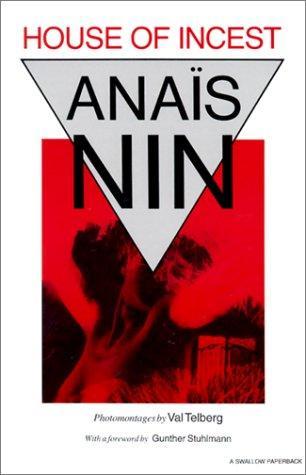
House of Incest


First published:- 1936 (Nin's first work of fiction)

Star Rating:-

What do they say about pretty words strung together into passages pregnant with symbolism and implications, some of them beyond the grasp of a dilettante like me? How do they compartmentalize Anaïs Nin's writing? 
'Erotica' they like to call it, perhaps, putting focus on the sexual imagery Nin invokes with the flair of her pen. 

But I would rather not enclose Nin's genius inside the banal prison of a genre like erotica. Her words, like splotches of the most exotic water color, coalesce into an abstract painting of such acute beauty that one can only stare at the phantasmagorical picture that forms in front of the mind's eye, with a deep sense of wonderment. 

Her words are magic. Her words instill life into the seemingly lifeless form of a road stretching ahead. Her words transform a taboo subject like incest into a fathomable, even an acceptable reality of our existence and temporarily divorce us from the social conventions, of the material world, as we know them. Her words whisk us away to a secluded, floating world where only surreal landscapes of Nin's imagination sprawl far and wide in all their majestic splendour. And the reader can only be a besotted traveller enjoying a one-of-a-kind sojourn - soaking up all the incomprehensible loveliness of Nin's prose in small bursts.

"I felt only the caress of moving - moving into the body of another - absorbed and lost within the flesh of another lulled by the rythm of water, the slow palpitation of the senses, the movement of silk..
Loving without knowingness, moving without effort, in the soft current of water and desire, breathing in an ecstasy of dissolution.
I awoke at dawn, thrown up on a rock, the skeleton of a ship choked in its own sails."


Her words accord a kind of literary immortality to so many hackneyed humane emotions and sentiments.

"But Jeanne, fear of madness, only the fear of madness will drive us out of the precincts of our solitude, out of the sacredness of our solitude. The fear of madness will burn down the walls of our secret house and send us out into the world seeking warm contact. Worlds self-made and self-nourished are so full of ghosts and monsters."


Her words are exquisite poetry. 

____

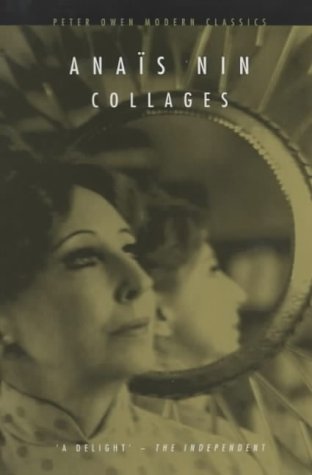
Collages


First Published:-1964

Star Rating:-


Anaïs Nin is my beloved witch, capable of making the nebulous frontiers between imagination and reality dissolve away into oblivion with one well-maneuvered flourish of her metaphorical pen, her personalized magic wand. Or I see her in my mind's eye, as a lovely but shabbily dressed seamstress, patiently weaving a patchwork quilt of exquisite beauty out of the gossamer strands of time. 

Does art imitate life or does the opposite hold true? 
Where does life begin? Where does it end? What lies in between? What does it all mean?
Anaïs Nin attempts to answer these hazy, unanswerable questions by giving us a snapshot of the perpetual movement of time and the phantasmagorical spectacle of humanity caught in its web, establishing without a doubt that there's no end, no beginning and no middle. Life is ad infinitum.

Dreams and reality collide in her writing, exploding in a dazzling array of fireworks illuminating the obscure part of our consciousness, giving us brief flashes of the realm in which the ultimate truth lies cocooned in the protective covering of the mundane, slumbering peacefully - the truth about life and beauty, love and lust, happiness and grief, the extraordinary and the common.

Collages is exactly what its title implies and much more than what our feeble imaginations can conceive upon the utterance of this word. It is not about a nation or a set of natives, a single protagonist or many, one life event or a set of discrete occurrences. Anaïs Nin renders perfect delineation unnecessary, makes clearly visible lines of divide vanish without a trace. Instead, vignettes, eerie and abstract, tangible and solid, merge and fall into each other, clumsily yet seamlessly, to create a surreal painting, a collage of the human consciousness holding the random admirer in thrall, glaringly all-encompassing in its wild, colorful abandon even though the viewer strives to make sense of it. But isn't life just like this baffling, bizarre work of art that Anaïs Nin begets? Comprehension stays forever out of reach. Even when we feel it floats mid-air at arm's length, attempts at trying to grasp it remain thwarted.

As Renate pours her beautiful, meaningless dreams into her empty canvasses, falls in and out of love with Bruce, drifting through space and time, touching the lives of many we get an impression of life's fluid grace and its capacity of encasing the infinite. The diseased, old man who shuns the company of his loved ones, preferring to live in a cave by the sea with a few seals as companions, the heart-broken French consul's wife who grieves for her broken marriage and vindictively contemplates finding a Turkish lover, the clairvoyant film critic who describes for Renate the scenarios written by struggling writers which never saw the light of the day, Nobuko who fights to free herself from the suffocating, rigid civility of the Japanese way of life - these are but a handful among the many myriad shades and facets of humanity shuttling in and out of Renate's life causing vague but perceptible upheavals. The quietly floating gondolas of Venice, the ochre-hued sand dunes of an African desert, the peaks of Peru and palaces of Marrakesh, upscale avenues of New York and streets of Arcadia, California all make fleeting appearances in this stunning collection of interlinked snippets, dismantling in the process all man-imposed barriers between nations and cultures and presenting to the reader an eerily arresting picture of life in all its glory and imperfection.

I don't care about Anaïs Nin being mostly recognized as a writer of literary erotica since I beg to differ on the subject of this categorization. I don't care about the fact that she shared an incestuous relationship with her father. But what I definitely care about is discovering and appreciating more of her splendidly assembled collages.


   photo C136E66569D294E4D5DA2D8124D4FF69.png

Saturday, August 31, 2013

Review : If on a winter's night a traveler by Italo Calvino

(Original review posted on Goodreads:- March 8th, 2013)

Putting into exact words all the feelings this book evokes in the reader, is a task not just
tremendously challenging but virtually impossible to execute.
After getting through the first few pages, I felt like Naomi Watts in The Ring, being pulled into the world of the creepy video by Samara.
I know that's a rather cheap analogy. Comparing a creation of one of the most well known post-modernist writers to have emerged from Europe to a Hollywood version of a Japanese film, is pretty close to blaspheming.
But then nothing more apt comes to mind at the moment.

If on a winter's night a traveler is Calvino's tribute to the spirit of reading, writing and the utterly unique but beautiful relationship between a writer and a reader.
In an inimitable style and with mordant wit he has dissected the art of writing and the melange of emotions any writer is bound to go through while working on his newest masterpiece, irrespective of whether it is aimed at garnering record sales or becoming a piece of critically acclaimed literature. He has also reached out from within the pages of the book, grabbed hold of the reader, sucked him/her right into the heart of the narrative(if you call it that) and taken him/her on a delightfully unpredictable journey where he/she is simultaneously the reader, the writer and a character at the mercy of a writer's whims.

In a nutshell, this is Italo Calvino serenading the reader and the spirit of this wonderful but singular form of communication that exists between two individuals who may never know each other in person but for a few blissful hours/days of their lives, feel bonded to each other on an alternate level in ways, unimaginable by a third party.
Because just as the reader tries to form an image of the story-teller in his/her mind, the writer too keeps his/her prospective reader in mind while penning down his/her thoughts.

A pure work of genius that is bound to enthrall readers for generations to come and perhaps it won't be an exaggeration to state that many aspiring writers may want to adopt this book as their Bible.

P.S:- Not recommended for readers looking for a great story to read. Since this is Calvino manipulating, baffling, exasperating and dazzling the reader in equal measure and in quick succession by writing the exact opposite (for lack of a better term) of a conventional novel.

5 out of 5 stars.


 photo C136E66569D294E4D5DA2D8124D4FF69.png

Review : Slaughterhouse-Five by Kurt Vonnegut

(Original review posted on Goodreads:- April 30th, 2013)

Neither does a war bring glory nor does a win in one ensure the moral infallibility of one
ideology over a conflicting one. Because essentially, war justifies countering genocide with more genocide. We all know that, right?
But nope, we don't. We only think we do. And that is what Kurt Vonnegut wishes to tell his reader, in a calm, detached and emotionless voice in Slaughterhouse Five.
He informs us, quite matter-of-factly that we don't know the first thing about a war and proceeds to explain to us what it really is, by fashioning a narrative as abstruse, disjointed and meaningless as war itself.
I must make a confession despite how morbid this may sound. I have a thing for war books because it's endlessly fascinating to read about the two World Wars which helped define our identity as a civilization in the last century. And despite the horrendous nature of crimes against humanity that were committed in both, these two wars held up a mirror in front of us where we could recognize our own failings as human beings and rectify our mistakes.
Which is why I agree with Tan Twan Eng's views on World War II:-,
"Moments in time when the world is changing, bring out the best and the worst in people."

But Vonnegut neither eulogizes war nor seeks to make our hearts bleed for the unimaginable loss and suffering it brings. Instead, he gives the traditional perspective on war a new twist by giving us a prolonged glimpse into the mind of a war veteran who neither considered himself a hero nor a coward. 

Billy Pilgrim's life or the way he viewed his own life in retrospect, was as chaotic and nonsensical as the war he fought in. It is the sheer absurdity of the concept of war that takes center stage in this highly experimental novel - how we carry on with our broken lives with a perverse sense of humor in the face of mindless cruelty and utter madness.

5 out of 5 stars.
Photobucket
Related Posts Plugin for WordPress, Blogger...