First published:-
2000
Star rating:-
 Some books are very obviously flawed, contrived in ways which slow down the reader's progress and heavily tax his/her ability to dredge up empathy over the headache-inducing frenzy of loaded work-weeks. And yet these narratives are so divine in their earnestness, so far-reaching in their scope, that you are filled with this overwhelming, earth-shattering zeal to shower them with a holy love and not let even a drop of your skepticism dilute your admiration for the writer's boldness. Your cowardice and inaction dictate you honor his unstated wish and this is the least you can do anyway. Embrace it all - the two-faced treachery perpetuated by the torchbearers of civilization, the endless cycle of degradation and corruption and the myriad sorrows of all the characters which bleed into its pages. Take one swig after another from the truth flask until you have been purged of all your self-indulgent guilt-trips and left with nothing but a crushing hopelessness which devours all other emotions with a vindictive fury.
There's us, cocooned in the warm illusion of security, dissecting the politics of injustice from our ivory towers, wholly in denial of our bubble of happiness feeding off the despair of others. In an effort to scramble toward whatever glamourous concept of affluence it is we consider salvation, we do not see the charred wreckage of lives strewn all around.
There's the woman of flesh and bone who becomes a grotesque assimilation of mere genitals, who can only be an abstract embodiment of the abuse with no human face - a walking, breathing cunt for hire whose existence you acknowledge only when you require its use. Every once in a while she leaves crack-addicted babies with no fathers in the maze of foster care or dumps them like inanimate blobs of flesh in seedy abortion clinics. She only lives in those documentaries harbouring Oscar-nomination ambitions, at the precipice of our segregated utopias merging with the abyss of the Tenderloins of the world. And the sanctimonious laws state with conviction, that the Tenderloins and the red light areas do not exist.
There are the hobos, the panhandlers, the bums, the destitute - not allowed to be anything other than victims of their own ineptitude, worthy of a stray sympathetic glance and a few seconds of pity, to be religiously warded off our vaunted inner sanctums. There is Henry Tyler, a pathetic loser bearing the Mark of Cain, wallowing in eternal self-pity, choosing to live as a homeless man to find his Queen, his antidote to a desiccating loneliness. And then there's the Queen of the Whores with her magical powers and her crack pipe - just an emblem, a protector, a redeemer, a guardian angel, a modern day Jesus - and law-abiding respected founder of 'Feminine Circus' Jonas Brady, with his multi-million dollar franchise of selling men the right to rape, torture, and mutilate disabled girls, her nemesis.
They are all actors in an absurd pantomime. They are all real.
'Part biblical allegory and part skewed postmodern crime novel', the blurb announces with relish. But that doesn't even skim the surface of this tome.
I call this Vollmann's gift to the perpetual outcasts of society, the ones we have pushed so far beyond the edge bit by bit in our own mad dash for the center that they exist in a kind of parallel netherworld where all humanly concerns are put to rest, where violence and deprivation are the order of the day. I call this his sincerest attempt at chronicling their stories the way they may have approved of, however alien to our feral cravings for taint-free reputations, routine and fake dignity, however repulsive to our faux-fragile sensibilities. I call this a searing critique of the hypocrisy of the ones holding the reins of the civilized world, who would sputter with mock indignation when asked to legalize prostitution.
However small or insignificant, I call this book an act of redemption.

First published:- Jan 1st, 1992
Star Rating:-
Read in:- November, 2013
"Some things are too terrible to grasp at once. Other things - naked, sputtering, indelible in their horror - are too terrible to really grasp ever at all. It is only later, in solitude, in memory that the realization dawns: when the ashes are cold; when the mourners have departed; when one looks around and finds oneself - quite to one's surprise - in an entirely different world."
Oh this vile bunch of snot-nosed college brats, fattened on their parents' money like ticks on blood. Oh their ennui and way of seeking solace in esoteric practices believing them to be the one-way ticket to some metaphysical dimension which will exclude us mere working class mortals with our worldly woes from entering and interfering with whatever unearthly pursuits they busy themselves with. Well guess what kids? We would like to be rid of over-confident, smug, self-important, world-weary bastards like you too. I almost wish I could go on a mad rampage during an eye-roll inducing, unbelievably ridiculous Dionysian rite and kill every single one of you as well.
The Secret History is one of the best crime thrillers I have ever read. And this is perhaps because this is not a crime thriller in the conventional sense of the term but literary fiction with moral ambiguity and loss of innocence as central themes. The actual crime(s) is a minor part of the narrative and doesn't eclipse the gradual build up to it or the domino effect it triggers subtly, a devastating chain reaction which results in the collective crumbling of the fabric of 5 young lives. And it is the shadow of this crime, the anticipation of its occurrence and the crushing psychological aftermath of it that lends the narrative its true substance. A discrepancy between the occasional sting of conscience felt by the perpetrators of the crime and their previous heinously selfish justification of the act of murder is what makes this book so utterly engrossing and a veritable unputdownable. Because here we aren't dealing with the solution of a complicated police case but instead getting acquainted with a thread of events which also happen to include a murder from the narrator's point of view who is a reluctant accomplice to the crime.
But then why the conflicted 3-star rating? That's because I foresaw every unimaginative turning point or cliched plot device thrown in for the sake of heightening the drama. A third of the way into the narrative, with the grand revelation (which is not very grand to be honest), the unravelling of the rest of the story becomes very guessable. This is not to mention the 'Argentum'-Argentina fallacy. Any attentive reader who has a grasp of high school level basic chemistry will realize that 'Aurum' refers to gold,'Argentum' refers to silver. But these aren't even the major irritants. My biggest problem is with the ludicrous contrivances that are passed off in the name of a premise for the story to build itself on. There's a tinge of unreality to the idea of a super close knit fraternity of 5 snobbish students of classical Greek in a college in 80s Vermont mentored by an even more snobbish and elitist professor, the narrator conveniently finding an entry into this brotherhood sort of grouping out of the blue and becoming a passive spectator to the sequence of events which follow. And lastly the main characters are hardly believable, especially the sole female character who remains a vaguely outlined one at best.
The 3 stars are for Tartt's writing which is never showy or deliberate but graceful and quite excellent. I hope The Goldfinch is more impressive and free of proof-reading errors.
First published:-
1924
Star rating:-
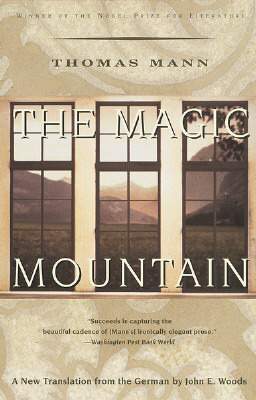
 Imagine being stuck in a place where all sense of time is lost in the web of inactivity, a place which enables people to lead a life devoid of any greater purpose and only focused on recuperation from a queer illness, a place almost hermetically sealed and self-controlled, successfully keeping the repercussions of wars and diplomatic feuds between nations at bay. Imagine being rid of all your earthly woes of finding means of survival and all the elements that stand as pillars supporting the normative structure of life during a sojourn in a special, secluded place. Imagine a miniature diorama of a society thriving on its own, divorced from society at large.
If you haven't been successful in imagining a real life scenario fitting aforementioned descriptions, do not despair. You can always discover this specially constructed safe haven in a certain fictional sanatorium in the Swiss Alps where our protagonist Hans Castorp languishes for seven whole years.
The experience of reading this book is akin to a painstaking hike up a dangerously steep slope. (Excuse the overused analogy but it happens to be quite apt)
There are long dry stretches requiring ritualistic finding of one footing after the next, ensuring that as a reader you do not slip and tumble headfirst into the gaping chasm of incomprehension. And then there are the moments of perfect clarity when snippets of Mann's wisdom filter in like errant rays of sunshine through the drear of many tedious descriptions of long walks and repetitive conversations, making the long and difficult climb seem worth it all of a sudden.
"But he who knows the body, who knows life, also knows death. Except that's not the whole thing - but merely a beginning, pedagogically speaking. You have to hold it up to the other half, to its opposite. Because our interest in death and illness is nothing but a way of expressing an interest in life..."
The summit of this "magic mountain" becomes the location of a metaphorical watch tower from where the spectacle of our collective civilizational march is viewed, dissected and analyzed with precision. The quirky patients inhabiting the sanatorium become mere proxies for some nations or disparate points of view, their inter-relationships often symbolic of some deeper ideological conflict woven intricately into the fabric of existence.
But despite the sheer brilliance of this premise, there's something off about this book. Something that prevented me from according that final star.
Even if this remains a lengthy and eruditely presented discussion on Europe's inner contradictions, its juxtaposition of progress in all spheres of life and violence brewing under the veneer of that sanctimonious progress, as a work of literature it is somehow imperfect and rough around the edges. Since I was often tempted to believe it would have worked better as a nonfictional philosophical discourse. It's sort of like what my eloquent friend Dolors says - 'The book lacks a soul.' How succinctly put. (Read her well-argued review here)
The characters are employed as mere mouthpieces, never resembling well-drawn sketches of actual people with their own stories. The situations and backdrops are mere contrivances specifically begotten to tout ideas on life and death. It's as if the whole narrative is an elaborate ruse developed to convey Mann's thoughts on the state of Europe prior to the First World War. During my moments of exasperation with the book I was able to recall a few of Nabokov's thoughts in his article onLolita-
"...All the rest is either topical trash or what some call the Literature of Ideas, which very often is topical trash coming in huge blocks of plaster that are carefully transmitted from age to age until somebody comes along with a hammer and takes a good crack at Balzac, at Gorki, at Mann."
Clearly a jibe at TMM if I have ever seen one.
Not that I agree with Nabokov's opinion on TMM being topical trash but it surely gives rise to the suspicion that if you strip the book of all its allegorical significance, almost nothing substantial remains. And with the turn of the last page, it leaves the reader with a sense of indescribable dissatisfaction about having just finished a journey neither very rewarding nor enjoyable.
Maybe a re-read some time years later on in life will restore the elusive star. Maybe it will not.