Showing posts with label Nobel Laureates. Show all posts

Wednesday, September 30, 2015

Review : So You Don't Get Lost in the Neighborhood by Patrick Modiano


First published:- October, 2014

Translated by:- Euan Cameron

Publisher:- Houghton Mifflin Harcourt 

Star rating:- 


Call this a book of mirages and mirrors that distort the contours of visible reality all the time. Call it a lament for the inevitability of change that erases all the landmarks to a place that anchors one to a past self. Call it a psychological thriller, a faux-noir in which people materialize out of thin air to serve as clues to lead the joyless protagonist to a truth too terrible for him to comprehend all at once. (Faux noir because Modiano ingeniously deploys its signature leitmotifs to subvert the genre. The token crook is merely a shady character, the token gangster's moll/seductive siren becomes a sympathetic confidante and the token mystery transforms into a disconcerting odyssey through the maze of time and memory.) But an adroitly spun yarn as this one transcends the imposed boundaries of any such labeling with ease and surprising grace.

One can tell the Nobel committee usually doesn't mess around at least when it comes to this greatest of honours reserved for literary achievement. Only pure artistry could have produced something as perfect as this - a combination of strategically placed expository bits, a dreamy, sublime narrative voice reflecting both a subconscious longing and antipathy for lost time, a melding together of reality and delusion, an overlapping of the worlds of 'was' and 'is', and a cautious but sure-footed unravelling of plot. The last time something this unambiguously postmodern in tone and form had brought me such pure reading pleasure was when I happily surrendered before Ali Smith's rhetorical playfulness in There But for The.

There, on the pavement, in the light of the Indian summer that lent the Paris streets a timeless softness, he once again had the feeling that he was floating on his back.

Author Jean Daragane's world is populated by ghosts - ghost-like individuals who hover over his reality to lead him to places and people he has forgotten and, in all likelihood, does not want to recall, the specter of self-written words that elude his feeble grasp on memory, ghost of a city's turbulent past intruding on the equanimity of the present, ghost of those nauseous years of the Occupation that one cannot shake off despite best efforts. And these myriad ghosts proliferate at the back of his mind to warp his sense of time, creating a stark dissonance between reality and memory that usher in a renewed sense of dislocation. In a way, he seems like a vagrant spirit himself, adrift in life like flotsam after a devastating tsunami, alienated from the rituals of work, love, relationships. But this deceptive placidity of the surface of his consciousness is disturbed by a phone call out of the blue which sets into motion a chain of fated meetings and ridiculous coincidences which eventually allow him to find a way back into his past, a journey he undertakes with considerable reluctance and disguised trepidation. I'll leave you to summon the curiosity to find out where this journey eventually leads him.

It would appear, he often used to say to himself, that children never ask themselves any questions. Many years afterwards, we attempt to solve puzzles that were not mysteries at the time and we try to decipher half-obliterated letters from a language that is too old and whose alphabet we don't even know.

Like a true master of the craft, Modiano only ever mentions the War in passing, subtly inserting roadsigns which point to the ineffaceable marks of damage on a Paris which itself appears like a figment of Daragane's imagination at times, as if it might flicker out of focus any moment to reappear in a pale imitation of an unrecognizable former avatar. But the memory of war lingers on in the desolation of rue de l'Arcade and the boulevard of Champs-Élysées witnessing the flow of time like a dispirited sentinel, in Daragane's uneasy perambulations through the courtyard of Louvre and the mist-laden autumn air of the rue de l'Ermitage. An amnesia sets in when the currents of time gradually whittle down the tangible reminders of a tragic event into unfamiliar forms but reality forgotten is never reality expunged. 

...And yet he now wondered whether he had not dreamed this journey, which had taken place over forty years ago.

Daragane's Paris is tied inextricably to the past just as he finds himself colliding with the vision of an abandoned, forgotten child navigating the unfamiliar nooks and corners of an unknown neighborhood, perhaps, pained and relieved in equal measure to have finally remembered that which he was so intent on forgetting. I could not have wished for a more befitting sense of closure for our traumatized narrator.


**with thanks to Netgalley and Houghton Mifflin Harcourt for an ARC**
__


Also posted on Goodreads & Amazon.

   photo C136E66569D294E4D5DA2D8124D4FF69.png

Wednesday, February 25, 2015

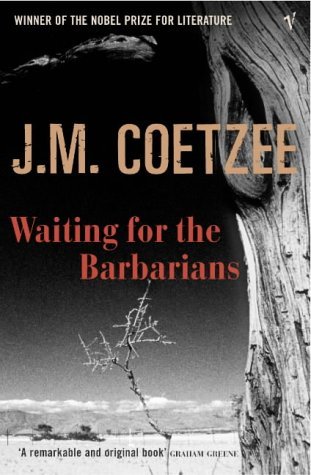
Review: Waiting for the Barbarians by J.M. Coetzee


First published:-1980

Star rating:-

It is impossible to read this and not be reminded of an almost genetically programmed inferiority complex, the burden of history only the descendants of the colonized have to bear. Despite those smug pronouncements of the 21st century being an era of a fair and equitable world and the hard battles won in favor of interracial harmony, there's the fact of your friend barely suppressing a squawk of alarm when you express your admiration for Idris Elba - no female I am acquainted with in real life has learned to wean herself away from the fixation with a white complexion. Scrub your skin raw till it bleeds but never fall behind in the race to make it whiter because that's the color the world approves of. You can fawn over Simon Baker's blonde, light-eyed glory but not over Elba's hulking, ruggedly handsome perfection; heaven forbid you prefer the latter over the former. The 21st century is yet to cast its magic spell over the standards of physical beauty. 

So if I, a citizen of a purportedly newer and better social order, can still feel the rippling aftershocks of the catastrophe called Imperialism from across the barrier of decades and centuries, what would a man like Coetzee have experienced, stranded in the middle of the suffocating sociopolitical stasis of Apartheid? Moral anguish? A bitter impotence? A premonitory sense of doom? Anger? 

Fiction, I believe, must have been his preferred method of exorcizing these demons. And purge these emotions he did through the composition of this slim little novel which can be aptly described as a most heart-wrenching lament on the condition of the world of his times. 

It may be true that the world as it stands is no illusion, no evil dream of a night. It may be that we wake up to it ineluctably, that we can neither forget it nor dispense with it. But I find it as hard as ever to believe that the end is near.

An anonymous magistrate stationed at a farthest corner of an unspecified Empire witnesses the death throes of its reign while recovering his own humanity at the loss of his position of power and influence. In the beginning he is convinced of his righteousness as a dutiful servant of the Empire who oversees the welfare his subjects with moderation but with the arrival of a bluntly tyrannical figure of authority whose methods differ vastly from his, he begins to question his own collusion in the maintenance of an unnatural order. Unable to stand as a mute witness to the horrendous abuse inflicted on innocent 'natives' on the false suspicion of their complicity with 'barbarians' or armed rebels who threaten the stability of the Empire, he clashes with the aforementioned administrator who undoubtedly represents the true face of any oppressor when divested of its sheen of sophistication. And thus begins his fall from grace culminating in a kind of metaphorical rebirth through extreme physical abasement. 

I was the lie that Empire tells itself when times are easy, he the truth that Empire tells when harsh winds blow. Two sides of imperial rule, no more, no less.

In the fashion of Coetzee's signature didacticism the novel is rife with allegorical implications but as much as these can be deeply thought-provoking, sometimes they also resemble conveniently inserted contrivances. Like the pseudo-erotic entanglement that develops between the ageing magistrate and a young 'barbarian' girl who is left maimed and partially blinded after a violent bout of interrogation is amply demonstrative of a colonizer-colonized arrangement - the one bereft of power to drive the relationship in a desired direction becomes dependent on the volatile benevolence of the other party. Or the mounting paranoia about the anticipated attack of the 'barbarians' who, much like Godot, fail to appear and remain a myth till the end although emerging as the key factor hastening the impending demise of Empire. All the layers of meaning and symbolism could send a dedicated literature student into paroxysms of pleasure no doubt.

With the buck before me suspended in immobility, there seems to be time for all things, time even to turn my gaze inward and see what it is that has robbed the hunt of its savour: the sense that this has become no longer a morning's hunting but an occasion on which either the proud ram bleeds to death on the ice or the old hunter misses his aim; that for the duration of its frozen moment the stars are locked in a configuration in which events are not themselves but stand for other things.

Wary as I am of Coetzee's often stilted world-building, my 5-star rating was an inevitability given my obsession with narratives containing a discernible vein of literary activism in harmony with notions of social justice. Here he also seems to have successfully reined in his pesky habit of turning his characters into sockpuppet-ish mouthpieces to tout his own passage-length worldviews. The narrator does occasionally morph into a pedagogue but his inner monologues never seem out of place given his unique circumstances. Besides it takes courage to acknowledge the fact of white man's guilt in a world which is yet to discard the rhetoric of 'white man's burden'.


   photo C136E66569D294E4D5DA2D8124D4FF69.png

Sunday, September 21, 2014

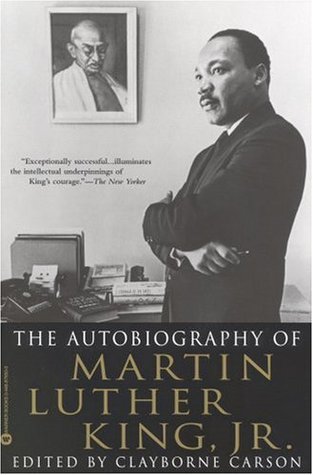
Review: The Autobiography of Martin Luther King, Jr. by Martin Luther King Jr.

First published:- 1998

Star rating:-

I had to keep reminding myself that it's not the civil rights movement I am rating and reviewing, because the spectrum of legitimate excuses, let alone justifications, which could explain the withholding of a star or two is rather limited. It comes as a kick to the gut every time a young, unarmed Clifford Glover or a Travyon Martin or a Michael Brown is shot for no valid reason and the realization sinks in that the process of integration which was initiated by Lincoln some 150+ years ago and furthered by Martin Luther is yet to reach its completion. So the essence of this book and MLK's doctrine of nonviolent agitation are now relevant more than ever. 

In a way this is Martin Luther's own account of the movement he helped steer in a direction which not only sought to free an entire community from socioeconomic and political servitude but prevented America from becoming synonymous with the ultimate hypocrisy of all - preaching the infallibility of human rights abroad (by waging wars against Communist totalitarianism) but carrying on with its tacit agenda of institutionalized discrimination back home. 
"I am convinced that if we are to get on the right side of the world revolution, we as a nation must undergo a radical revolution of values. We must rapidly begin the shift from a thing-oriented society to a person-oriented society. When machines and computers, profit motives and property rights, are considered more important than people, the giant triplets of racism, extreme materialism, and militarism are incapable of being conquered."

How the spirit of rebellion - which found expression for the first time with the Montgomery Bus Boycott in '55 (unwittingly started by Rosa Parks' act of denying her occupied seat to a white passenger) - trickled into the hearts of oppressed millions in Albany, Georgia, Birmingham, Alabama, Florida, Chicago, Boston, and Washington culminating in the passage of the landmark Civil Rights Act of 1964, is recounted by King himself.
That aside, there's a brief autobiographical sketch patched together from the fragments of writings gathered from the Stanford University archive by Clayborne Carson. Excerpts from King's speeches (sometimes even the full text) also make appearances in between the accounts of all the non-violent movements of civil disobedience he gave leadership to. 

To put it more accurately, this is less of an autobiography (since King didn't live long enough to write one) and more like a montage of every single written document or important oratory piece which King left behind. So lucidly written are these that Carson's work must have been reduced to simple editing and piecing together a coherent narrative out of the vast amount of material at her disposal.

And yet there are such glaring mistakes here which marred my reading experience. Consider this excerpt from King's personal writings after his visit to India in '59 which cemented his faith in the inviolability of civil disobedience as an effective tool to usher in socioeconomic and political change -
"On March 1 we had the privilege of spending at the Amniabad ashram and stood there at the point where Gandhi started his walk of 218 miles to a place called Bambi."

It's not Amniabad. In all probability, it's the Sabarmati ashram in Ahmedabad King is talking about, while the historic walk was to 'Dandi' - a coastal village in Gujarat (the state our present PM hails from). Not Bambi, the iconic Disney deer. 

Even if it was a memory lapse on King's part or a sad apathy for geographical names, as a King scholar looking to publish a work of monumental importance Carson should have been more vigilant for inconsistencies such as the above, especially since Gandhi gets mentioned several times by virtue of his being King's role model. 
(Some quick googling led me to the unhappy discovery that the Stanford archive still retains the unedited, therefore, incorrect information derived from the original sources. I can understand the significance of preserving King's writings exactly as he authored them but the insertion of incorrect facts diminishes the integrity of this work.)
Also occasionally 'Gandhi' is spelled as 'Ghandi'. (Aaarrrrggghhhhhh!)

In addition to these turn-offs, nearly all of King's speeches are so chock full of archetypal metaphor after metaphor that I felt it weakened the gravitas of the narrative. Perhaps, they would have been better off being included in shortened formats. The fact of God's mercy and benevolence being invoked (quite natural since King was a pastor) in every alternate sentence also served as an effective irritant. These are undoubtedly the primary reasons why it took me a whole month to finish reading this. 

But these causes of botheration aside, there's plenty of good to be found in this compilation. Like the way MLK expresses his disappointment with 20th century capitalism in a letter addressed to his wife, Coretta -
"...I am not so opposed to capitalism that I have failed to see its relative merits. It started out with a noble and high motive, viz., to block the trade monopolies of the nobles, but like most human systems it fell victim to the very thing it was revolting against. So today capitalism has out-lived its usefulness. It has brought about a system that takes necessities from the masses to give luxuries to the classes."

or his critique of the Vietnam War and correlation drawn between American militarism and the dangerously skewed nature of race relations in the deep south-
"I do not believe our nation can be a moral leader of justice, equality, and democracy if it is trapped in the role of a self-appointed world policeman."

The absence of that missing star, thus, should be attributed to my personal aversion to factual inaccuracies, overused metaphors and bad analogies. Otherwise no rating system in existence can measure MLK's significance in American history and all that he stood for.


   photo C136E66569D294E4D5DA2D8124D4FF69.png

Monday, April 21, 2014

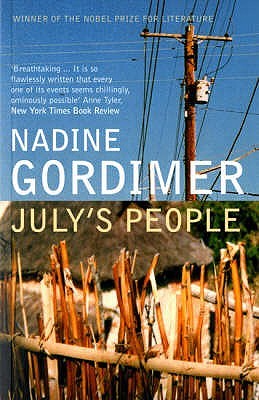
Review: July's People by Nadine Gordimer


First published:- 1981

Star rating:- 


The 5 stars you see flashing at you are not just any 5 stars. They were the end result of a whole day of deliberation. 
I happen to be one of those people who are not stingy with their ratings. If a book manages to bestow equal importance on both the prose and the message contained within in such a way that neither overshadows the other and both meld into a single entity of an unforgettable work of literature/fiction capable of whisking the reader away to a special place, then it can take my 5 stars right away.

But July's People had me dawdling back and forth between a 4 and a 5 star rating for the longest period of time. 

What happens to a middle-class family of white liberals in South Africa fleeing the horrors of a large scale violent agitation started by the blacks in the city? They find a safe haven in their black manservant July's village. 
Away from the amenities of an upscale, urban neighborhood in Johannesburg, away from all known civilization, in the heart of the formidable great South African wilderness, among people whose lives are different from their own as chalk is from cheese, Bamford and Maureen Smales and their 3 children become witnesses to the spectacle of humanity, stripped of all its materialistic props.

They become mute spectators to their own struggle for survival in the harshest of conditions and are left with no other option but to fall into the same pattern of weed-gathering, mealie-meal consuming, wart-hog slaying daily activities of the native Africans. They are also forced to accept this drastic role reversal with July, who had so far been at the receiving end of their patronizing 'kindness' and occasional thoughtfulness.

When July becomes their savior and protector, they finally start to realize how it must have been for July all this time to have been reduced to the status of dependence on a white family, to be considered human but still never judged according to the same criteria used to evaluate a white man's worth. 

Thus in the middle of the intractable African countryside, in the constant presence of buzzing mosquitoes and other poisonous bugs and in an environment redolent of decay and rotting animal corpses, all the hitherto insurmountable barriers between Maureen, the mistress, and July, the servant, are dismantled by the tide of circumstances. Maureen and July assume their true roles as mere humans in a symbiotic relationship where the nature of the dependence of one on the other may vary with a change in the scenario. 
And herein lies the poignancy of this story which relies much on the Maureen-July equation to lend the plot its true substance.
"We can go to my home - July said it, standing in the living-room where he had never sat down, as he would say 'We can buy a little bit paraffin' when there was a stain to be removed from the floor. That he should have been the one to decide what they should do, that their helplessness, in their own house, should have made it clear to him that he must do this - the sheer unlikeliness was the logic of their position."

"How was she to have known, until she came here, that the special consideration she had shown for his dignity as a man, while he was by definition a servant, would become his humiliation itself, the one thing there was to say between them that had any meaning."

"Of course, 'July' was a name for whites to use; for fifteen years they had not been told what the chief's subject was really called."

"She was unsteady with something that was not anger but a struggle: her inability to enter into a relation of subservience with him that she had never had with Bam."


Oh I could go on quoting such brilliant lines, fraught with underlying implications of life-changing proportions. 

Thus, July's People is not just a fantastic meditation on inter-racial tension but also an attempt at acknowledging the humanity of the ones considered less human. 
Gordimer doesn't merely highlight the ambiguity of the South African socio-political situation against the backdrop of the Anti-Apartheid movement or this imperfect intermingling of two cultures so disparate and alien to each other. She also poses a few fundamental questions which go far beyond the limits of a topic like racial discrimination. How do we live together in harmony? How do we come to terms with the differences(social, economic or racial) we perceive in others? 

As I write this, I am repeatedly struck by my own inadequacy as a reviewer and the fact that a few measly passages in a review cannot even come close to recording the experience of reading this book. I am fumbling around for the right words to present to the future reader, all the vivid images and the indescribably complex human emotions that Gordimer has stitched together with the gift of her skillful yet subtle story-telling in this narrative.

At times I forgot I was reading this in an air-conditioned room and found myself in Maureen's shoes - having to wash the unhygienic dirty rags she uses in the absence of sanitary napkins to soak up her menstrual blood or squatting down together with the women of July's family and plucking edible vegetables. I could almost imagine myself living the same nightmare as the Smales family in that stifling atmosphere rife with Equatorial heat and humidity and taut with the tension between July's black people and his white employers.

I am letting Ms Gordimer take over from me again- 

"On this night alone - Saturday - were the people awake among their sleeping companions, their animals; in the darkness(Drawing away, up from it, in the mind, like an eagle putting distance between his talons and the earth) the firelight of their party was a pocket torch held under the blanket of the universe. Heat and dark began to dissolve and she had to go in. There were no gutters; the soft rain was soundless on the thatch."

"It was the first time there had been rain since they came; the worn thatch darkened and began helplessly to conduct water down its smooth stalks; it dripped and dribbled. Insects crawled and flew in. They were activated by the moisture, broke from the chrysalis of darkness that had kept them in the walls, in the roof. She knew that the lamp attracted them but she kept it on. The flying cockroaches that hit her face were creatures she was familiar with."


And so I give July's People all the 5 stars. Because Nadine Gordimer excels at what she sets out to do here - dissect the human predicament with precision and deep sympathy, remove layering upon layering of man-made fabrications and reveal the crux of a human relationship as simple and complicated as Maureen and July's.

And if one thinks about it, she has titled this book ingeniously as well. What does she mean by July's people? July's own kith and kin, the anonymous and indistinguishable (to the white people) blacks of his own village? Does she mean July's white people who are also an indispensable part of his existence? Or is she referring to both at the same time? I think she left it as an unanswered question, left it for us to decide who July's people are.

And one has to admit, that it is certainly a question worth pondering.


   photo C136E66569D294E4D5DA2D8124D4FF69.png

Monday, January 27, 2014

Review: The Summer Before the Dark by Dorris Lessing

First published:-2009
Star rating:-
Read in:-November, 2013


Before it all slips away from my feeble psychological grasp, before the after-effects start wearing off, let me write it all out. About the summer before the dark.

The first thing that struck me while reading was this - Fuck purple prose. Or red or maroon or magenta prose for that matter. (And I say this in full acknowledgement of the fact that my prose is often closer to purple than any other color.) Screw post-modernism and its deliberate way of being obtuse, obscure, snarky. Screw all that.

Because this is it. This is what I want to achieve if I were to attempt writing a stream of consciousness novel some day. This laying bare of all the everyday inner battles a woman wages with her conscience, with society, with those hunters lined up on the sidewalk eyeing her with the interest of a sexual predator as she walks home in that form-fitting dress. Delving this deep into the psyche of a human being who navigates the space of a few months rapidly changing disguises never knowing which of them are closer to her real self, but in prose so beautifully self-evident. The things nobody in the world is bothered about because all of it is so awfully pedestrian. After all, there's nothing remotely tantalizing about an upper class woman having perfunctory sex in a passionless affair or caring for her husband, her children, molding her existence around their schedules. There's barely any appreciation for what she is doing for society at large by playing the forever-at-your-service comfort-giver. The way she is working a thankless job, drifting through life mostly invisible in the eyes of the ones who surround her. 

This is how Virginia Woolf would have written if she had been alive right now. Because Mrs Kate Brown is nothing but a slightly modified modern day avatar of Clarissa Dalloway or Mrs Ramsay. Her insecurities about her steadily whitening hair and declining sex appeal maybe belittled as a rich white woman's first world problems but pay a little attention to them and you will see how universal and all-encompassing her gripe with patriarchy is. 

"She marries because to get married young is to prove herself; and then it must be as if she has inside her an organ capable of absorbing and giving off thousands of watts of Love, Attention, Flattery, and this organ has been working at full capacity, but she can't switch the thing off."

This is what I can only hope to do some day. Make my words bite, sting and burn those who read them. Force them to ponder upon devoured words for extended periods of time.

But does it really deserve 5 stars? Perhaps not, especially in light of the portions where the narrative loses sight of its destination in one of its countless meanderings and gives us the impression that we are trapped in the quagmire of Kate's own inner chaos. But then I am already in awe of Doris Lessing's voice and its power, her way of systematically eviscerating an unequal partnership where the husband is somehow in command of his own life but the wife isn't, her way of cutting open and dissecting motherhood, magnifying each one of its ignored, glossed over aspects for us to see clearly. I love the way this perfectly ordinary Kate Brown with her ordinary name gets under my skin and burrows through my insides, making me so deeply uncomfortable, coercing me into reconsidering my view of the women I have known closely over the years. 

How elegantly she bridges the gap between the inner and outer worlds of an individual and yet in the simplest of manners! And that, for me, is a 5-star achievement. 

   photo C136E66569D294E4D5DA2D8124D4FF69.png

Wednesday, January 1, 2014

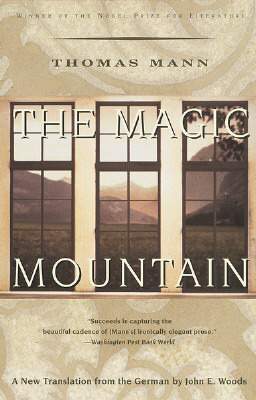
Review: The Magic Mountain by Thomas Mann

First published:-1924
 Star rating:-

Imagine being stuck in a place where all sense of time is lost in the web of inactivity, a place which enables people to lead a life devoid of any greater purpose and only focused on recuperation from a queer illness, a place almost hermetically sealed and self-controlled, successfully keeping the repercussions of wars and diplomatic feuds between nations at bay. Imagine being rid of all your earthly woes of finding means of survival and all the elements that stand as pillars supporting the normative structure of life during a sojourn in a special, secluded place. Imagine a miniature diorama of a society thriving on its own, divorced from society at large. 
If you haven't been successful in imagining a real life scenario fitting aforementioned descriptions, do not despair. You can always discover this specially constructed safe haven in a certain fictional sanatorium in the Swiss Alps where our protagonist Hans Castorp languishes for seven whole years.

The experience of reading this book is akin to a painstaking hike up a dangerously steep slope. (Excuse the overused analogy but it happens to be quite apt)
There are long dry stretches requiring ritualistic finding of one footing after the next, ensuring that as a reader you do not slip and tumble headfirst into the gaping chasm of incomprehension. And then there are the moments of perfect clarity when snippets of Mann's wisdom filter in like errant rays of sunshine through the drear of many tedious descriptions of long walks and repetitive conversations, making the long and difficult climb seem worth it all of a sudden.

"But he who knows the body, who knows life, also knows death. Except that's not the whole thing - but merely a beginning, pedagogically speaking. You have to hold it up to the other half, to its opposite. Because our interest in death and illness is nothing but a way of expressing an interest in life..."

The summit of this "magic mountain" becomes the location of a metaphorical watch tower from where the spectacle of our collective civilizational march is viewed, dissected and analyzed with precision. The quirky patients inhabiting the sanatorium become mere proxies for some nations or disparate points of view, their inter-relationships often symbolic of some deeper ideological conflict woven intricately into the fabric of existence.
But despite the sheer brilliance of this premise, there's something off about this book. Something that prevented me from according that final star. 
Even if this remains a lengthy and eruditely presented discussion on Europe's inner contradictions, its juxtaposition of progress in all spheres of life and violence brewing under the veneer of that sanctimonious progress, as a work of literature it is somehow imperfect and rough around the edges. Since I was often tempted to believe it would have worked better as a nonfictional philosophical discourse. It's sort of like what my eloquent friend Dolors says - 'The book lacks a soul.' How succinctly put. (Read her well-argued review here)

The characters are employed as mere mouthpieces, never resembling well-drawn sketches of actual people with their own stories. The situations and backdrops are mere contrivances specifically begotten to tout ideas on life and death. It's as if the whole narrative is an elaborate ruse developed to convey Mann's thoughts on the state of Europe prior to the First World War. During my moments of exasperation with the book I was able to recall a few of Nabokov's thoughts in his article onLolita

"...All the rest is either topical trash or what some call the Literature of Ideas, which very often is topical trash coming in huge blocks of plaster that are carefully transmitted from age to age until somebody comes along with a hammer and takes a good crack at Balzac, at Gorki, at Mann."

Clearly a jibe at TMM if I have ever seen one. 
Not that I agree with Nabokov's opinion on TMM being topical trash but it surely gives rise to the suspicion that if you strip the book of all its allegorical significance, almost nothing substantial remains. And with the turn of the last page, it leaves the reader with a sense of indescribable dissatisfaction about having just finished a journey neither very rewarding nor enjoyable. 

Maybe a re-read some time years later on in life will restore the elusive star. Maybe it will not.


   photo C136E66569D294E4D5DA2D8124D4FF69.png

Monday, October 28, 2013

Review : Life & Times of Michael K by J.M. Coetzee

**Winner of the Man Booker Prize in 1983.**
Star Rating:- 

Ask me to pronounce verdict on a work of literature flaunting self-indulgent wordplay, 
revelling in its own brand of avant-gardism which stops short of making a powerful statement on our troubled times and my response to it is likely to be lukewarm. 
Ask me to judge a book dissecting the greater human quandary with keen insight but in stilted prose, and my reaction is likely to be more or less the same. 

But give me a story capable of dismantling all the divides of race, culture, political/religious indoctrination, time and space, encompassing all the inner contradictions of our existence into a compelling commentary on human follies that elicits a very visceral, emotional response, and my being won over is practically guaranteed.

Reading Michael K's tale took me on one such heart-breaking metaphorical journey. At the culmination of which I realized that pitying the innocence of Michael Ks of the world who are repeatedly squashed like bugs under the bootsoles of the 'system' is but a foolish thing to do. Instead, I pitied the ones who are incapable of recognizing true misery when they see it, the ones who fail to identify the root cause of all human conflict and its futility, who pride themselves on their achievements which are, sometimes, nothing but grave mistakes in the greater scheme of things.

Inspite of being born with genetic deformities and other crucial handicaps like the absence of a privileged background, Michael K is a fortunate being in my eyes. Someone who doesn't baulk at staring truth right in the eye, a venerable hero stranded in the midst of cowards. He can summon the moral strength to shun the comforts of life, deprived of which each one of us are bound to wither away and die the pathetic death of an unwatered plant. He can seek refuge in the heart of the inhabitable mountains, combat starvation by feasting on insects and the cherished pumpkins he cultivates with the tender care of a mother. He is brave enough to eschew the path prescribed by the ones positioned on the top most echelons of the social hierarchy. He doesn't know which side to choose during a war. So he chooses life over death, physical misery over psychological enslavement, creation over destruction. Simply put, he deserts the company of men to embrace humanity.

"You are precious, Michaels in your way; you are the last of your kind, a creature left over from an earlier age, like the coelacanth or the last man to speak Yaqui. We have all tumbled over the lip into the cauldron of history: only you, following your idiot light, biding your time in an orphanage, evading the peace and the war, skulking in the open where no one dreamed of looking, have managed to live in the old way, drifting through time, observing the seasons no more trying to change the course of history than a grain of sand does. We ought to value you and celebrate you, we ought to put your clothes and your packet of pumpkin seeds too, with a label; there ought to be a plague nailed to the racetrack wall commemorating your stay here."

He understands the one thing that others are too cowardly or too ignorant to acknowledge. That laying the groundwork for a future way of life through ruthless violence blunts the human intellect to the point where one is only aroused by the urge to draw blood, inflict fatal injury and the application of reason loses its appeal.
Michael doesn't understand what a war is, so he struggles to flee the myriad horrors of it, clinging to the last shred of his dignity and his self-made definitions of right and wrong. As everything falls apart in the cities, in the labour camps, swallowed up by the chaos brought about during war, Michael busies himself with creating and rebuilding life in the countryside.

Thus, Michael is nothing but a representation of that slumbering voice of reason within each one of us, the voice of the dissenter, the voice of the one putting up a passive but stubborn resistance against the absurd, inhumane demands of society. And that is precisely the reason why this world needs more silent revolutionaries like him. 

P.S.:- My only grouse with Coetzee is his pedagogical compulsion to launch into a lengthy discourse expounding on hidden meanings, instead of having faith in the perceptive reader to grasp underlying implications. That caused me to take away that 1 star.

 photo C136E66569D294E4D5DA2D8124D4FF69.png

Saturday, September 28, 2013

What else is new?

Drumroll please!

Because the Man Booker has now been officially opened to writers of EVERY nationality.
That's pretty amazing news right?

Read the Man Booker Committee's official press release here


I was wondering if this would mean the end of the Man Booker International Prize which is open to writers from all nationalities but picks a winner based on their achievements over a lifetime instead of one specific book but apparently NOT.

So now the cause for concern is whether American authors (too many of them and too many of them write pretty damned well) will dominate the shortlists and longlists.
Which undoubtedly they will but this may make the prize winning book more worthy since the competition is surely going to intensify now.

Man Booker Committee's decision comes on the heels of the announcement of the Folio prize which is going to start handing out prizes from 2014. It is the first English-language prize open to writers from around the world.
I guess the Booker committee, feared that they were going to become less relevant now.

In other important news, Goodreads has announced a draconian new review policy which allows its administrators/moderators to delete reviews and shelves describing author behavior. As in, calling the author a jerk or an asshole would lead to your review getting deleted. You can discuss the author in your review but only in context of the subject matter of the book.


Meaning you cannot write a review of a David Gilmour book where you call him a misogynist or an ignorant idiot (which he totally is since apparently he thinks Virginia Woolf is the only woman writer worth reading or teaching). Or you cannot call Scott Orson Card a homophobe and a racist.
It is okay to recommend books to others on Goodreads, but not okay to ask people not to buy an author's book or read it because of their bigoted, racist, misogynistic, sexist, offensive remarks or actions in real life.

Not only is this policy shady and geared towards integrating Goodreads with Amazon and boosting sales of contemporary titles (particularly by young adult, new adult and other 'best-selling' writers), it also infringes on reviewers' freedom of speech.
No doubt a storm is in the making over at Goodreads with many people migrating to sites like Booklikes and voicing their protest by directly writing reviews, naming shelves in violation of the new rules, letting their discontent known in the Goodreads Feedback group.

But I have a feeling everything is falling on deaf ears.

I haven't made a Booklikes account yet (Scarlet has though), since what is the guarantee that once Booklikes is a regular, healthy and active community Amazon won't purchase it too?
I think I am going to stick to my blog if Goodreads continues to enforce more unjust rules and regulations.

The Nobel Prize for Literature announcement for 2013 is also just around the corner. Canadian short story writer Alice Munro, South Korean poet Ko Un and the one and only Haruki Murakami are among the more prominent names doing the rounds as likely winners. I wonder if Philip Roth is still in the running, since last year his name was very visible. This year, however, not so much.

I'll keep my fingers crossed for Murakami this year but I have no hope (given his name has been circulating for the past 10 years and the Nobel Committee are unlikely to hand the prize to two Asian writers in two consecutive years). A woman winning the prize will be awesome too given how terribly few women writers have won the prize over the years.

 photo C136E66569D294E4D5DA2D8124D4FF69.png

Monday, September 2, 2013

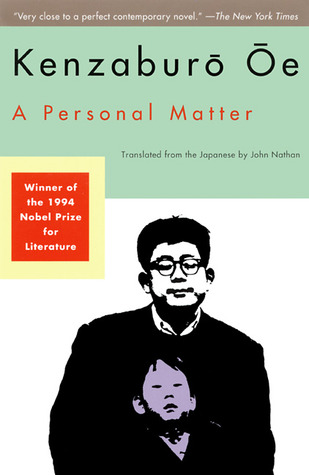
Review : A Personal Matter by Kenzaburō Ōe

(Original review posted on Goodreads:- May 29, 2013)

Reading this book is nothing short of an agonizing experience.
It almost feels like somebody poking at and opening up our most secret, suppurating psychological wounds and making them bleed all over again, thereby compelling us to wake up to the realization of their existence.
These scars and bruises make their presence known time and again by causing us pain of the highest order. And so we proceed to wrap them up in the protective wadding of false pretensions, carefully hiding them away from the scrutiny of the rest of the world and more importantly, ourselves.
But Kenzaburo Oe does not only wish to cause us pain. He also forces us to acknowledge its perpetuity, accept it and achieve a state of harmony with it.

With every turn of a page, we find ourselves plunging deeper into the bottomless pit of shame, self-loathing and sheer grief along with Bird, our protagonist. But Oe breaks our fall right when we feel we are about to land with a resounding thud and teaches us how to rise, how to summon the courage to confront grim reality and reconcile ourselves with the cruelties inflicted by fate.

Bird (nickname), a young man of twenty seven, keeps drifing in and out of consciousness throughout the length of the narrative. While walking along a busy Tokyo street he is capable of sparing a thought for his pregnant wife experiencing labour pains at the hospital and alternately seeking escapism in the form of dreaming about landscapes of Africa, a continent he desperately wishes to visit some day. He neither seems to feel passionately about his wife nor about the job at the cram school he has landed thanks to the benevolence of his father-in-law. In a sense, he is apathetic to his own life but we are shown that he is not immune from feelings of embarrassment.
Weak-willed and jittery, he refuses to accept the birth of a child with a grotesque lump on its head and crucial genetic deformities. He is appalled to hear his baby would never grow up as a normal child and shamelessly gives in to feelings of utter relief, when he hears from the doctor that chances of his baby's survival are next to none. Although immediately afterwards, he suffers from a keen self-hatred.

During the course of the next few days, like the most cowardly criminal ever, he plots his own baby's murder - by conspiring with the doctor to substitute his supply of milk with sweetened water and, when that fails, by taking the baby to the clinic of a shady abortionist. Yet at the same time he shudders in revulsion at the thought of having to kill a helpless, sick child with his bare hands. He fears being in the presence of his wife and mother-in-law both of whom seem to blame him for everything, and seeks solace in violent sex with an old lover.
Thus, Bird, seems to possess no redeeming characteristics whatsoever. He is a failure at life and everything he does. He is selfish to the point of entertaining ideas of running away with his lover to Africa, abandoning all his responsibilities. He only views his biological child as an oddly assembled, defective mass of flesh, blood and bone. He refuses to give him a name or even acknowledge his gender and burden himself with the task of acquainting himself with his newborn son.
Bird is despicable in the true sense of the term.

But then at the same time, Bird is also the very personification of all our worst human weaknesses. He disgusts the reader but he also evokes feelings of sympathy and solidarity.
Because if we maybe honest enough with ourselves, there's a Bird in each one of us and his deformed baby is a symbol of the indignities of our own personal existence.
Slowly as the days trickle by after the birth of the unwanted child, Bird starts viewing the entity he repeatedly refers to as 'the monster baby', as a human offspring blessed with the powers of sensation and expression. It seems this indisputable fact had eluded him so far.
Thus begins Bird's gradual transformation, which the reader witnesses with mixed feelings. As he comes full circle, traversing the seemingly infinite distance between madness and sanity, so does the reader.
And when he finally finds hope in a hopeless place and begins the long, convoluted process of acceptance, it is not the predictability of this ending which strikes us.
Rather, we are moved by the truth in Bird's realizations and actions.

Oe has written about such a deeply personal aspect of his life (being the father of a brain-damaged son himself) with a mastery, truly characteristic of a  Nobel Laureate. His writing isn't wordy or verbose yet it hits the reader's most sensitive, vulnerable spot every time and makes one feel raw and cut up deep inside.

"The baby was no longer on the verge of death; no longer would the sweet, easy tears of mourning melt it away as if it were a simple jelly. The baby continued to live, and it was oppressing Bird, even beginning to attack him. Swaddled in skin as red as shrimp which gleamed with the luster of scar tissue, the baby was beginning ferociously to live, dragging its anchor of a heavy lump."

He does not want us to shed copious tears at the misfortunes that befall Bird or feel only an acute hatred for his indecision, but experience the entire gamut of human actions and emotions, no matter how blasphemous or conventionally unacceptable each one of them maybe.
In slow succession, the reader becomes-
Bird, the indifferent cram school teacher.
Bird, the day-dreamer.
Bird, the miserable failure of a man.
Bird, the conspiring murderer.
Bird, the unfaithful husband.
And at the very end, Bird, the accepting father.

As one plows along, it becomes apparent that Oe's aim has not been self-indulgent or cathartic story-telling, but instead, to take the whole world along on an immensely difficult journey, he must have embarked on all alone at some point.

Thus, A Personal Matter, ceases to be merely about a personal matter somewhere. Instead, it transforms into one of the most life-affirming stories ever, meant to serve as a universal panacea for the ones suffering from the affliction of an undignified existence.
Oe knows all too well, that he cannot make the pain go away. So he gifts us with the strength to endure it, instead.

5 out of 5 stars.


 photo C136E66569D294E4D5DA2D8124D4FF69.png
Related Posts Plugin for WordPress, Blogger...