First published:-
1924
Star rating:-

Read in:-
December, 2014
Make no mistake. This, to me, will always be Forster's magnum opus even though I am yet to even acquaint myself with the synopses of either Howards End or Maurice. Maybe it is the handicap of my Indian sentimentality that I cannot remedy on whim to fine-tune my capacity for objective assessment. But strip away a colonial India from this layered narrative. Peel away the British Raj too and the concomitant censure that its historical injustices invite. And you will find this to be Forster's unambiguous, lucid vision of humanity languishing in a zone of resentful sociocultural synthesis, his unhesitant condemnation not merely of racism, casteism, religion-ism and what other noxious, vindictive 'ism's we have had throughout the history of our collective existence but of the fatalistic human tendency of rejecting a simple truth in favour of self-justifying contrivances.
Yes there's the much hyped 'crime' analyzed in the broader context of presupposed guilt and innocence . There's the issue of race, class and privilege factoring into the ensuing judicial process. The ripples of the eventual fallout of this mishap disrupt the frail status quo that all parties on either side of the race divide were tacitly maintaining so far and pose crucial existential questions before people of all communities.
Then there are hypocritical Englishmen who cannot choose between preserving the sanctity of the Empire's administrative machinery and upholding their own prejudices. And hypocritical Indians who righteously accuse the Englishmen of institutionalized hatred while stringently maintaining their own brand of intolerance. But greater than the sum of all these thematic veins is the connecting thread of Forster's sure-footed, measured prose which explores not only the inner lives of the central characters but tries to penetrate the heart of a nation-state in the making.
The India depicted here is a foreign country to me - a time and a place yet to be demarcated irreversibly along lines of communal identities that are presently dominating our political rhetoric. It is of little appeal to the newly arrived umpteenth Englishman but, nonetheless, presents itself as an amalgamation of unrealized possibilities. Not once did my brows knit together in frustration on the discovery of any passage or line even casting a whiff of Forster's bias against the people or the land. My senses were stretched taut all the time in an effort to detect any. Sure, Dr. Aziz is a little infantilized and his importance is sometimes reduced to that of a plot device used for manufacturing the central conflict while Adela Quested, Mrs Moore and Mr Fielding appear before a reader as upright individuals who stand for the truth. The other Indian characters seem to be defined by their general pettiness. But these imperfect characterizations can be more than forgiven in the light of what Forster does accomplish.
The song of the future must transcend creed.
There are times when the narrator's voice dissects the drama unfolding against unfamiliar Indian landscapes with a kind of fond exasperation and times when it dissolves into a withering regret for the way the engines of civilization continue to trundle along towards some catastrophic destiny without ever pausing for the purpose of self-assessment. And it is the profound clarity of Forster's worldviews and his sensitivity and forthrightness in deconstructing the enigma of the 'Orient' that elevates his writing even further.
Perhaps life is a mystery, not a muddle; they could not tell. Perhaps the hundred Indias which fuss and squabble so tiresomely are one, and the universe they mirror is one.
It's not the 'handicap of my Indian sentimentality' after all. Forster sought to extract the kernel of truth buried underneath layers of artifice and his craft could successfully flesh out the blank spaces between that which can be expressed with ease. Those are always worthy enough literary achievements in my eyes.

First published:-
2006
Star rating:-
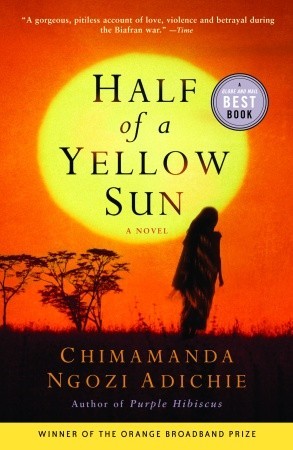
 It came to me as an epiphany as I barreled through the last few pages of this book, blanketed in my Sunday evening lethargy, marveling at Adichie's graceful evocation of a forgotten time and place and feeling the embarrassment of having known nothing about the Biafran war, that somewhere in the Gaza strip the maimed bodies of children must lie strewn amidst the debris of their former lives while vicious debates rage on twitter in which people pick a side - Israel or Hamas - to defend from criticism. As if that's what matters.
Somewhere at this very moment there may be a terror-stricken, weeping child, fleeing to find cover, unaware of what she is running from, unaware of the finality of death, shielded by the caprices of the same history she is living, perhaps. Someday she may grow up well to become another Chimamanda to write the story which is hers to tell, and time, circumstances, and health permitting, I am going to be reading that book and be reminded of the umpteenth 'war' that not even my generation of enlightened, Nobel-peace-prize winning heads of state did enough to prevent, the damage that could have been preempted, and the children who could have grown up to carry the weight of civilization some day but didn't.
The farce of this relentless cycle of mayhem, killing, pillage, rape, and starvation will hit us time and again and yet leaders of the first world will continue to look dapper in their crisp suits and appear dignified while justifying their sale of high-tech weapons to warring parties because revenue is to be earned from the spilling of blood. For the sake of self-made demarcations, for the sake of that ridiculous nonentity called national pride, for the sake of righting wrongs done in the past we'll bury our children and future in mass graves and commit more wrongs.
This book deserves 4 stars in my eyes. It's not a flawlessly written work with its frequent straying into the territory of melodramatic personal relationships and cliched characterization and Adichie's writing seems to lack polish in places. But in no way does that stop this from being a highly important work of fiction that the annals of literature ought to acknowledge with a gleaming appraisal.
This is the past transcending the barriers of time to appear before us in a surely pale imitation of its true grotesqueness. This is Adichie leading us to history of a corner of the world we only associate with food programs, the UNHCR, unstable governments and inexorable ethnic conflicts. This is Adichie telling us that history ignored isn't history blotted out.
I didn't know Biafra at all; there are not enough books on Biafra (as confirmed by Goodreads and Google Books), because only those horrors of war survive oblivion which are fortunate enough to receive the world media's stamp of approval. Not all death and devastation caused by 'civil wars' are worthy of the glory of 'crimes against humanity' like Nigeria's smooth war tactic of starving Biafran children with tacit British support wasn't.
"Starvation propelled aid organizations to sneak-fly food into Biafra at night since both sides could not agree on routes. Starvation aided the careers of photographers. And starvation made the International Red Cross call Biafra its gravest emergency since the Second World War."
But there was a Biafra. Not the transient existence of the nation represented by half of a yellow sun but the reality of the people who, in the paroxysms of misguided idealism, picked the losing side in a war.
Chimananda's Olanna, Ugwu and Richard, all of whom weave their way in and out of manifold conflicts of morality, identity, and survival, serve as our guides in this landscape of kwashiorkor-plagued children with pot bellies while trying to make sense of the muddle of mutual Hausa-Yoruba-Igbo animosity. And along with them the reader navigates the maze of wartime barbarity, political allegiances, and interpersonal relationships with a growing sense of unease and uncertainty - who are the ones truly responsible? who are the perpetrators? who are the victims? what was the war for and what did it achieve?
"Grief was the celebration of love, those who could feel real grief were lucky to have loved. But it was not grief that Olanna felt, it was greater than grief. It was stranger than grief."
In the end any such attempt at such neat compartmentalization makes little difference to the truth of lives destroyed in a fit of murderous passion. In all likelihood, there will be more Biafras and Srebrenicas and Rwanda-Burundis and Syrias and Gazas as there will be the burden of future tragedy and loss to be borne by hapless survivors. But there's the small assurance that there will be the Chimamanda Ngozi Adichies of the world to give a human face to the solemn formality of statistics every time.
First published:-
1999
Star rating:-

There are parts of this book fully deserving of unadulterated love and veneration, worthy of 4 stars in the least. The fact that the real India, Jamaica and Bangladesh are recreated here and not the imagined India, Jamaica and Bangladesh of white writers too reluctant to put in the requisite amount of research for getting the most inconsequential tidbits right has much to do with it. In addition, Zadie Smith succeeds in keenly evoking their history, language, cultural ethos, the stench of their festering old wounds inflicted by an undo-able past, and their bizarre hypocrisies making the leap across land and oceanic borders into alien territory, exempted from being dissected by the scalpel of 'western reason' in the name of minority rights.
There's the undeniable truth of centuries of conditioned servility, hatred of the power which established the ground rules of the abusive relationship called colonialism, and the unfathomable responsibility of bearing the burden of yesterday.
"[] they can't help but reenaact the dash they once made from one land to another, from one faith to another, from one brown mother country in to the pale, freckled arms of an imperial sovereign."
There's the Bengaliness of the family to be religiously guarded against the sallies of Western liberalism; imminent dilution of the much treasured Bengali DNA in the gene pool staved off at all costs. And there's war to be waged on foreign territory - for another inch of land, another notch up on the dignity scale, for yet another step of the socioeconomic ladder. Whenever stung by the prick of casual racism, whenever thwarted, they will go back to their institutionalized tendencies of seeing things in black and white and studiously avoiding mentions of a gray area; they won't think twice before disregarding their favorite Gandhiji's famed 'An eye for an eye will make the whole world blind.' They will seek out the greener pastures of first world optimism but resist synthesis, tugging at the roots of old grudges again and again so that the present and the now can be drawn and quartered on the altar of history.
"And then you begin to give up the very idea of belonging. Suddenly this thing, this belonging, it seems like some long, dirty lie...and I begin to believe that birthplaces are accidents, that everything is an accident."
But then there are the 'just-roll-with-it' parts which deserve no more than 2 stars - the cocksure and smug tone in which the narrator recounts this multi-generational saga of families caught in the chaos of modern day materialism vs heritage, the unrealistic, often two-dimensional characterization and the zany Britcom feel to the episodes which warrants a suspension of disbelief and gives rise to the nagging suspicion that this was written with the idea of a film or tv series adaptation in mind.
As much as Smith's light-hearted, tongue-in-cheek, clever mockery of roots and righteous reliance on said roots for existential validation is absolutely legitimate and spot-on, it is awfully disingenuous to think roots can and should be so easily discarded. Assimilation requires time and the immigration conundrum will never be felt as acutely by second generation immigrants (like Smith herself) as by their progenitors. This is where I prefer Jhumpa Lahiri's narrative voice (her later works) over Smith's - no inflection of moral and intellectual superiority, no pronouncing of judgement on flawed choices but a restrained attempt at humanizing all characters.
Since the 4-star and 2-star ratings are equally bona fide in my eyes, a 3-star it is. More so because I can't remember the last time a woman writer of contemporary literary fiction made me laugh so hard.