Showing posts with label Nigeria. Show all posts

Friday, September 5, 2014

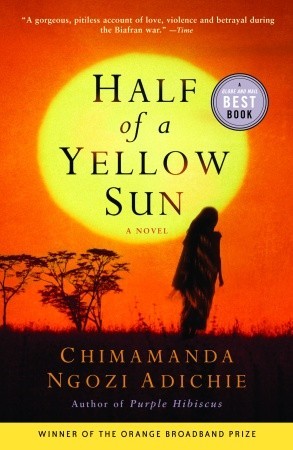
Review: Half of a Yellow Sun by Chimamanda Ngozi Adichie


First published:-2006

Star rating:-

It came to me as an epiphany as I barreled through the last few pages of this book, blanketed in my Sunday evening lethargy, marveling at Adichie's graceful evocation of a forgotten time and place and feeling the embarrassment of having known nothing about the Biafran war, that somewhere in the Gaza strip the maimed bodies of children must lie strewn amidst the debris of their former lives while vicious debates rage on twitter in which people pick a side - Israel or Hamas - to defend from criticism. As if that's what matters.

Somewhere at this very moment there may be a terror-stricken, weeping child, fleeing to find cover, unaware of what she is running from, unaware of the finality of death, shielded by the caprices of the same history she is living, perhaps. Someday she may grow up well to become another Chimamanda to write the story which is hers to tell, and time, circumstances, and health permitting, I am going to be reading that book and be reminded of the umpteenth 'war' that not even my generation of enlightened, Nobel-peace-prize winning heads of state did enough to prevent, the damage that could have been preempted, and the children who could have grown up to carry the weight of civilization some day but didn't.

The farce of this relentless cycle of mayhem, killing, pillage, rape, and starvation will hit us time and again and yet leaders of the first world will continue to look dapper in their crisp suits and appear dignified while justifying their sale of high-tech weapons to warring parties because revenue is to be earned from the spilling of blood. For the sake of self-made demarcations, for the sake of that ridiculous nonentity called national pride, for the sake of righting wrongs done in the past we'll bury our children and future in mass graves and commit more wrongs.

This book deserves 4 stars in my eyes. It's not a flawlessly written work with its frequent straying into the territory of melodramatic personal relationships and cliched characterization and Adichie's writing seems to lack polish in places. But in no way does that stop this from being a highly important work of fiction that the annals of literature ought to acknowledge with a gleaming appraisal.

This is the past transcending the barriers of time to appear before us in a surely pale imitation of its true grotesqueness. This is Adichie leading us to history of a corner of the world we only associate with food programs, the UNHCR, unstable governments and inexorable ethnic conflicts. This is Adichie telling us that history ignored isn't history blotted out.

I didn't know Biafra at all; there are not enough books on Biafra (as confirmed by Goodreads and Google Books), because only those horrors of war survive oblivion which are fortunate enough to receive the world media's stamp of approval. Not all death and devastation caused by 'civil wars' are worthy of the glory of 'crimes against humanity' like Nigeria's smooth war tactic of starving Biafran children with tacit British support wasn't. 

"Starvation propelled aid organizations to sneak-fly food into Biafra at night since both sides could not agree on routes. Starvation aided the careers of photographers. And starvation made the International Red Cross call Biafra its gravest emergency since the Second World War."

But there was a Biafra. Not the transient existence of the nation represented by half of a yellow sun but the reality of the people who, in the paroxysms of misguided idealism, picked the losing side in a war. 
Chimananda's Olanna, Ugwu and Richard, all of whom weave their way in and out of manifold conflicts of morality, identity, and survival, serve as our guides in this landscape of kwashiorkor-plagued children with pot bellies while trying to make sense of the muddle of mutual Hausa-Yoruba-Igbo animosity. And along with them the reader navigates the maze of wartime barbarity, political allegiances, and interpersonal relationships with a growing sense of unease and uncertainty - who are the ones truly responsible? who are the perpetrators? who are the victims? what was the war for and what did it achieve?

"Grief was the celebration of love, those who could feel real grief were lucky to have loved. But it was not grief that Olanna felt, it was greater than grief. It was stranger than grief."

In the end any such attempt at such neat compartmentalization makes little difference to the truth of lives destroyed in a fit of murderous passion. In all likelihood, there will be more Biafras and Srebrenicas and Rwanda-Burundis and Syrias and Gazas as there will be the burden of future tragedy and loss to be borne by hapless survivors. But there's the small assurance that there will be the Chimamanda Ngozi Adichies of the world to give a human face to the solemn formality of statistics every time.


   photo C136E66569D294E4D5DA2D8124D4FF69.png

Sunday, May 11, 2014

Review: Home and Exile by Chinua Achebe

First published:- 2000

Read in:- February, 2014

Star rating:-

'The Empire Writes Back' would have been a fitting alternative title for this essay collection. (Achebe doesn't fail to pay a tribute to Salman Rushdie's essay of the same name published in 1982). Because that is what the running theme here is - a reclamation of a land and a culture that was wrested away with brutal force and made a part of an 'Empire' which still insists on viewing that period as one of glory and not characterized by the worst kind of human rights violation ever. And a heralding of the arrival of the African voice in the world literary scene.

Achebe is slowly turning into my personal literary hero. His wry humor, elegant prose, mildly sardonic tone and passion for social justice exude a righteousness that's hard not to defer to. His writings continue to make me question certain pet notions and ideas that are so deeply ingrained in each one of us that they seem like indisputable facts and consequently evade further introspection. My penchant for unconsciously comparing Latin American, South East Asian and African writing to the style, technique and language of the Americans and Europeans I admire and immediately pronouncing judgement on them on the basis of said parameters has to go away now, I realize.
It doesn't matter if African, Asian and other writers of the Commonwealth (Dear god, why do we have that ridiculous redundant grouping still? is it not there for the sole purpose of reminding us that we were once colonies?) have the same degree of grammatical precision and structural integrity to their English prose as their European and American counterparts. It matters that their voices be heard and universally acknowledged and the overlooked truths, their narratives highlight, be analyzed without bias.

Although this collection consists of 3 essays titled 'My Home Under Imperial Fire', 'The Empire Fights Back' and 'Today, the Balance of Stories' it should be considered a single body of work or discourse intended to dispel certain flawed notions about African people who are often derogatorily referred to as 'tribes' and automatically consigned to a lesser category of humanity. 
Achebe begins with his reminiscences on his early years as a young university student in Nigeria, reading literature based on Africa authored mostly by British and European scholars who, of course, liberally manufactured painfully offensive 'facts' regarding the intellectual and anatomical inferiority of his fellow brethren and propagated the theory that European acquisition of their land and sphere of existence was for the sake of their own personal benefit.

This is what Achebe says about the interlinked nature of inherently racist literature of the time (he is sophisticated enough not to use the word 'racist' even once though) and the Atlantic slave trade:-

"I will merely say that a tradition does not begin and thrive, as the tradition of British writing about Africa did, unless it serves a certain need. From the moment in the 1560s when the English captain John Hawkins sailed to West Africa and 'got into his possession, partly by the sword and partly by other means, to the number of three hundred Negroes,' the European trade in slaves was destined by its very profitability to displace trade in commodities with West Africa."

Achebe directs his suppressed ire at Anglo-Irishman Joyce Cary who was regarded as one of the finest novelists of his time and his creation 'Mister Johnson' which Achebe systematically breaks down and interprets as a text strewn with viciously hateful commentary on Africans. Another renowned novelist and polymath who had considerable first hand experience of Africa, Elspeth Huxley, isn't spared either as her criticism of Amos Tutuola's 'The Palm-Wine Drinkard' as a 'folk tale full of queer, distorted poetry, the deep and dreadful fears, the cruelty, the obsession with death and spirits, the macabre humour, the grotesque imagery of the African mind' comes off as an insidious denunciation of all African literature in general. 
Joseph Conrad, predictably, is his next victim. (Criticism of 'Heart of Darkness' seems like a recurrent theme in Achebe's essays)

Quote from 'Heart of Darkness' -

"Well, you know, that was the worst of it-this suspicion of their not being inhuman."

Achebe's deconstruction-

"A more deadly deployment of a mere sixteen words it would be hard to imagine. I think it merits close reading. Note first the narrator's suspicion; just suspicion, nothing more. And note also that even the faint glimmer of apparent charitableness around this speculation is not, as you might have thought, a good thing, but actually the worst of it! And note finally, the coup de grace of double negation, like a pair of prison guards, restraining that problematic being on each side."

Next in Achebe's line of fire is the ever controversial V.S. Naipaul and his lecture titled 'Our Universal Civilization' delivered at the Manhattan Institute and his caustic and downright obnoxious comments on Asian and African readership and cultures. Achebe brings into focus the difference in attitudes between the Indian-origin Naipaul and the famed Indian writer R.K. Narayan by stating how Narayan saw 'a million stories' every time he looked out of his window and not a 'million mutinies' like Naipaul did.

He ends by hailing story-tellers of repute like Nadine Gordimer (for her literary activism in the backdrop of the Anti-Apartheid movement in South Africa), Wole Soyinka, Amos Tutuola and names like Nigerian Cyprian Ekwensi (People of the City), Guinea's Camara Laye (L'Enfant Noir), Cameroon's Mongo Beti, Ferdinand Oyono (Houseboy), Cheikh Hamidou (Ambiguous Adventure) who have lent enormous credibility to the African literary landscape and have led readers all over the world, to take into account the complementary points of view of the people who had been, so far, deprived of a voice.

"Despite the significant changes that have taken place in the last four or five decades, the wound of the centuries is still a long way from healing. And I believe the curative power of stories can move the process forward."


P.S.:-My rating may be upgraded (or downgraded) in the future based on what I glean from a reading of A Bend in the RiverIndia: A Million Mutinies Now and a re-reading of Heart of Darkness.


   photo C136E66569D294E4D5DA2D8124D4FF69.png

Sunday, September 8, 2013

3 short reviews

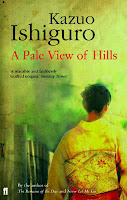
A Pale View of the Hills by Kazuo Ishiguro

Ishiguro's A Pale View of the Hills, despite being his debut, is no less an emotional tale than
his other better known works. It is a delicately woven tapestry of several themes, stitched together by the gift of Ishiguro's masterful but tender story-telling.
Through the eyes of Etsuko, we see a war-ravaged Japan trying to rise from its ashes - torn between the difficult choice of shunning past ideologies which lured it down the path of devastation or holding on to the frail sentimentality of traditions. The narrative switches back and forth between Etsuko's present where she is merely drifting through life in England with a daughter she barely knows and her memories of one particular summer in Japan when she came across a dysfuctional mother-daughter duo. We see women in a changing society who slowly begin to assert themselves, while a passive and pregnant Etsuko merely observes. It's almost as if Etsuko's life itself is an allegory of her homeland during turbulent times, about to undergo a major paradigm shift.
A story of loss, pain, self assertion and the aftermath of war.

4 stars out of 5.

An Image of Africa by Chinua Achebe

Presently, An Image of Africa has 49 ratings and 3 reviews (including mine) on Goodreads.
While Hopes and Impediments: Selected Essays, a compilation of essays by Achebe which contains this famous piece along with a few others, has 109 ratings and 8 reviews.

Which means this particular essay is as unknown and ignored as Heart of Darkness is universally read and worshipped.
This does not however indicate that Achebe has been given the cold shoulder by Goodreaders. (Oh no not at all, he is very popular instead.) 
Merely this that, either most people on Goodreads are not too intent on reading essays or not specifically interested in an African writer's denouncement of a most revered piece of literature written by a European. 
Even a Google search wasn't able to cough up links to coherent reviews of Achebe's essay than a meagre 2 or 3, one of which was posted on a UK based website, which understandably enough, shot down all of Achebe's claims in the same way as the rest of the world may dismiss a threat of nuclear war made by North Korea. 

Sharp, precise, thorough and keen in its deconstruction of Conrad's Heart of Darkness as a piece of mainstream literature fraught with racist implications, An Image of Africa does not only seek to label Conrad as a 'bloody racist' as the description says. (for your information, reader, he uses the word 'thoroughgoing' instead of 'bloody')
Achebe also brings to our notice, the often overlooked aspects of this literary fiction that is read by millions and taught as coursework for literature students worldwide, especially in American universities. Among the numerous critiques of Heart of Darkness, not one exists which points out Conrad's blatant dehumanization of the inhabitants of Africa as a manifestation of an obstinate white sense of superiority. 
Which is why Achebe took it upon himself to write one. 

"A Conrad student informed me in Scotland that Africa is merely a setting for the disintegration of the mind of Mr. Kurtz.

Which is partly the point. Africa as setting and backdrop which eliminates the African as human factor. Africa as a metaphysical battlefield devoid of all recognizable humanity, into which the wandering European enters at his peril. Can nobody see the preposterous and perverse arrogance in thus reducing Africa to the role of props for the break-up of one petty European mind? But that is not even the point. The real question is the dehumanization of Africa and Africans which this age-long attitude has fostered and continues to foster in the world. And the question is whether a novel which celebrates this dehumanization, which depersonalizes a portion of the human race, can be called a great work of art."


I think I ended up highlighting so much while reading that it would have sufficed to just highlight the entire printed text or leave it alone and consider the whole thing highlighted, anyway. 
Achebe's line of reasoning and thought is impossible to slight and makes one see Conrad's much vaunted literary masterpiece in a new light altogether.
But another reading of Heart of Darkness is needed before I can extol the infallibility of Achebe's arguments with more conviction.


4 stars out of 5.

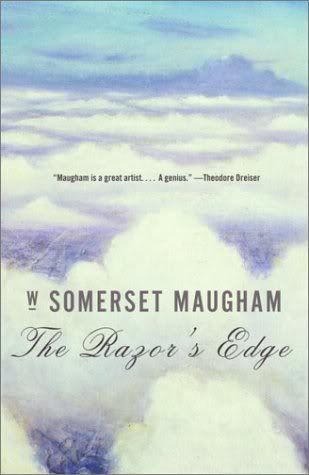
The Razor's Edge by Somerset Maugham


In a nutshell, this contains Maugham's indictment of the culture of materialism, upper class
snobbery and the story of a man's spiritual awakening and search for the true meaning of life. He has analyzed the opposite ends of the spectrum of human existence and juxtaposed themes of kindness and human goodwill along with the basest of human feelings such as contempt and jealousy in a way truly characteristic of a master of the art. But some portions were unnecessarily drawn out. And I felt Maugham's deliberate reveal of himself as a character in the story and as the narrator, didn't add anything to the narrative and instead mellowed down its intensity to a certain extent.

3.5 stars out of 5. 

 photo C136E66569D294E4D5DA2D8124D4FF69.png
Related Posts Plugin for WordPress, Blogger...