Showing posts with label Autobiographical-Biography-Memoir. Show all posts

Sunday, September 21, 2014

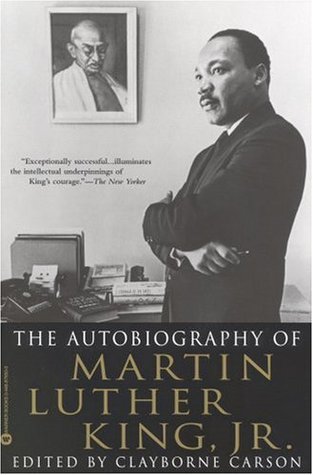
Review: The Autobiography of Martin Luther King, Jr. by Martin Luther King Jr.

First published:- 1998

Star rating:-

I had to keep reminding myself that it's not the civil rights movement I am rating and reviewing, because the spectrum of legitimate excuses, let alone justifications, which could explain the withholding of a star or two is rather limited. It comes as a kick to the gut every time a young, unarmed Clifford Glover or a Travyon Martin or a Michael Brown is shot for no valid reason and the realization sinks in that the process of integration which was initiated by Lincoln some 150+ years ago and furthered by Martin Luther is yet to reach its completion. So the essence of this book and MLK's doctrine of nonviolent agitation are now relevant more than ever. 

In a way this is Martin Luther's own account of the movement he helped steer in a direction which not only sought to free an entire community from socioeconomic and political servitude but prevented America from becoming synonymous with the ultimate hypocrisy of all - preaching the infallibility of human rights abroad (by waging wars against Communist totalitarianism) but carrying on with its tacit agenda of institutionalized discrimination back home. 
"I am convinced that if we are to get on the right side of the world revolution, we as a nation must undergo a radical revolution of values. We must rapidly begin the shift from a thing-oriented society to a person-oriented society. When machines and computers, profit motives and property rights, are considered more important than people, the giant triplets of racism, extreme materialism, and militarism are incapable of being conquered."

How the spirit of rebellion - which found expression for the first time with the Montgomery Bus Boycott in '55 (unwittingly started by Rosa Parks' act of denying her occupied seat to a white passenger) - trickled into the hearts of oppressed millions in Albany, Georgia, Birmingham, Alabama, Florida, Chicago, Boston, and Washington culminating in the passage of the landmark Civil Rights Act of 1964, is recounted by King himself.
That aside, there's a brief autobiographical sketch patched together from the fragments of writings gathered from the Stanford University archive by Clayborne Carson. Excerpts from King's speeches (sometimes even the full text) also make appearances in between the accounts of all the non-violent movements of civil disobedience he gave leadership to. 

To put it more accurately, this is less of an autobiography (since King didn't live long enough to write one) and more like a montage of every single written document or important oratory piece which King left behind. So lucidly written are these that Carson's work must have been reduced to simple editing and piecing together a coherent narrative out of the vast amount of material at her disposal.

And yet there are such glaring mistakes here which marred my reading experience. Consider this excerpt from King's personal writings after his visit to India in '59 which cemented his faith in the inviolability of civil disobedience as an effective tool to usher in socioeconomic and political change -
"On March 1 we had the privilege of spending at the Amniabad ashram and stood there at the point where Gandhi started his walk of 218 miles to a place called Bambi."

It's not Amniabad. In all probability, it's the Sabarmati ashram in Ahmedabad King is talking about, while the historic walk was to 'Dandi' - a coastal village in Gujarat (the state our present PM hails from). Not Bambi, the iconic Disney deer. 

Even if it was a memory lapse on King's part or a sad apathy for geographical names, as a King scholar looking to publish a work of monumental importance Carson should have been more vigilant for inconsistencies such as the above, especially since Gandhi gets mentioned several times by virtue of his being King's role model. 
(Some quick googling led me to the unhappy discovery that the Stanford archive still retains the unedited, therefore, incorrect information derived from the original sources. I can understand the significance of preserving King's writings exactly as he authored them but the insertion of incorrect facts diminishes the integrity of this work.)
Also occasionally 'Gandhi' is spelled as 'Ghandi'. (Aaarrrrggghhhhhh!)

In addition to these turn-offs, nearly all of King's speeches are so chock full of archetypal metaphor after metaphor that I felt it weakened the gravitas of the narrative. Perhaps, they would have been better off being included in shortened formats. The fact of God's mercy and benevolence being invoked (quite natural since King was a pastor) in every alternate sentence also served as an effective irritant. These are undoubtedly the primary reasons why it took me a whole month to finish reading this. 

But these causes of botheration aside, there's plenty of good to be found in this compilation. Like the way MLK expresses his disappointment with 20th century capitalism in a letter addressed to his wife, Coretta -
"...I am not so opposed to capitalism that I have failed to see its relative merits. It started out with a noble and high motive, viz., to block the trade monopolies of the nobles, but like most human systems it fell victim to the very thing it was revolting against. So today capitalism has out-lived its usefulness. It has brought about a system that takes necessities from the masses to give luxuries to the classes."

or his critique of the Vietnam War and correlation drawn between American militarism and the dangerously skewed nature of race relations in the deep south-
"I do not believe our nation can be a moral leader of justice, equality, and democracy if it is trapped in the role of a self-appointed world policeman."

The absence of that missing star, thus, should be attributed to my personal aversion to factual inaccuracies, overused metaphors and bad analogies. Otherwise no rating system in existence can measure MLK's significance in American history and all that he stood for.


   photo C136E66569D294E4D5DA2D8124D4FF69.png

Friday, January 3, 2014

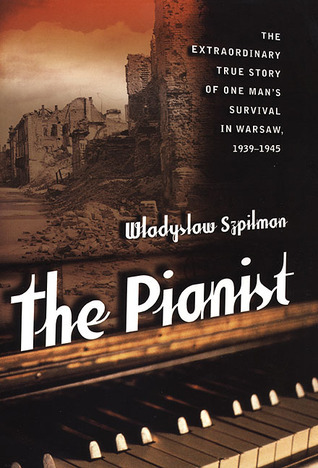
Review: The Pianist by Wladyslaw Szpilman

First published:- 1999
Star rating:- None

This is the first time I am reviewing a book that I have tried and failed to rate.

How do I decide on a rating anyway? Should I judge the prose? the content? the author's style of presentation? his narrative voice? the quality of the translation?
Do I even have the right to? 

Awarding a star rating to this man's unbelievably harrowing and miraculous tale of surviving a war which claimed the lives of 6 million of his fellow brethren for no reason at all, seems a more sacrilegious act than calling Infinite Jest a bad book on Goodreads. 

So I choose not to.

Wladyslaw Szpilman, a pianist working for the Polish radio station, takes us through the years of Nazi occupation of Poland and Warsaw, in particular, and the insensate violence that had the Jewish inhabitants of the city (the ones who were fortunate enough to be spared the concentration camps) living the most brutal and unforgiving of nightmares for a period of almost 5 years.

description
                                                 Wladyslaw Szpilman

Szpilman writes with a kind of unnerving indifference, as if this were someone else's tale of horrors he is narrating and not his own. It is obvious that since he had written this in 1946, immediately after the war, his senses may still have been numbed under the influence of the barbarous acts he had witnessed through the 6 years of the Occupation. His voice doesn't sound sarcastic, debilitated or even a little bit acerbic. Instead, he gives us a neat, uncluttered, unemotional, chronologically ordered account of events which saw him narrowly escaping certain death many, many times.

But this is not just his story. A surprise awaits the unsuspecting reader at the very end, in the form of Wilm Hosenfeld, a Nazi officer who saved Szpilman's life in the last few months of 1944. An astonishingly mild-mannered, generous soul who not only kept the knowledge of Szpilman's existence a secret from the other SS officers, but saved him from certain death out of starvation and the unbearable cold.

But true to the nature of war which justifies countering violence with more violence, Hosenfeld was taken as a prisoner of war when the Soviets finally recaptured Poland. He was tortured to death years later (1952) in some unnamed labor camp in the icy swathes of Stalingrad. His tormentors were especially cruel with him, angered by his claims of having saved the lives of many Jews and Poles during the Warsaw occupation. Which, of course, was nothing but the truth.*

description
                                             Wilhelm Adalbert Hosenfeld

It goes without saying, while reading this book I had no sense of time or any movement around me, I had no idea whether it was still daytime or whether night had fallen. Turning over the last page, when I finally took note of my surroundings I discovered my pillow was half-wet with tears and that I had a dreadful headache.

Some of the most poignant, haunting and reflective passages of the narrative are in Wilm's journal which was recovered years later and incorporated into Szpilman's memoir -

"Evil and brutality lurk in the human heart. If they are allowed to develop freely, they flourish, putting out dreadful offshoots...."

A mere German officer seems to have had the moral strength to admit - 

"Our entire nation will have to pay for all these wrongs and this unhappiness, all the crimes we have committed. Many innocent people must be sacrificed before the blood-guilt we've incurred can be wiped out. That's an inexorable law in small and large things alike."

And yet the "great" Der Führer, in front of whom a vast Empire bowed down at one point of time, could only choose the coward's way out by committing suicide in the end. 

A million stars to the courage of Wladyslaw Szpilman, who aided the Jewish resistance in the Warsaw ghetto, disregarding the constant threat to his own life. A million stars to his unflinchingly honest attempt at looking back at a terrible past. A million stars for enabling the citizens of the world to read, know and derive lessons from the story of his life. A million stars to Wilm Hosenfeld for holding on to his conscience at a time when morality and compassion were in short supply. 

And a million stars to the triumph of the human spirit. 

(So you see the correct rating of this book should be 5 million stars which is beyond the scope of any conventional rating system.) 

*Wilm Hosenfeld was posthumously recognized as a Righteous among the Nations in 2009 by Israel.

P.S.:- This review maybe updated after I watch the movie.


   photo C136E66569D294E4D5DA2D8124D4FF69.png

Sunday, December 29, 2013

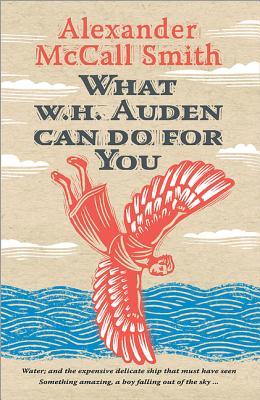
Review: What W.H. Auden Can Do For You by Alexander McCall Smith

First published:- 2013
Published by:- Princeton University Press

Star rating:-


How should we like it were stars to burn 
With a passion for us we could not return? 
If equal affection cannot be, 
Let the more loving one be me.


My association with W.H. Auden and his literary output has been restricted to the occasional browsing through poets.org which gave rise to a somewhat fickle love for Lullaby (which I couldn't help but read more than once) and As I walked Out One Evening. But somehow the lines faded away from memory as soon as I closed the browser window, sometimes mere beautiful words and perfect cadence aren't sufficient to stimulate further intellectual curiosity. But Alexander McCall Smith's near fanboyish enthusiasm for one of the greatest English poets of the 20th century has forced me to reconsider my views on Auden and maybe even provided the much needed push to delve into his oeuvre further.

This is not literary criticism per se, but rather a mixed bag of Smith's views on the poet's personal life, his body of work and the way his worldviews figured in his poetry. It goes without saying, literature students may find this book vastly redundant as it contains nothing that hasn't already been recorded by academicians who have analyzed and dissected Auden's poetry from all probable angles. And Smith acknowledges this right at the beginning, very clearly stating that his intention behind writing this has been to offer a tribute to Auden who was, in a way, his personal literary icon.

There are separate chapters devoted to Auden's early years at Gresham's School, another one in the long tradition of stiff upper-lipped English boarding schools, and later at Oxford, his lifelong friendship with Christopher Isherwood who had been inspired to write the renowned Goodbye to Berlin after Auden's visit to Berlin in 1928, his homosexual dalliances, his desire to drive an ambulance during Spanish Civil War which resulted in one of his celebrated, but subsequently disowned, poems 'Spain'(vehemently denounced by George Orwell who of course was accredited with a deeper understanding of the politics of the Civil War), his growing admiration for socialism in the wake of the rise of fascism in Europe prior to the Second World War and his eventual disillusionment with Communism. 

Auden's poetry is widely criticized as a hollow compilation of sublime imagery and flowery writing with little to no depth but Smith, in the tradition of most Auden lovers, defends the sanctity of his work with assertions like the following:- 

"'In Praise of Limestone' contributes greatly to the appeal of what he wrote. It is easy on the ear - and ease here has no pejorative implications: the fact that something is easy to listen to does not make it less intellectually significant."

"There are plenty of poets, especially those given to the writing of confessional verse, who are ready to tell us about their particular experience of love. We listen sympathetically, and may indeed be touched or inspired by their insights. But few poets transcend the personal when talking about love. They are talking, really, about how they felt when they were in love; Auden digs far deeper than that. He talks about love and flesh as it can be experienced by all of us - he transcends the specific experience in a particular place and time, to get to the heart of what we are."

Smith also makes a significant point in regard to Auden's disposition as a poet, he was known to acknowledging misrepresentations of facts in his earlier poems instead of quietly hoping for the work in contention to be erased from public memory like the other writers of his time did. He humbly acknowledged whenever he was wrong and was extremely self-critical.

To conclude, this is a fine book to gift to the random Auden devotee and perfect for introducing Auden to a neophyte who knows virtually nothing about the great Anglo-American poet (like myself for instance).


Also published on Goodreads and Amazon.
   photo C136E66569D294E4D5DA2D8124D4FF69.png

Tuesday, October 8, 2013

Review : Orlando by Virginia Woolf

The most prudent way to review a Virginia Woolf book, perhaps, would be to write 'READ THIS  BOOK. IT'S STUPENDOUS. GENIUS. AMAZING. WHY HAVEN'T YOU READ THIS YET?' and leave it at that. Because not only does this relieve you of the responsibility of casting about for appropriate words to serenade Woolf but also because you know no review in the world does justice to the sheer magic that she is capable of creating with words.
But since I have a thing for self-flagellation (not really) I wish to undertake precisely this mammoth task of writing about Orlando.

After having closed the book and put it aside, the first predominant emotions are that of being overwhelmed by the all-encompassing nature of its inherent themes, then awestruck, then of being very close to tears.
One is compelled to sit quietly in a corner, still under the heady influence of Orlando's poetic stream of thoughts, and brood over all the discrete human sentiments, actions and events that make up life as we know it, letting precious minutes trickle by.

Our hero-heroine, Orlando, seems not only to be a representation of the human spirit, a union of yin and yang in all its imperfect glory, but also a lasting testament to the perpetual flow of time. His-her pronouncements sound almost like a chorus of voices, echoing all the dichotomies that characterize our existence and the transience of our emotions.
Orlando begins the journey of life as a man of wealth and social standing in Elizabethan era England, comfortable in the skin of his vanity, amorous in his dalliances with women. And the book ends on 11th of October, 1928, in modern England where Orlando is a married woman, a mother, an accomplished writer and finally at peace with life's many ironies and caprices. I will refrain from going into all that takes place between these two distant points in time because for that one can always read the book.

It will suffice to say that Orlando swings back and forth between craving and shunning love, between pursuing his-her literary interests and trivializing the urge to write, between seeking the august company of men of letters like Pope, Addison and Swift and then belittling them. And even though hundreds of years pass by as Orlando goes through the many myriad experiences that life had in store for him-her, it seems like everything has remained essentially the same. The reader is struck by a sense of passivity in motion, of an enduring constancy even though the sights and sounds and scenarios, that Orlando flits through, keep varying.

Thus in a way Orlando is not different from Woolf's other works just because of the noticeable absence of a stream of consciousness(which, again, is not totally absent here) but because here, she attempts to grasp at an amorphous entity like time and enclose it within the pages of this gem. And I am mightily pleased to say that she pulls it off with an elan, one associates only with her.
What makes Orlando really stand out among other VW works is the dual gender of its protagonist. Orlando keeps oscillating between his-her manly and womanly bearings and towards the very end, what nullifies the differences between the sexes is his-her humanity, his-her detachment from the material world and a crossover into the realm of the spiritual.

"The whole of her darkened and settled, as when some foil whose addition makes the round and solidity of a surface is added to it, and the shallow becomes deep and the near distant; and all is contained as water is contained by the sides of a well. So she was now darkened, stilled, and become, with the addition of this Orlando, what is called, rightly or wrongly, a single self, a real self."

The narrative does seem a bit disjointed at certain points, especially when Woolf foregoes conventions and goes into intricate detailing of events which seem of little importance in the greater scheme of things or inserts her witty observations on society's prejudices concerning women, chastity and more.

"Orlando, who was a passionate lover of animals, now noticed that her teeth were crooked and the two front turned inward, which, he said, is a sure sign of a perverse and cruel disposition in women, and so broke the engagement that very night for ever." 
"I am she that men call Modesty. Virgin I am and ever shall be. Not for me the fruitful fields and the fertile vineyard. Increase is odious to me; and when the apples burgeon or the flocks breed, I run, I runl I let my mantle fall. My hair covers my eyes, I do not see. Spare, O spare!"
 "Truth come not out from your horrid den. Hide deeper, fearful Truth. For you flaunt in the brutal gaze of the sun things that were better unknown and undone; you unveil the shameful; the dark you make clear, Hide! Hide! Hide!"

See what I mean? This is probably Woolf at her funniest and wittiest. So not a single sentence or passage can be devalued even though it may appear a little out of place or slow down the progress of the narrative.

In essence, Orlando is a summation of all the irrepressible instincts of both the man and woman - their quest for knowledge, their search for meaning in chaos, their feelings of inferiority aroused by the vastness of the universe and their desire to find an eternity trapped within their brief lifetimes.

5 out of 5 stars.

 photo C136E66569D294E4D5DA2D8124D4FF69.png

Monday, September 2, 2013

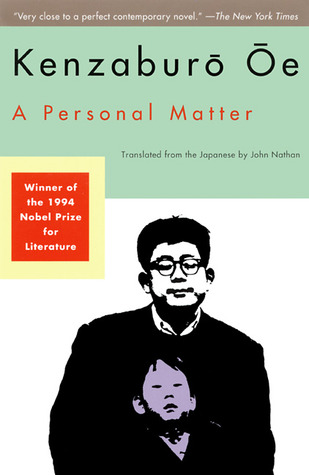
Review : A Personal Matter by Kenzaburō Ōe

(Original review posted on Goodreads:- May 29, 2013)

Reading this book is nothing short of an agonizing experience.
It almost feels like somebody poking at and opening up our most secret, suppurating psychological wounds and making them bleed all over again, thereby compelling us to wake up to the realization of their existence.
These scars and bruises make their presence known time and again by causing us pain of the highest order. And so we proceed to wrap them up in the protective wadding of false pretensions, carefully hiding them away from the scrutiny of the rest of the world and more importantly, ourselves.
But Kenzaburo Oe does not only wish to cause us pain. He also forces us to acknowledge its perpetuity, accept it and achieve a state of harmony with it.

With every turn of a page, we find ourselves plunging deeper into the bottomless pit of shame, self-loathing and sheer grief along with Bird, our protagonist. But Oe breaks our fall right when we feel we are about to land with a resounding thud and teaches us how to rise, how to summon the courage to confront grim reality and reconcile ourselves with the cruelties inflicted by fate.

Bird (nickname), a young man of twenty seven, keeps drifing in and out of consciousness throughout the length of the narrative. While walking along a busy Tokyo street he is capable of sparing a thought for his pregnant wife experiencing labour pains at the hospital and alternately seeking escapism in the form of dreaming about landscapes of Africa, a continent he desperately wishes to visit some day. He neither seems to feel passionately about his wife nor about the job at the cram school he has landed thanks to the benevolence of his father-in-law. In a sense, he is apathetic to his own life but we are shown that he is not immune from feelings of embarrassment.
Weak-willed and jittery, he refuses to accept the birth of a child with a grotesque lump on its head and crucial genetic deformities. He is appalled to hear his baby would never grow up as a normal child and shamelessly gives in to feelings of utter relief, when he hears from the doctor that chances of his baby's survival are next to none. Although immediately afterwards, he suffers from a keen self-hatred.

During the course of the next few days, like the most cowardly criminal ever, he plots his own baby's murder - by conspiring with the doctor to substitute his supply of milk with sweetened water and, when that fails, by taking the baby to the clinic of a shady abortionist. Yet at the same time he shudders in revulsion at the thought of having to kill a helpless, sick child with his bare hands. He fears being in the presence of his wife and mother-in-law both of whom seem to blame him for everything, and seeks solace in violent sex with an old lover.
Thus, Bird, seems to possess no redeeming characteristics whatsoever. He is a failure at life and everything he does. He is selfish to the point of entertaining ideas of running away with his lover to Africa, abandoning all his responsibilities. He only views his biological child as an oddly assembled, defective mass of flesh, blood and bone. He refuses to give him a name or even acknowledge his gender and burden himself with the task of acquainting himself with his newborn son.
Bird is despicable in the true sense of the term.

But then at the same time, Bird is also the very personification of all our worst human weaknesses. He disgusts the reader but he also evokes feelings of sympathy and solidarity.
Because if we maybe honest enough with ourselves, there's a Bird in each one of us and his deformed baby is a symbol of the indignities of our own personal existence.
Slowly as the days trickle by after the birth of the unwanted child, Bird starts viewing the entity he repeatedly refers to as 'the monster baby', as a human offspring blessed with the powers of sensation and expression. It seems this indisputable fact had eluded him so far.
Thus begins Bird's gradual transformation, which the reader witnesses with mixed feelings. As he comes full circle, traversing the seemingly infinite distance between madness and sanity, so does the reader.
And when he finally finds hope in a hopeless place and begins the long, convoluted process of acceptance, it is not the predictability of this ending which strikes us.
Rather, we are moved by the truth in Bird's realizations and actions.

Oe has written about such a deeply personal aspect of his life (being the father of a brain-damaged son himself) with a mastery, truly characteristic of a  Nobel Laureate. His writing isn't wordy or verbose yet it hits the reader's most sensitive, vulnerable spot every time and makes one feel raw and cut up deep inside.

"The baby was no longer on the verge of death; no longer would the sweet, easy tears of mourning melt it away as if it were a simple jelly. The baby continued to live, and it was oppressing Bird, even beginning to attack him. Swaddled in skin as red as shrimp which gleamed with the luster of scar tissue, the baby was beginning ferociously to live, dragging its anchor of a heavy lump."

He does not want us to shed copious tears at the misfortunes that befall Bird or feel only an acute hatred for his indecision, but experience the entire gamut of human actions and emotions, no matter how blasphemous or conventionally unacceptable each one of them maybe.
In slow succession, the reader becomes-
Bird, the indifferent cram school teacher.
Bird, the day-dreamer.
Bird, the miserable failure of a man.
Bird, the conspiring murderer.
Bird, the unfaithful husband.
And at the very end, Bird, the accepting father.

As one plows along, it becomes apparent that Oe's aim has not been self-indulgent or cathartic story-telling, but instead, to take the whole world along on an immensely difficult journey, he must have embarked on all alone at some point.

Thus, A Personal Matter, ceases to be merely about a personal matter somewhere. Instead, it transforms into one of the most life-affirming stories ever, meant to serve as a universal panacea for the ones suffering from the affliction of an undignified existence.
Oe knows all too well, that he cannot make the pain go away. So he gifts us with the strength to endure it, instead.

5 out of 5 stars.


 photo C136E66569D294E4D5DA2D8124D4FF69.png
Related Posts Plugin for WordPress, Blogger...