First published:-
1980
Star rating:-
 It is impossible to read this and not be reminded of an almost genetically programmed inferiority complex, the burden of history only the descendants of the colonized have to bear. Despite those smug pronouncements of the 21st century being an era of a fair and equitable world and the hard battles won in favor of interracial harmony, there's the fact of your friend barely suppressing a squawk of alarm when you express your admiration for Idris Elba - no female I am acquainted with in real life has learned to wean herself away from the fixation with a white complexion. Scrub your skin raw till it bleeds but never fall behind in the race to make it whiter because that's the color the world approves of. You can fawn over Simon Baker's blonde, light-eyed glory but not over Elba's hulking, ruggedly handsome perfection; heaven forbid you prefer the latter over the former. The 21st century is yet to cast its magic spell over the standards of physical beauty.
So if I, a citizen of a purportedly newer and better social order, can still feel the rippling aftershocks of the catastrophe called Imperialism from across the barrier of decades and centuries, what would a man like Coetzee have experienced, stranded in the middle of the suffocating sociopolitical stasis of Apartheid? Moral anguish? A bitter impotence? A premonitory sense of doom? Anger?
Fiction, I believe, must have been his preferred method of exorcizing these demons. And purge these emotions he did through the composition of this slim little novel which can be aptly described as a most heart-wrenching lament on the condition of the world of his times.
It may be true that the world as it stands is no illusion, no evil dream of a night. It may be that we wake up to it ineluctably, that we can neither forget it nor dispense with it. But I find it as hard as ever to believe that the end is near.
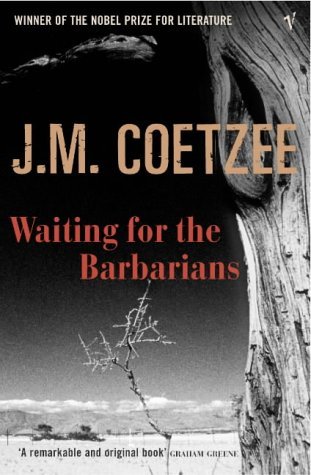
An anonymous magistrate stationed at a farthest corner of an unspecified Empire witnesses the death throes of its reign while recovering his own humanity at the loss of his position of power and influence. In the beginning he is convinced of his righteousness as a dutiful servant of the Empire who oversees the welfare his subjects with moderation but with the arrival of a bluntly tyrannical figure of authority whose methods differ vastly from his, he begins to question his own collusion in the maintenance of an unnatural order. Unable to stand as a mute witness to the horrendous abuse inflicted on innocent 'natives' on the false suspicion of their complicity with 'barbarians' or armed rebels who threaten the stability of the Empire, he clashes with the aforementioned administrator who undoubtedly represents the true face of any oppressor when divested of its sheen of sophistication. And thus begins his fall from grace culminating in a kind of metaphorical rebirth through extreme physical abasement.
I was the lie that Empire tells itself when times are easy, he the truth that Empire tells when harsh winds blow. Two sides of imperial rule, no more, no less.
In the fashion of Coetzee's signature didacticism the novel is rife with allegorical implications but as much as these can be deeply thought-provoking, sometimes they also resemble conveniently inserted contrivances. Like the pseudo-erotic entanglement that develops between the ageing magistrate and a young 'barbarian' girl who is left maimed and partially blinded after a violent bout of interrogation is amply demonstrative of a colonizer-colonized arrangement - the one bereft of power to drive the relationship in a desired direction becomes dependent on the volatile benevolence of the other party. Or the mounting paranoia about the anticipated attack of the 'barbarians' who, much like Godot, fail to appear and remain a myth till the end although emerging as the key factor hastening the impending demise of Empire. All the layers of meaning and symbolism could send a dedicated literature student into paroxysms of pleasure no doubt.
With the buck before me suspended in immobility, there seems to be time for all things, time even to turn my gaze inward and see what it is that has robbed the hunt of its savour: the sense that this has become no longer a morning's hunting but an occasion on which either the proud ram bleeds to death on the ice or the old hunter misses his aim; that for the duration of its frozen moment the stars are locked in a configuration in which events are not themselves but stand for other things.
Wary as I am of Coetzee's often stilted world-building, my 5-star rating was an inevitability given my obsession with narratives containing a discernible vein of literary activism in harmony with notions of social justice. Here he also seems to have successfully reined in his pesky habit of turning his characters into sockpuppet-ish mouthpieces to tout his own passage-length worldviews. The narrator does occasionally morph into a pedagogue but his inner monologues never seem out of place given his unique circumstances. Besides it takes courage to acknowledge the fact of white man's guilt in a world which is yet to discard the rhetoric of 'white man's burden'.

First published:-
1998
Star rating:-

I had to keep reminding myself that it's not the civil rights movement I am rating and reviewing, because the spectrum of legitimate excuses, let alone justifications, which could explain the withholding of a star or two is rather limited. It comes as a kick to the gut every time a young, unarmed Clifford Glover or a Travyon Martin or a Michael Brown is shot for no valid reason and the realization sinks in that the process of integration which was initiated by Lincoln some 150+ years ago and furthered by Martin Luther is yet to reach its completion. So the essence of this book and MLK's doctrine of nonviolent agitation are now relevant more than ever.
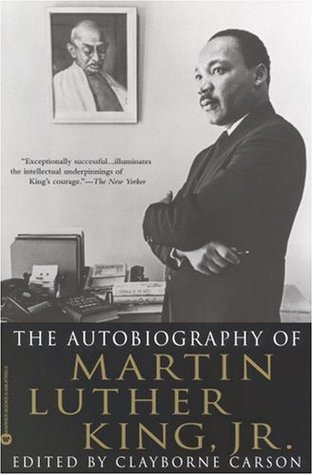
In a way this is Martin Luther's own account of the movement he helped steer in a direction which not only sought to free an entire community from socioeconomic and political servitude but prevented America from becoming synonymous with the ultimate hypocrisy of all - preaching the infallibility of human rights abroad (by waging wars against Communist totalitarianism) but carrying on with its tacit agenda of institutionalized discrimination back home.
"I am convinced that if we are to get on the right side of the world revolution, we as a nation must undergo a radical revolution of values. We must rapidly begin the shift from a thing-oriented society to a person-oriented society. When machines and computers, profit motives and property rights, are considered more important than people, the giant triplets of racism, extreme materialism, and militarism are incapable of being conquered."
How the spirit of rebellion - which found expression for the first time with the Montgomery Bus Boycott in '55 (unwittingly started by Rosa Parks' act of denying her occupied seat to a white passenger) - trickled into the hearts of oppressed millions in Albany, Georgia, Birmingham, Alabama, Florida, Chicago, Boston, and Washington culminating in the passage of the landmark Civil Rights Act of 1964, is recounted by King himself.
That aside, there's a brief autobiographical sketch patched together from the fragments of writings gathered from the Stanford University archive by Clayborne Carson. Excerpts from King's speeches (sometimes even the full text) also make appearances in between the accounts of all the non-violent movements of civil disobedience he gave leadership to.
To put it more accurately, this is less of an autobiography (since King didn't live long enough to write one) and more like a montage of every single written document or important oratory piece which King left behind. So lucidly written are these that Carson's work must have been reduced to simple editing and piecing together a coherent narrative out of the vast amount of material at her disposal.
And yet there are such glaring mistakes here which marred my reading experience. Consider this excerpt from King's personal writings after his visit to India in '59 which cemented his faith in the inviolability of civil disobedience as an effective tool to usher in socioeconomic and political change -
"On March 1 we had the privilege of spending at the Amniabad ashram and stood there at the point where Gandhi started his walk of 218 miles to a place called Bambi."
It's not Amniabad. In all probability, it's the Sabarmati ashram in Ahmedabad King is talking about, while the historic walk was to 'Dandi' - a coastal village in Gujarat (the state our present PM hails from). Not Bambi, the iconic Disney deer.
Even if it was a memory lapse on King's part or a sad apathy for geographical names, as a King scholar looking to publish a work of monumental importance Carson should have been more vigilant for inconsistencies such as the above, especially since Gandhi gets mentioned several times by virtue of his being King's role model.
(Some quick googling led me to the unhappy discovery that the Stanford archive still retains the unedited, therefore, incorrect information derived from the original sources. I can understand the significance of preserving King's writings exactly as he authored them but the insertion of incorrect facts diminishes the integrity of this work.)
Also occasionally 'Gandhi' is spelled as 'Ghandi'. (Aaarrrrggghhhhhh!)
In addition to these turn-offs, nearly all of King's speeches are so chock full of archetypal metaphor after metaphor that I felt it weakened the gravitas of the narrative. Perhaps, they would have been better off being included in shortened formats. The fact of God's mercy and benevolence being invoked (quite natural since King was a pastor) in every alternate sentence also served as an effective irritant. These are undoubtedly the primary reasons why it took me a whole month to finish reading this.
But these causes of botheration aside, there's plenty of good to be found in this compilation. Like the way MLK expresses his disappointment with 20th century capitalism in a letter addressed to his wife, Coretta -
"...I am not so opposed to capitalism that I have failed to see its relative merits. It started out with a noble and high motive, viz., to block the trade monopolies of the nobles, but like most human systems it fell victim to the very thing it was revolting against. So today capitalism has out-lived its usefulness. It has brought about a system that takes necessities from the masses to give luxuries to the classes."
or his critique of the Vietnam War and correlation drawn between American militarism and the dangerously skewed nature of race relations in the deep south-
"I do not believe our nation can be a moral leader of justice, equality, and democracy if it is trapped in the role of a self-appointed world policeman."
The absence of that missing star, thus, should be attributed to my personal aversion to factual inaccuracies, overused metaphors and bad analogies. Otherwise no rating system in existence can measure MLK's significance in American history and all that he stood for.
First published:-
2000
Star rating:-
 Some books are very obviously flawed, contrived in ways which slow down the reader's progress and heavily tax his/her ability to dredge up empathy over the headache-inducing frenzy of loaded work-weeks. And yet these narratives are so divine in their earnestness, so far-reaching in their scope, that you are filled with this overwhelming, earth-shattering zeal to shower them with a holy love and not let even a drop of your skepticism dilute your admiration for the writer's boldness. Your cowardice and inaction dictate you honor his unstated wish and this is the least you can do anyway. Embrace it all - the two-faced treachery perpetuated by the torchbearers of civilization, the endless cycle of degradation and corruption and the myriad sorrows of all the characters which bleed into its pages. Take one swig after another from the truth flask until you have been purged of all your self-indulgent guilt-trips and left with nothing but a crushing hopelessness which devours all other emotions with a vindictive fury.
There's us, cocooned in the warm illusion of security, dissecting the politics of injustice from our ivory towers, wholly in denial of our bubble of happiness feeding off the despair of others. In an effort to scramble toward whatever glamourous concept of affluence it is we consider salvation, we do not see the charred wreckage of lives strewn all around.
There's the woman of flesh and bone who becomes a grotesque assimilation of mere genitals, who can only be an abstract embodiment of the abuse with no human face - a walking, breathing cunt for hire whose existence you acknowledge only when you require its use. Every once in a while she leaves crack-addicted babies with no fathers in the maze of foster care or dumps them like inanimate blobs of flesh in seedy abortion clinics. She only lives in those documentaries harbouring Oscar-nomination ambitions, at the precipice of our segregated utopias merging with the abyss of the Tenderloins of the world. And the sanctimonious laws state with conviction, that the Tenderloins and the red light areas do not exist.
There are the hobos, the panhandlers, the bums, the destitute - not allowed to be anything other than victims of their own ineptitude, worthy of a stray sympathetic glance and a few seconds of pity, to be religiously warded off our vaunted inner sanctums. There is Henry Tyler, a pathetic loser bearing the Mark of Cain, wallowing in eternal self-pity, choosing to live as a homeless man to find his Queen, his antidote to a desiccating loneliness. And then there's the Queen of the Whores with her magical powers and her crack pipe - just an emblem, a protector, a redeemer, a guardian angel, a modern day Jesus - and law-abiding respected founder of 'Feminine Circus' Jonas Brady, with his multi-million dollar franchise of selling men the right to rape, torture, and mutilate disabled girls, her nemesis.
They are all actors in an absurd pantomime. They are all real.
'Part biblical allegory and part skewed postmodern crime novel', the blurb announces with relish. But that doesn't even skim the surface of this tome.
I call this Vollmann's gift to the perpetual outcasts of society, the ones we have pushed so far beyond the edge bit by bit in our own mad dash for the center that they exist in a kind of parallel netherworld where all humanly concerns are put to rest, where violence and deprivation are the order of the day. I call this his sincerest attempt at chronicling their stories the way they may have approved of, however alien to our feral cravings for taint-free reputations, routine and fake dignity, however repulsive to our faux-fragile sensibilities. I call this a searing critique of the hypocrisy of the ones holding the reins of the civilized world, who would sputter with mock indignation when asked to legalize prostitution.
However small or insignificant, I call this book an act of redemption.
First published:-
1978
Star rating:-
 These poems are like shards of glass refracting the blurred image of some sombre new insight into the human condition - the agony of love, the pangs of coming to grips with the idea of racial segregation in a world one previously thought had no demarcations, the pervasive pessimism of living as reaffirmed by the morning newspaper, an elegy to the memories of a childhood friend whose time on earth ran out too soon, the melancholic ruminations of a prostitute, the absurdity of children of today being raised like slaughterhouse pigs to be sent to the war-front tomorrow.
Coming in and out of cities
untouched by their magic
I think without feeling
this is what men do
who try for some connection
and fail
and leave
five dollars on the table.
If the annals of literature are to be consulted, most of these are time-worn subjects which other more renowned poets have regurgitated throughout their distinguished careers, after molding them in accordance with their perceptions of the world and its many idiosyncrasies. And yet Audre Lorde's words, imbued with despondency, regret, hope and fortitude at the same time, tempt you to read them again and again. Her lines flow effortlessly despite their innate simplicity, maintaining an enviable rhythmic symmetry, rendering the reader's tendency to puzzle over esoteric references unnecessary since there are almost none.
There are a handful of poems here, in praise of the female and androgynous forms of divinity worshipped by the inhabitants of the historical kingdom of Dahomey and the Yoruba people of western Nigeria, which bring to light the oft-overlooked aspects of the cultural ethos of African people. But there's a conveniently provided glossary of African terms at the end to better facilitate complete understanding of these.
You were not my first death.
but your going was not solaced by the usual
rituals of separation
the dark lugubrious murmurs
and invitations by threat
to the grownups' view
of a child's inelegant pain
so even now
all these years of death later
I search through the index
of each new book
on magic
hoping to find some new spelling
of your name
The implications hidden between her verses do not reinforce a kind of self-obsessed confessionalism as often found in Sylvia Plath or Anne Sexton's works or the heavy-handed inclusion of so many allusions that the poet's urge to communicate is buried under towering ambitions of dismantling poetic conventions.
Sometimes, her words give the impression of mildly cryptic messages casually scribbled at the back of a notebook, perhaps, while she may have been staring out of her window distractedly. Sometimes, they are her anguished lament, her impassioned protest, wrenched out of her by the brutality of the world or the injustice perpetually dished out to those clinging to the lowermost rungs of the societal ladder for dear life. Her 'Power', one of the most influential and well-known poems from her entire oeuvre, simmers with a righteous rage, intense enough to blow a hole through the edifice of 'white supremacist patriarchy' aside from being a tribute to the memory of young Clifford Glover, a 10-year-old African American boy shot dead by a white cop on duty in South Jamaica, Queens, New York in '73, who was later acquitted by a white-majority jury with a single black female judge.
Today that 37-year-old white man with
13 years of police forcing
has been set free
by 11 white men who said they were satisfied
justice had been done
and one black woman who said
"They convinced me" meaning
they had dragged her 4'10" black woman's frame
over the hot coals of four centuries of white male approval
until she let go of the first real power she ever had
and lined her own womb with cement
to make a graveyard for our children.
Lorde remains one of the few poets in American history who had to contend with the tyranny of conforming to the demands of too many labels conferred on persecuted minorities - black woman in a white man's world, radical feminist, lesbian, civil rights activist. And yet she managed to breach the boundaries of these individual identities by singing in a richly resonant voice whose musicality still holds the power of bridging gaps, relaying the stories of the voiceless and the marginalised, healing the scars left by turbulent times and smoothening out our countless differences across continents and timelines.
In my eyes, that makes her a hero more than a poet.
____