Showing posts with label Religion-Spirituality. Show all posts

Friday, February 19, 2016

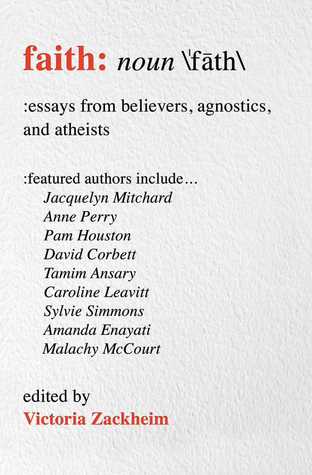
Review: Faith: Essays from Believers, Agnostics, and Atheists (edited by Victoria Zackheim)

First published:- February, 2015

Star rating:-

2.5/5

There was a time when I was still an optimistic seeker of doctrinal wisdom blissfully entertaining the certainty that there would at least be one religious doctrine fashioned by humans in the whole wide world which would not delight in depriving members of one half of the human race of any political and social standing. I was naive then. My ardor in this regard cooled considerably once I came across information that even Buddha helpfully classified seven kinds of wives (as recorded in the Anguttara Nikaya found within the Sutta Pitaka) of which the wife who meekly takes a beating from her husband, never argues back and remains as slavish as possible is defined as the ideal one. 

So is there any organized religion in the world which does not cheerfully preach, propagate and advocate misogynistic ideas and practices? If there is, do let me know. Meanwhile, I delight in evolving my personal belief systems to deal with pangs of short-term nihilism and remaining as religion-free as possible even though, to my dismay, every time I'm required to fill a government-printed form, I am hard-pressed to tick the 'Hindu' box. 

Organized religion has all the elements of organized crime, except for compassion. If you offend a crime boss who has no compassion, he will have you beaten up and sometimes killed. If the crime boss wants you to go to hell, he will have you killed after you have committed a sin so you have had no time to repent (i.e. you get yours as you leave a whorehouse or have just eaten pork, or have neglected to kill a female relative who has disgraced the family). Organized religion, however, does show some compassion. Still, in my mind, crime bosses and the guy called God have a lot in common: revenge, rage, and punishment are essential to their mission.

I requested this collection on Netgalley expecting to discover other, disparate ways of viewing faith and institutional religion and maybe challenging discussions on the intersection between religious philosophy and recent developments/intelligent speculation in the domain of astrophysics and the cosmo-sciences but nope. Instead what I got was a collection of maudlin musings on life and its trials and tribulations. It doesn't help either that most of the writers were raised in a Judeo-Christian tradition which means most of the articles lose their sheen of novelty after a while with similar anecdotes of childhood rites of initiation into a state of knowledge about organized religion re-appearing time and again. Catholic school, baptism ceremonies, obsession with collecting Virgin Mary statues, bar mitzvah experiences, traumatic memories of having to endure indoctrination at an early age and so on and so forth. A majority of the believers narrate experiences of dealing with life-threatening situations and losing loved ones to cancer and other terminal illnesses which is perfectly understandable because nobody really seeks out 'God' unless hardships and despair wrestle their way into life but after a while these reminiscences just wore me out. 
And then there are the more ridiculously cringe-worthy interpretations of faith - one contributor literally going on and on about her miserable love life and the fact that no man wants to be with her for the long haul. 

For believers, Faith is a remedy; for atheists, it's a smoke screen obscuring as shameful the essence of being human: our fallibility.

The only essays which made any impression were by Tamim Ansary, Amanda Enayati, and Aviva Layton. All of them are secular humanists/decriers of institutional religion of course but that does not mean their writings do not showcase a keen interest in giving the benefit of the doubt to all sides of the debate. Ansary, who identifies as a secular mystic, refreshingly does not go into saccharine-flavored tales of personal woes and triumph, instead choosing to recount a simple anecdote about a few moments spent in the heart of nature with his youngest daughter which helped him appreciate the fact that to be alive, for however brief a blink in the unending spiral of time, is to be close to the mystery of all creation. Amanda Enayati's touching piece documents her tryst with a most harrowing period in the history of Iran in an almost Marjane Satrapi-ish fashion except her voice is devoid of the latter's signature humor. Another plus was getting to know about the surprisingly liberal tenets of the Bahá'í faith, a minority monotheistic sect whose members were ruthlessly persecuted during the Iranian Revolution of '79. Aviva Layton's ruminations held nothing special unless one counts her wonderfully unsentimental description of the aftermath of personal loss and her logically argued repudiation of superstitious ideas about heaven and hell.

To conclude, it's not like all the other remaining essays were completely unpalatable or anything but the very fact that I scarcely remember anything about them speaks for itself.


__

Also posted on Goodreads & Amazon.


 photo C136E66569D294E4D5DA2D8124D4FF69.png

Friday, June 26, 2015

Review: Middlemarch by George Eliot


First published:- 1872

Star rating:-

First read:- April-May, 2015


Take this for granted. Middlemarch will haunt your every waking hour for the duration you spend within its fictional provincial boundaries. At extremely odd moments during a day you will be possessed by a fierce urge to open the book and dwell over pages you read last night in an effort to clarify newly arisen doubts -'What did Will mean by that? What on earth is this much talked about Reform Bill? What will happen to poor Lydgate? Is Dorothea just symbolic or realistic?'
And failure to act on your impulses will give rise to irritation. The world all around you will cease to matter and you will be forced to perform everyday tasks on autopilot mode, partly zombified, completely at the mercy of this wonderful, wonderful book. Even hours after you turn over the last page, Middlemarchers and their manifold conundrums and self-delusions will maintain their firm grasp on your consciousness. What I mean by these not at all far-fetched generalizations, is that Middlemarch is engaging, suspenseful and readable. Profoundly so. 

Despite its dense outlay of character arcs dovetailing into the politics of the community, subplots jostling against each other for primacy and the reader's attention, vivid commentary by an omniscient narrator who interjects often to shape a reader's perception, and the painstakingly detailed inner lives of its zealous hero and heroine struggling to hold on to their lofty ideals in the face of sobering reality and suffocating marriages, everything moves at a breakneck speed. I never knew when I ran out of pages to tear through. There are few happy coincidences here and certainly no deus ex machinas to bestow easy resolution on conflicts. Characters do not stumble upon gentrified fulfillment accidentally, those persecuted because of their 'lower birth' do not magically acquire status and wealth, thereby proving beyond doubt that Mary Ann Evans meant to contravene the most fundamental of tropes created by her more celebrated contemporaries. Instead they wrestle with their own conscience, hypocrisies, prejudices, mortal desires and fatalistic judgments. The day to day grind deepens their spiritual crisis, derails their noble mission of being a part, however insignificant, of the progress story of the world at large, makes them realize the futility of the individual's struggle against the forces that govern society. Some emerge victorious, able to cling to the passions and ardors that drive them ahead in life despite the inclemency of their circumstances. While others flail and flounder, succumbing to the tyranny of material wants and demanding, selfish spouses. If that's not bitter reality served up on a plate I don't know what is.

If I am asked to pick one flaw with the plot and characters, I must confess I had considered withholding a star initially because of the book's treatment of Dorothea and the infuriating Ladislaw-Dorothea arc which made me want to quit reading out of pure frustration. Evans' fascination with subjecting every character's mental makeup to her trenchant irony seemed to expire every time her beloved heroine came into the picture. Frequent comparisons with the Virgin Mary and St Theresa and references to her queenly grace made me skeptical about her credibility as a character of flesh and blood in a narrative otherwise populated with believable, fallible men and women. Is she merely symbolic then of a life dominated by a 'soul hunger', completely immune to the mundane concerns of quotidian living? Why must her womanhood be almost deified and worshipped? But thankfully Dorothea is salvaged and humanized in the end, when she lets her own romantic passions overpower her altruistic zest. 

...the growing good of the world is partly dependent on unhistoric acts; and that things are not so ill with you and me as they might have been, is half owing to the number who lived faithfully a hidden life, and rest in unvisited tombs.

Many may disapprove of the choice but if I had to name one book very similar to 'Middlemarch' in thematic content and in terms of a multiple-perspective narrative structure set against a modern backdrop, then Rowling's The Casual Vacancy comes to mind. In fact, it is hard not to figure out the connection after having read both books. If the slew of unfavorable reviews on GR and elsewhere nipped your interest in the bud, I urge you to give it a shot. Unworthy of literary immortality as it maybe, perhaps, it still offers an intricately detailed portrait of a small town and how individual choices shape the destiny of a society. Of course it is no Middlemarch as no book ever will be but it is where Rowling shows her true calibre as a novelist. And really, it is not as horrid as most reviewers made it out to be. Far from it
.

__


   photo C136E66569D294E4D5DA2D8124D4FF69.png

Friday, February 13, 2015

Review: A Passage to India by E.M. Forster


First published:-1924

Star rating:-

Read in:-December, 2014

Make no mistake. This, to me, will always be Forster's magnum opus even though I am yet to even acquaint myself with the synopses of either Howards End or Maurice. Maybe it is the handicap of my Indian sentimentality that I cannot remedy on whim to fine-tune my capacity for objective assessment. But strip away a colonial India from this layered narrative. Peel away the British Raj too and the concomitant censure that its historical injustices invite. And you will find this to be Forster's unambiguous, lucid vision of humanity languishing in a zone of resentful sociocultural synthesis, his unhesitant condemnation not merely of racism, casteism, religion-ism and what other noxious, vindictive 'ism's we have had throughout the history of our collective existence but of the fatalistic human tendency of rejecting a simple truth in favour of self-justifying contrivances.

Yes there's the much hyped 'crime' analyzed in the broader context of presupposed guilt and innocence . There's the issue of race, class and privilege factoring into the ensuing judicial process. The ripples of the eventual fallout of this mishap disrupt the frail status quo that all parties on either side of the race divide were tacitly maintaining so far and pose crucial existential questions before people of all communities. 
Then there are hypocritical Englishmen who cannot choose between preserving the sanctity of the Empire's administrative machinery and upholding their own prejudices. And hypocritical Indians who righteously accuse the Englishmen of institutionalized hatred while stringently maintaining their own brand of intolerance. But greater than the sum of all these thematic veins is the connecting thread of Forster's sure-footed, measured prose which explores not only the inner lives of the central characters but tries to penetrate the heart of a nation-state in the making.

The India depicted here is a foreign country to me - a time and a place yet to be demarcated irreversibly along lines of communal identities that are presently dominating our political rhetoric. It is of little appeal to the newly arrived umpteenth Englishman but, nonetheless, presents itself as an amalgamation of unrealized possibilities. Not once did my brows knit together in frustration on the discovery of any passage or line even casting a whiff of Forster's bias against the people or the land. My senses were stretched taut all the time in an effort to detect any. Sure, Dr. Aziz is a little infantilized and his importance is sometimes reduced to that of a plot device used for manufacturing the central conflict while Adela Quested, Mrs Moore and Mr Fielding appear before a reader as upright individuals who stand for the truth. The other Indian characters seem to be defined by their general pettiness. But these imperfect characterizations can be more than forgiven in the light of what Forster does accomplish.

The song of the future must transcend creed.

There are times when the narrator's voice dissects the drama unfolding against unfamiliar Indian landscapes with a kind of fond exasperation and times when it dissolves into a withering regret for the way the engines of civilization continue to trundle along towards some catastrophic destiny without ever pausing for the purpose of self-assessment. And it is the profound clarity of Forster's worldviews and his sensitivity and forthrightness in deconstructing the enigma of the 'Orient' that elevates his writing even further.

Perhaps life is a mystery, not a muddle; they could not tell. Perhaps the hundred Indias which fuss and squabble so tiresomely are one, and the universe they mirror is one.

It's not the 'handicap of my Indian sentimentality' after all. Forster sought to extract the kernel of truth buried underneath layers of artifice and his craft could successfully flesh out the blank spaces between that which can be expressed with ease. Those are always worthy enough literary achievements in my eyes.


   photo C136E66569D294E4D5DA2D8124D4FF69.png

Sunday, March 30, 2014

Review: Kokoro by Natsume Sōseki

First published:- 1914

Star rating:-


A languid, melancholic dream of a novel which pierces the heart of the reader with its quiet intensity.

Cautious in its narrative tread on the ground of contentious issues, delicate in its broaching of subjects like the indignity of death, sin and redemption, existentialist ennui, self-recrimination and misanthropy, 'Kokoro' is a masterful recounting of a tragedy which unfolds against the backdrop of the dying years of the Meiji era. As Emperor Meiji breathes his last taking along with him the anachronistic echoes of an obsolete way of life rigidly shackled by the conservatism of the isolationist years, a hesitant Japan steps into the welcoming embrace of modern day materialism while simultaneously waging an inner war with the self-denying Confucian ideologies of its past. 

A mysterious and scholarly middle-aged man only referred to as 'Sensei' meets our young protagonist in a chance encounter and the unique mentor-protege bonding, that forms between them subsequently, brings an indescribable joy and solace to both. While 'Sensei' eventually summons the courage to confess to past wrongdoings in a letter to the young man he barely knows and attains a kind of salvation through a self-imposed exile from society, his unnamed protege learns to look past the horror and agony of slow bodily death and accept the natural order of things. A powerfully written spiritual inquiry into the corruption of the human soul, an elegant acknowledgement of the juxtaposition of mournful endings and optimistic beginnings and a testimony to the fragility of human lives.


   photo C136E66569D294E4D5DA2D8124D4FF69.png

Sunday, September 8, 2013

3 short reviews

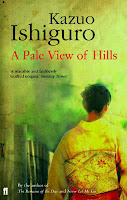
A Pale View of the Hills by Kazuo Ishiguro

Ishiguro's A Pale View of the Hills, despite being his debut, is no less an emotional tale than
his other better known works. It is a delicately woven tapestry of several themes, stitched together by the gift of Ishiguro's masterful but tender story-telling.
Through the eyes of Etsuko, we see a war-ravaged Japan trying to rise from its ashes - torn between the difficult choice of shunning past ideologies which lured it down the path of devastation or holding on to the frail sentimentality of traditions. The narrative switches back and forth between Etsuko's present where she is merely drifting through life in England with a daughter she barely knows and her memories of one particular summer in Japan when she came across a dysfuctional mother-daughter duo. We see women in a changing society who slowly begin to assert themselves, while a passive and pregnant Etsuko merely observes. It's almost as if Etsuko's life itself is an allegory of her homeland during turbulent times, about to undergo a major paradigm shift.
A story of loss, pain, self assertion and the aftermath of war.

4 stars out of 5.

An Image of Africa by Chinua Achebe

Presently, An Image of Africa has 49 ratings and 3 reviews (including mine) on Goodreads.
While Hopes and Impediments: Selected Essays, a compilation of essays by Achebe which contains this famous piece along with a few others, has 109 ratings and 8 reviews.

Which means this particular essay is as unknown and ignored as Heart of Darkness is universally read and worshipped.
This does not however indicate that Achebe has been given the cold shoulder by Goodreaders. (Oh no not at all, he is very popular instead.) 
Merely this that, either most people on Goodreads are not too intent on reading essays or not specifically interested in an African writer's denouncement of a most revered piece of literature written by a European. 
Even a Google search wasn't able to cough up links to coherent reviews of Achebe's essay than a meagre 2 or 3, one of which was posted on a UK based website, which understandably enough, shot down all of Achebe's claims in the same way as the rest of the world may dismiss a threat of nuclear war made by North Korea. 

Sharp, precise, thorough and keen in its deconstruction of Conrad's Heart of Darkness as a piece of mainstream literature fraught with racist implications, An Image of Africa does not only seek to label Conrad as a 'bloody racist' as the description says. (for your information, reader, he uses the word 'thoroughgoing' instead of 'bloody')
Achebe also brings to our notice, the often overlooked aspects of this literary fiction that is read by millions and taught as coursework for literature students worldwide, especially in American universities. Among the numerous critiques of Heart of Darkness, not one exists which points out Conrad's blatant dehumanization of the inhabitants of Africa as a manifestation of an obstinate white sense of superiority. 
Which is why Achebe took it upon himself to write one. 

"A Conrad student informed me in Scotland that Africa is merely a setting for the disintegration of the mind of Mr. Kurtz.

Which is partly the point. Africa as setting and backdrop which eliminates the African as human factor. Africa as a metaphysical battlefield devoid of all recognizable humanity, into which the wandering European enters at his peril. Can nobody see the preposterous and perverse arrogance in thus reducing Africa to the role of props for the break-up of one petty European mind? But that is not even the point. The real question is the dehumanization of Africa and Africans which this age-long attitude has fostered and continues to foster in the world. And the question is whether a novel which celebrates this dehumanization, which depersonalizes a portion of the human race, can be called a great work of art."


I think I ended up highlighting so much while reading that it would have sufficed to just highlight the entire printed text or leave it alone and consider the whole thing highlighted, anyway. 
Achebe's line of reasoning and thought is impossible to slight and makes one see Conrad's much vaunted literary masterpiece in a new light altogether.
But another reading of Heart of Darkness is needed before I can extol the infallibility of Achebe's arguments with more conviction.


4 stars out of 5.

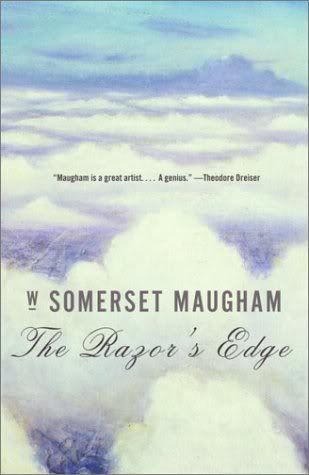
The Razor's Edge by Somerset Maugham


In a nutshell, this contains Maugham's indictment of the culture of materialism, upper class
snobbery and the story of a man's spiritual awakening and search for the true meaning of life. He has analyzed the opposite ends of the spectrum of human existence and juxtaposed themes of kindness and human goodwill along with the basest of human feelings such as contempt and jealousy in a way truly characteristic of a master of the art. But some portions were unnecessarily drawn out. And I felt Maugham's deliberate reveal of himself as a character in the story and as the narrator, didn't add anything to the narrative and instead mellowed down its intensity to a certain extent.

3.5 stars out of 5. 

 photo C136E66569D294E4D5DA2D8124D4FF69.png

Monday, August 19, 2013

Review : The End of the Affair by Graham Greene

(Original review posted on Goodreads:- June 21, 2013)

I'm trying very badly not to launch into a full fledged rant against this book as I type this out because rants
are rarely, if ever, proper reviews. And I want to pose a rational argument explaining my dislike for this book.
As much as the sexist ramblings of the protagonist and the selfish, irrational actions of the main characters served to irritate me to a great extent, I still reigned in my impatience and held out hope for the narrative till the time I was done with the very last page. But sadly enough, the ending left me not only disappointed but positively fuming with anger.
(Spoiler ahead)


I always welcome flawed characters in literature because truly what real person is perfect? or even close to being perfect?
Characters are meant to act like morons, do things that defy logic and frustrate us and yet earn our empathy in the end simply by virtue of their being human. But forget empathy, I just did not feel an ounce of anything for the central characters here except some occasional annoyance for abruptly starting one-sided conversations with this entity called 'God'.
As is obvious from the title this is about an affair, a torrid one at that, which ends badly and its subsequent repercussions. But the author just had to drag the much hyped up subject of 'God' into this and translate his love/hate for a woman into his love/hate for 'God'. How his insatiable desire for a woman forced him to confront his own atheistic/agnostic values and come closer to acknowledging the importance of faith. Which I didn't mind that much either, really.

But how do you look the other way when every other line of a passage has either the word 'God' or 'You' or 'Him' in it and the characters are engaging in endless monologues with 'Him'? (Please pay attention to how I am deliberately overlooking the crucial debate on God's gender)
'God' is a subject that I am yet to face head on and make my peace with. But my attitude so far has been a little like Haruki Murakami's in Kafka on the Shore -

“If you think God’s there, He is. If you don’t, He isn’t. And if that’s what God’s like, I wouldn’t worry about it.”

I can tolerate a healthy dose of reflections on religion, faith and worship, IF it is served with a touch of rationale and has the capacity to appeal to even the staunch non-believer. Like in a Life of Pi-ish way - nothing life-altering or too preachy but still understandable.
But I hate it when 'God' is shoved right in my face in long, winding passages replete with repetitive rhetorical questions. It's like 'He' is a character in this without being one. A passive, ubiquitous presence which steals everybody's thunder without doing a damned thing.
Was this about the affair or about 'God' or Catholicism? or was it about the author's attempt at coming to terms with the tragedy of his affair by seeking a form of oneness with 'God' and something bigger than life itself?
It's like Greene carelessly threw away chunks of the bigger picture but did not strive towards aiding the reader in stitching them all together. Which is why the book just stopped short of making a much larger impact.
If I am to take this novel only as a piece of autobiographical writing and a tribute to Greene's affair with one Lady Catherine Walston, then maybe some of my criticism automatically becomes void. But since this is a work of fiction, I think my points of contention are quite valid.
Dear 'God', you do not impress me in the least, especially when characters are citing 'You' as an excuse for their reluctance to behave like logical human beings.
Although there are few points in the narrative where the humanity of the characters shine through and one can't help but feel for their dilemma and suffering.

2 out of 5 stars.
Related Posts Plugin for WordPress, Blogger...