Showing posts with label Slice of Life. Show all posts

Tuesday, July 29, 2014

Review: Em and the Big Hoom by Jerry Pinto


First published:- 2012

Star rating:-


The tragedy of words like 'touching' and 'poignant' is that they have become hackneyed to the point they only give rise to skepticism if one spots them in a blurb. And yet I can't think of word choices more apt at the moment. 

After having had nothing but disdain for the present crop of Indian Dan Brown wannabes and writers of mythological retellings and nauseating romances riddled with blatant sexism, featuring terminally ill fiancees and 'hot girl on campus' and what other pathetic genre tropes have you, my faith in contemporary Indian literature (sans the Kiran & Anita Desais, Amitav Ghoshs, Vikram Seths, and Arundhati Roys) has been revived all thanks to this critically acclaimed gem of a novel. Rejoice Indian readers! Do not abandon hope ye all. 

It comes as a blessing when your mind is still fresh from the tvshow-esque humor of White Teeth and you are confronted with a good instance of the kind of tragicomic family drama you consider free of any intent of providing amusement at the cost of insidious disparagement. 'Em and the Big Hoom', which is only but a few modifications away from being the story of my growing years, is suffused with the kind of humor which delineates the comedy of quotidian life while attempting to pare down its tragedies. 

For a country whose pop culture validates the use of the word'mad' as an excuse for dehumanizing the psychologically unwell, here's an author who cuts through the bullshit of stereotypes, accepted misconceptions, and whatever it is that sets the cash registers ringing and keeps us stuck in the dark ages, and creates an endearing, true to life portrait of a Goanese, Roman Catholic family in the Bombay of 70s-80s. A family of four ensconced in a love for each other as much as an acute distrust for life's caprices. An unusual but not dysfunctional family conjured from reality and not the fantasy of Bollywood-ish tear-inducing schmaltziness. 

The bumbling, manic depressive, bipolar disorder-afflicted, suicidal, terrifying and fascinating matriarch Imelda, called Em by her offsprings, is the centre of this family with her dreadful mood swings, her chain-smoking of cheap beedis and addiction to countless cups of tea, and her capability of antagonizing and praising her children in the same sentence. Em is loved, feared and despised in equal measure while Augustine aka the Big Hoom is the reliable better half of volatile Em, the father with the stolid outer facade, a 'paragon' of patience, the iron wall which refuses to be shaken even in the most distressing of circumstances. 

"Love is never enough. Madness is enough. It is complete, sufficient unto itself. You can only stand outside it, as a woman might stand outside a prison in which her lover is locked up. From time to time, a well-loved face will peer out and love floods back. A scrap of cloth flutters and it becomes a sign and a code and a message and all that you want it to be. Then it vanishes and you are outside the dark tower again."

The young narrator, who unravels the mysteries of his mother's life, takes the reader on a journey through Bombay of the last few decades, its socio-cultural quirks, the hilarity of Imelda and Augustine's courtship years, their unspoken, enduring love for each other, and the family's bitter battle with Em's post-partum depression.

There's something to be said for a book which makes you tear up and laugh at the same time. And I am not exaggerating or making a good use of rhetoric in this context. 
For those of you, like me, adequately suspicious of blurbs, you can take those words of high praise from Rushdie and Amitav Ghosh at face value here. For this one at least you can more than suspend your disbelief.


______

Also published on Goodreads and Amazon.

   photo C136E66569D294E4D5DA2D8124D4FF69.png

Saturday, July 5, 2014

Review: Law of Desire: Stories by Andrej Blatnik

First published:- 2000

About to be republished on (after being translated into English):- July 15th, 2014

Republished by:- Dalkey Archive Press

Star rating:-

Short stories are such a tricky thing to get right and such a hassle to review. 
Before you have even settled down into the comfort of one minor narrative, a new one with brand new settings is silently demanding your undivided attention. A tiny slip in your concentration could result in that elusive thread of some unnameable, intangible emotion that you are struggling to disentangle from the jumble of lives and internal monologues, zipping past you with the agile grace of an eel. 
And having turned over the last page, you are facing the difficult prospect of making out all the discordant notes from the individual stories and combining them into a common refrain which captures the general mood of the collection. Unless the author can profess to being at par with one of those world-renowned masters and mistresses of the short story format (Munro, Maupassant, Carver, Lydia Davis, Gogol and so on) who have got it down so pat that each one of their stories stand out and leave permanent markings etched on to the slippery sands of memory, he/she has an uphill task ahead. 

I can vouch for the fact that Andrej Blatnik's stories cannot be shoehorned into any known category of writerly acuity. There's no single overarching theme that strings the whole collection together. And not all the stories can be commended on their execution or even thematic clarity. While some of the short stories give off a surrealistic Italo Calvino-esque vibe by blurring the boundaries between real and absurd, some of the others remind me of Murakami with their efficient juggling of nameless, wryly witty narrators who shirk responsibilities, intriguingly secretive women and emotional isolation. The remaining deal with themes as varied as PTSD-afflicted, psychologically scarred young men returning from the battlefield, the beauty and terror of fatherhood, the tragedy of young children adjusting to a newly motherless household and even something as eerie and nihilistic as a runaway convict resigned to his fate of being turned into a human sacrifice in an African village.

"The man feels the open dome of the sky descending, embracing him, he senses the universe closing in, he smells the brittle tail of comets, the gravity of distant worlds brushes his cheek. Galaxies open up and beckon him in. The man knows: This is the beginning; this is just the beginning."

The stories seem to be weakly delineated on purpose, the characters having no qualities that make an impression worth remembering, their lives appearing to be hazy silhouettes that never truly come into focus, just remaining out of reach for you to draw your own conclusions, which is precisely how short stories should be. But there's something more which accentuates their uniqueness, a disorienting effect that Blatnik manages to induce in the reader - an all-too-familiar sorrow, a feeling of unfulfillment arising out of a failure to communicate, and the concomitant cruelty of everyday lives of people trapped in the labyrinth of the urban jungle.

So even though I had my mind virtually made up to go with a 3.5 stars rounded off to a 3, I am conceding another one in the hopes that an above-average rating will help this Slovenian writer gain a wider readership, especially now that he has been translated. He really does deserve all the attention he can get.

**I received an ARC from the Dalkey Archive Press via Netgalley**


Also published on Goodreads and Amazon.

   photo C136E66569D294E4D5DA2D8124D4FF69.png

Thursday, January 9, 2014

Review: The Pure Gold Baby by Margaret Drabble

First published:- October 1st, 2013
Published by:-  Houghton Mifflin Harcourt (HMH) 
Star rating:-

There are two kinds of rambling I have come across in literature - the good kind of rambling wherein the narrator jumps from one topic to another sub-topic quite abruptly, dwelling on one subject for a good many number of pages before attempting to make a point of some sort and succeeding in that endeavour. And the bad kind of rambling wherein a reader, realizes with a growing certainty, that the author's intention has been merely to dawdle and haphazardly branch out into topics with little to no substantial connection, occasionally inserting a philosophical musing or two to dispel some of the aimlessness of the narrative but with less than satisfactory results. 'The Pure Gold Baby' is an adherent of the latter kind of intolerable rambling. And Margaret Drabble is an eloquent rambler. It's good to hear her talking but there's also the moment of irritation creeping in intermittently when one is tempted to abandon reading and wonder aloud 'is this going anywhere?'.

Is this about the perils of motherhood? a feminist take on the dynamics of a mother-daughter relationship? a commentary on mental illness and neurological conditions? an ode to children afflicted by congenital disorders? 

I could not fathom. And that's majorly responsible for the half-hearted 3-star rating.

But a few days ago, by a stroke of good luck, I found Margaret Drabble's article in The Guardian on the deplorable treatment of senior citizens worldwide and her well-argued pitch for allowing them their right to die a dignified death (legalizing euthanasia in other words). And I found the connection with 'The Pure Gold Baby' developing instantly. The concept of growing old is inextricably linked with the idea of growing more and more incapable of being in control of one's life and that's one identifiable theme in this book. 

The eponymous pure, gold baby, a differently-abled child of sunny disposition who doesn't comprehend the complexities of the world and smiles and stumbles along her way through an uneventful life with the aid of her competent and headstrong mother has very little to do with the narrative but everything described within somehow revolves around her pitiable existence. Throw in the life story of a single mother, some theoretical anthropology, case studies of Zambian 'lobster-claw' children (born with physical deformities), examples of famed winners of the Nobel Prize for Literature with brain-damaged children like Kenzaburō Ōe, Pearl S. Buck and Doris Lessing, top it off with references to Jane Austen's mentally ill brother George Austen and what you get is a jumbled mess named 'The Pure Gold Baby'

To be fair to Ms Drabble, it is quite an aesthetically put together mess since she surely possesses the ability of fashioning a narrative out of sensitive issues without venturing into drippily sentimental territory. But that's about the only redeeming feature of this mess. 
That and the correct usage of the word 'prolepsis'

**Thanks to Houghton Mifflin Harcourt and Netgalley for an advance reader's copy**


Also posted on Goodreads and Amazon.
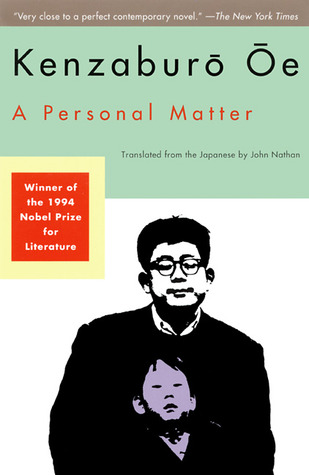
   photo C136E66569D294E4D5DA2D8124D4FF69.png

Monday, October 14, 2013

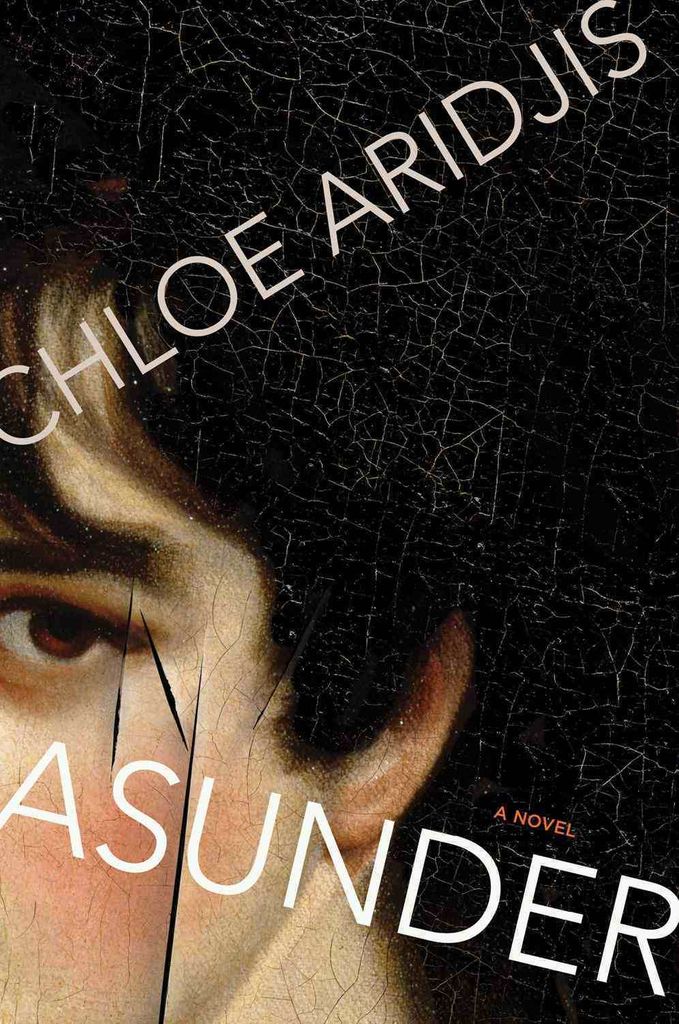
Review : Asunder by Chloe Aridjis

Publisher:-Houghton Mifflin Harcourt
Published on:-September 17th, 2013

A vague sense of foreboding persistently stalks the reader on every page of this narrative, as if something potentially dangerous and forbidding awaits one at the turn of the next page. But then the pages fly by, nothing truly nefarious ever materializes and the feeling finally settles in that the substance of this narrative lies not in a likely event of cosmic importance or even in the anticipation of its occurrence but in the minutiae a reader usually glosses over.
The everyday happenings, some of them mystically inexplicable, some of them a little odd but so commonplace that they do not merit even a second thought let alone further introspection - the things we breeze past in an effort to dwell on the more materially satisfying aspects of life without realizing that each one of these discrete snippets of time spent with people in places is what makes up the structure of life itself.

As I glanced at the blurb (which clearly does not do the book justice even as a half-hearted synopsis), I felt a stab of sympathy for whoever wrote it (author/publisher/random intern), because not only is it very difficult to clearly define the contours of this book but it is equally trying to put one's finger on one strongly resonant theme in it since there are many.

There's the subject matter of the suffragettes (the term used for women campaigning in Britain in the late 19th and 20th centuries for the female ballot) and a young Mary Richardson who had taken a blade to assault one of the priceless works of art in the National Gallery on the eve of the First World War while Marie's great-grandfather Ted was a guard at the museum. It's no coincidence that our protagonist is the namesake of this revolutionary since the shadow of Mary Richardson's act of bravado looms large over Marie's life, silently influencing her in ways she remains oblivious to.
Hence it can be stated that feminist undertones are delicately woven into the the narrative without being glaringly obvious.

There's also an overarching feeling of the protagonist's unnerving indifference to most things, her tacit refusal to take the wheels of her own life and letting herself be propelled by happenings and the decisions made by people around herself. In the beginning I was speculating on the possibility of some sort of unique psychological condition plaguing her in an attempt to convincingly explain her aloofness from life or what could even be called her cowardice. But by the end of the narrative, I realized, a little bit of Marie's dogged impassivity lives inside all of us.

She is haunted by the spectre of her own isolation in the midst of people and her inability to steer her life in the direction of romantic entanglements and fulfillment of any kind. As a guard at the National Gallery in London, Marie comes across many visitors from day to night who spend agonizing minutes peering over works of art which have been witness to centuries of history. With the passage of time, she starts equating the cracks and fissures showing up in the fabric of her life with the craquelures in the paintings. And finally when she confronts her own hesitations after an enigmatic encounter with an owner of a chateau in France, the reader is left with the parting message that Marie has finally summoned the courage to destabilize the status quo in her life just as a certain young Mary Richardson of yesterday had dismantled the status quo in the socio-political landscape.

Chloe Aridjis is a gifted story-teller. Her writing is richly atmospheric and often plays out like a discordant symphony, combining too many erratic musical notes together and yet sounding so perfectly melodious. Same can be said about her choice of original but beautiful metaphors.
"It began with those viragos, he'd tell me, comets detached from the firmament, deviant and sharply veering, long-haired vagabond stars, hissing through the universe on their solitary paths, a tear in the social fabric, threats to the status quo. Yes once war broke out, Ted said, their battle eclipsed by larger events, became no more than one of many lit matches in the stratosphere."
This book made me feel thankful for my relationship with Netgalley which has allowed me to discover such promising new female authors as Chloe Aridjis and Nina Schuyler. In other words, this is very highly recommended.

4.5/5

Also posted on GR:- https://www.goodreads.com/review/show/698912348
Also posted on Booklikes:- http://samadrita.booklikes.com/post/612329/review-asunder-by-chloe-aridjis

**with thanks to Netgalley and the publishing house for providing me with a free copy of the e-edition**
 photo C136E66569D294E4D5DA2D8124D4FF69.png

Thursday, October 10, 2013

Review : Paper Towns by John Green

I sit here at my desk, staring blankly at the notepad document wondering what kind of a review will be able to portray effectively all that I felt for this book and yet manage not to come off as an incoherent, mawkishly emotional discourse on the failings of life.
On the one hand, there's this hazy voice at the back of my head - the one voice embodying the spirit of the slightly snooty me who almost had me convinced that I won't find another good YA book to read again - telling me to single out all the minor flaws and inconsistencies, elaborate on them and dismiss John Green with a condescending, pat-on-the-back kind of review.
On the other hand, there's the voice of the the flawed, often conflicted, unsure but honest me - asking me to be generous instead of patronizing, to have the courage to admit that the poignant ending made me shed tears and that often, our heart craves for a heart-warming, bittersweet yet simplistic story that represents life itself, in its myriad manifestations, rather than endless pages of rich, flowery prose and little more.
I am honoring the intentions of the second voice. (I mostly go with the second voice. Please care to note the word 'mostly'.)

At a superficial level, Paper Towns, is not much apart from a regular YA novel. It's about American teenagers doing what teenagers do - survive high school, try to fit into social cliques, get into colleges, date, break up, date again, lose their virginities and so on and so forth.
Yet deeper beneath that surface, it is a story flavoured with the bittersweetness of life itself.
It is about an unremarkable, often ignored boy named Quentin whose presence is almost taken for granted by every one around him. And it is about his polar opposite - an exceptionally interesting girl called Margo, Quentin's neighbor, who is seen only as the quintessential popular girl at school. And it is about the pair of them discovering who they really are underneath that exterior of carefully preserved appearances through a long and convoluted process..
When Margo goes missing after a night of vengeance wreaked on a handful of people at school who 'betrayed' her, the only person truly interested in getting her back or finding out her whereabouts is none other than Quentin. Because, predictably, our male lead has a crush on Margo since he was a kid.
But how does he find her when she has disappeared supposedly without a trace? - Turns out Margo has left clues behind for only Quentin to piece together and figure out where she is headed and more importantly, why she has taken off abruptly anyway.
This puts Quentin at the head of a long, winding, physical and metaphysical journey of deconstructing the enigma that Margo Roth Spiegelman is, figuring out where she is and in the process of it all, coming closer to understanding himself and the people around him better.

As a woman who spent her adolescence in a country named India, let me say that American YA fiction makes us feel as if we're reading about people from an alternate plane of reality. While American teens go to prom, date, lose their virginity, smoke pot, go clubbing, (sometimes) engage in illegal activities, take a gap year after school and mainly act and behave like adults, Indian teens are busy taking tuitions to get into the premier engineering institute in the country.
Because our society holds a degree in engineering in the highest regard and sees it as a one-way ticket to the realm of financial eminence.
So it's more of an understatement to say that we do not relate to American teens - we read these YA novels partly out of bizarre fascination and partly out of curiosity.
But rarely do we stumble upon a YA book which is able to surmount the barriers of stiff cultural divides and sing to the universal human spirit.
Paper Towns is like that rare gem in a genre well-known for its banality. It is alternately frivolous in its portrayal of teenagers and melancholic in its ruminations on life, love and the way we choose to put labels on people without caring to know the real person under the disguise of the stereotype.
But it is not free from its quota of cliches and minor flaws. The pairing up of the school geek with the school beauty, her jock boyfriend and bitchy best friend and two additional nerdy boys as sidekicks of the male lead - these are but formulaic elements found in a run-of-the-mill YA novel.
Also, in real life a girl like Margo Roth Spiegelman is unlikely to exist and even though she insists on the contrary, her penchant for drama and actions appear to be desperate bids for more attention - a fact John Green doesn't gloss over by making the side characters point this out to Quentin time and again. There's also something very Holden Caulfield-ish about Margo, a thought I just couldn't get out of my head.
Not to mention, the whole premise comes off as a little unrealistic as well - Margo is repeatedly shown to be a near invincible character whose plans and designs seldom fail.
But even so, the strengths of this book do enough to overshadow its shortcomings. John Green's fast dialogue and witty one-liners make you smile.
"Getting you a date to prom is so hard that the hypothetical idea itself is actually used to cut diamonds."

"Girls dig you," he said to me, which was at best true only if you defined the word as girls as "girls in the marching band."

Some of the hilarious situations that Quentin and his friends find themselves in during the course of their road trip, made me laugh out loud multiple times. Which doesn't happen often.

Ben keeps bouncing his legs up and down.
"Will you stop that?"
"I've had to pee for three hours."
"You've mentioned that."
"I can feel the pee all the way up to my rib cage," he says. I am honestly full of pee. Bro, right now, seventy percent of my body weight is pee."

And what sealed my absolute, unwavering love for this book was the ending. The sheer poignancy of it will stay with me for a long time.
John Green dares to ponder on the difference between being in love with the idea of a person and being in love with the actual person, while staying within the limits of a genre not noted for its depth or emotional range.
And this is why, Paper Towns stays with the reader long after he/she has finished reading - as a great story and as a somewhat sentimental discourse on the imperfection of our lives.

 photo C136E66569D294E4D5DA2D8124D4FF69.png

Thursday, October 3, 2013

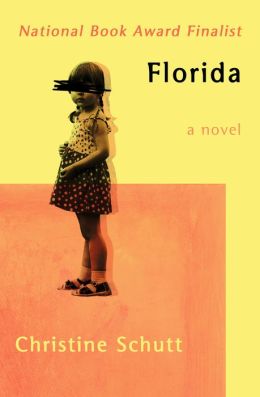
Review : Florida by Christine Schutt

While reading this, I suffered from a keen sense of déjà vu.

"Now where have I come across similar prose?"


Then I dredged up from memory, my feelings about Offred's nearly toneless, emotionally detached, subtly traumatized voice in The Handmaid's Tale.
The protagonist, Alice Fivey's voice shares stark similarities with Offred's, in the way it drips with a resignation to fate and acute despair. There's nothing much lyrical about the prose of THT as opposed to the prose-poem like structure of Florida, but there's the note of desolation and suppressed grief palpable in both the narrator voices. 
While I liked THT extremely because of the brilliant extrapolation of facts concerning present trends on misogyny, Alice Fivey's rather blandly narrated tale of grappling with abandonment issues left me cold and unaffected. 

And the thing is I am not a big fan of this kind of writing characterized by awkward, stumpy sentences which must be the polar opposite of Proustian prose. In fact, it grates on my nerves. My brand of poetic prose would be Anaïs Nin's, Virginia Woolf's in pretty much every one of her books or Toni Morrison's in Beloved. Sorry Christine Schutt, but your prose doesn't seem all that poetic to me. 

Alice Fivey is an orphaned child who lost her father to a car accident. A few years later her mother falls victim to a mental illness and has to be institutionalized as a result of which Alice becomes homeless, reduced to the state of temporary live-in arrangements with a set of unsympathetic relatives. 

"I was ten - ten was my age when Mother left for good, and this sleep-over life began."

The reader is led through her growing years in the midwest, where she is shown rather implicitly to suffer from profound loneliness, her dreams of a laughter-filled life with her parents in Florida shattered to bits. Her isolation is so pronounced that only the company of her family chauffeur Arthur, whom Alice comes to view as a kind of father figure, seems to provide her with a degree of comfort. Arthur becomes the only person who doesn't treat her unkindly or make thoughtless remarks regarding her mother the way her Aunt Frances and Uncle Billy do.

"No one was there to think he was my father, so I could love him as I might a father."

There are certain sentences containing heart-breaking implications of Alice's sense of hurt and subdued anger at her mother's 'betrayal'.

"Mother, or the woman who said she was my mother, settled in California, finally."

This one really stabbed me in a rather sensitive spot. But barring a few instances like the sentences I quoted above, Alice's story didn't achieve any kind of high emotional resonance. More often than not, the monotony of reading similarly structured sentences crept in unnoticed and I found myself trying to glide over them with a fluid grace in an effort to finish the book soon and move on to better reads.


3.5 stars out of 5.

P.S.:- My slightly negative review notwithstanding, this novella was a finalist for the National Book Award in 2004 so it could be worth a shot after all. 


 photo C136E66569D294E4D5DA2D8124D4FF69.png

Sunday, September 22, 2013

Review : A Schoolboy's Diary and Other Stories by Robert Walser

Faced with the prospect of reviewing a collection of short stories, which is probably my least favorite writing chore ever, I am choosing the easy way out. I am so taken with the quiet, restrained beauty of Walser's writing that I am most unwilling to disassemble his short stories into separate assessing criteria like style, essence, prose, plot, imagery and so on.

So what I'll do is convince you, dear random uninitiated reader, to pick up this little gem, flip through its pages and discover for yourself the treasures embedded within without trying your patience by going into excruciating details. And by letting Walser speak on my behalf.

The initial few short stories are written from the point of view of a school boy in the format of essays on various topics ranging from school, poverty, careers to friendship, politeness, nature and so on.
It is astonishing to note that despite the glaringly trite nature of these subjects, Walser manages to bring something new to the stories by adding a distinct touch of his own. His tone fluctuates between mildly sardonic and wistful to complacent and observant but unassuming.

Sample what he has to say about "school" -

"School is the unavoidable choker around the neck of youth, and I confess that it is a valuable piece of jewelery indeed. What a burden we would be to our parents, workers, passersby, shop owners, if we didn't have to go to school!"

And this is what he says about 'Politeness'-

"The more big and important a polite person is, the more benevolence his civility has."

His thoughts on anger and conflict -

"Not only boys can bear grudges against other boys in such a way, so too just as well can grownups against grownups, mature adults against mature adults, and I would venture to say, nations against nations. A vengeance or revenge can collect in the heart of a nation due to self-regard that has been injured in various ways, and it grows and grows, without end, becomes more and more pressing, more and more painful rises up like a high mountain no longer to be cleared away, obstructs any mutual understanding, inhibits warm, healthy, reasonable reciprocal communication, turns into twitching nervous fury, and is so tyrannical and degrading that it can one day no longer be reined in and cries out wildly for bloody conflict."

There are references to nature, changing seasons and vivid descriptions of lush, green landscapes in the Swiss countryside aplenty.


"Autumn was beautiful, with its brownish melancholy that seemed attractive and happily right to me, while in May the blossoming trees and all the singing and wonderful smells plunged into sadness."

The short stories included in the latter half of the book seem to be written from different perspectives like that modest young men about to enlist in the army or confused, lost writers trying to seek validation in a life fraught with failures and rejections. (This is vaguely autobiographical I believe.)

"Restlessness, uncertainty, and a premonition of a singular fate may have been what led me, in my sequestered isolation, to pick up my quill and attempt to create a reflection of myself."

Here are a few of his excellent ruminations on reading -

"A book bewitches and dominates us, it holds us spellbound, in other words it exerts a power over us, and we are happy to let such tyranny occur, for it is a blessing. Anyone captivated and gripped by a book for a given time does not use that time to initiate gossip about his dear fellow man, which is always a great and crude mistake."
And ahem, book snobs please do take note of this -

"I have sometimes heard people talk about so-called harmful reading, e.g., infamous Gothic novels. That's another story we shall avoid getting into but we can say this much: the worst book in the world is not as bad as the complete indifference of never picking up a book at all. A trashy book is not nearly as dangerous as people sometimes think, and the so-called really good books are under certain conditions by no means as free of danger as people generally like to believe. Intellectual things are never as harmless as eating chocolate or enjoying an apple tart or the like. In principle, the reader just has to know how to cleanly separate reading from life."

Walser's short sentences gave me the impression of beads of morning dew collecting on blades of grass, the evanescent beauty of which evaporates away before we even have time enough to bask in its resplendence. But for as long as the novelty lasts, it is the most exquisite thing in the world. He is not overly pedantic yet his writing exudes immense charm and clarity.

"But soon enough he was cheerful again. Love of humanity and the sorrows thereof, a lust for life and the pain therefrom, rose exquisitely up like tall ghostly shapes in the pale, golden air of the summer evening. Softly the figures seemed to wave to him."

To conclude, this is a thoroughly delightful collection but I'll hold out on that 5-star rating until I read a full-fledged novel of his.

4 out of 5 stars (more of a 4.5)

**special thanks to Netgalley for a copy of the e-edition**

 photo C136E66569D294E4D5DA2D8124D4FF69.png

Tuesday, September 3, 2013

Review : The Translator by Nina Schuyler

Publisher: Pegasus Books
Published on:- July 2nd, 2013.

(Original review posted on Goodreads:- Sep 1, 2013)

I have always frowned upon people who seem to think that reading is a mere pastime, barely suppressing the resentment I felt for those who consider the act of complete engagement with a narrative akin to a childish desire of letting go of reality for a while and stepping into a world detached from our own. I believed them to be ignorant, presumptuous and hopelessly prejudiced.
But after having read The Translator, I feel like I have gained enlightenment of a special kind, become a more empathetic and thoughtful being blessed with a newer perspective on the matter.

Reading can, indeed, be categorized as a form of escapism. A gateway opening up into another metaphysical dimension we cannot gain physical access to. Or it can be the very best thing about our lives. Reading can be whatever we will it to be or perceive it to be. Because contrary to what we like to believe, our world views and personal preferences end up coloring the judgement we pronounce upon every thing else. Nothing can be classified as the absolute truth. It is not wise to view an opinion as a fact, certainly not our own, since our understanding of the world is forever a work in progress.

The essence of The Translator consists not so much of the life events of one particular Hanne Schubert, who effortlessly navigates the world of various languages, but of the basic human fallacy of failing to understand another, the accompanying pangs of miscommunication and the tragedies that transpire as a consequence.
A professional translator, Hanne, eases into the reticent formality of the Japanese language from the confident brusqueness of English within the same heartbeat. She keenly understands the basics of linguistics and elements of a foreign culture, yet struggles to understand her own flesh and blood. As a result, an unbridgeable chasm opens up between Hanne and her daughter Brigitte and this yawning gap stretches across time and space, affecting Hanne in ways she remains unwilling to acknowledge.

She continues to drift through a life revolving around translation assignments, shouldering the burden of repressed grief for her departed husband and estranged daughter without letting it engulf her completely.
But when an accident involving a head injury causes her to lose her mastery of all languages barring Japanese, she is forced to evaluate her true standing in life and embark on a journey of self-discovery, at the end of which she reconciles with her daughter. Although by the time realization dawns on her, it is too late.

But is it really? Nina Schuyler seems to leave the reader with the message that it is never too late to cast aside reluctance and commence the often difficult, two-way process of communication, to stop speaking for a while and patiently listen to what the other one is saying without offering interruptions. And perhaps, it will not be mere folly to take off the rose-tinted glasses of preconceived notions and glance at the world once again, just so we can see facets of it we have been willfully blind to.

As a relatively new author, Nina Schuyler shows incredible promise. Her elegant, understated writing style succeeds in capturing the poignancy of many tender moments. There is something deeply atmospheric about this book and had it not been for the meticulous research that Schuyler must have conducted on Japanese culture and language (even the mention of Japanese tv show 'Long Vacation' holds true since I have seen it), half of the scenarios wouldn't have come to life as they did. Japan, the character of Moto Okuro, the theatre art of Noh could have resembled lifeless replicas but in Schuyler's deft hands, they appear believable.

Hence, a very impressed 4.5 stars rounded off to a 4.

This is definitely the best among all the 2013 releases I have had the fortune of reading so far.

**I received an ARC from netgalley in exchange for an honest review**

 photo C136E66569D294E4D5DA2D8124D4FF69.png

Monday, September 2, 2013

Review : A Personal Matter by Kenzaburō Ōe

(Original review posted on Goodreads:- May 29, 2013)

Reading this book is nothing short of an agonizing experience.
It almost feels like somebody poking at and opening up our most secret, suppurating psychological wounds and making them bleed all over again, thereby compelling us to wake up to the realization of their existence.
These scars and bruises make their presence known time and again by causing us pain of the highest order. And so we proceed to wrap them up in the protective wadding of false pretensions, carefully hiding them away from the scrutiny of the rest of the world and more importantly, ourselves.
But Kenzaburo Oe does not only wish to cause us pain. He also forces us to acknowledge its perpetuity, accept it and achieve a state of harmony with it.

With every turn of a page, we find ourselves plunging deeper into the bottomless pit of shame, self-loathing and sheer grief along with Bird, our protagonist. But Oe breaks our fall right when we feel we are about to land with a resounding thud and teaches us how to rise, how to summon the courage to confront grim reality and reconcile ourselves with the cruelties inflicted by fate.

Bird (nickname), a young man of twenty seven, keeps drifing in and out of consciousness throughout the length of the narrative. While walking along a busy Tokyo street he is capable of sparing a thought for his pregnant wife experiencing labour pains at the hospital and alternately seeking escapism in the form of dreaming about landscapes of Africa, a continent he desperately wishes to visit some day. He neither seems to feel passionately about his wife nor about the job at the cram school he has landed thanks to the benevolence of his father-in-law. In a sense, he is apathetic to his own life but we are shown that he is not immune from feelings of embarrassment.
Weak-willed and jittery, he refuses to accept the birth of a child with a grotesque lump on its head and crucial genetic deformities. He is appalled to hear his baby would never grow up as a normal child and shamelessly gives in to feelings of utter relief, when he hears from the doctor that chances of his baby's survival are next to none. Although immediately afterwards, he suffers from a keen self-hatred.

During the course of the next few days, like the most cowardly criminal ever, he plots his own baby's murder - by conspiring with the doctor to substitute his supply of milk with sweetened water and, when that fails, by taking the baby to the clinic of a shady abortionist. Yet at the same time he shudders in revulsion at the thought of having to kill a helpless, sick child with his bare hands. He fears being in the presence of his wife and mother-in-law both of whom seem to blame him for everything, and seeks solace in violent sex with an old lover.
Thus, Bird, seems to possess no redeeming characteristics whatsoever. He is a failure at life and everything he does. He is selfish to the point of entertaining ideas of running away with his lover to Africa, abandoning all his responsibilities. He only views his biological child as an oddly assembled, defective mass of flesh, blood and bone. He refuses to give him a name or even acknowledge his gender and burden himself with the task of acquainting himself with his newborn son.
Bird is despicable in the true sense of the term.

But then at the same time, Bird is also the very personification of all our worst human weaknesses. He disgusts the reader but he also evokes feelings of sympathy and solidarity.
Because if we maybe honest enough with ourselves, there's a Bird in each one of us and his deformed baby is a symbol of the indignities of our own personal existence.
Slowly as the days trickle by after the birth of the unwanted child, Bird starts viewing the entity he repeatedly refers to as 'the monster baby', as a human offspring blessed with the powers of sensation and expression. It seems this indisputable fact had eluded him so far.
Thus begins Bird's gradual transformation, which the reader witnesses with mixed feelings. As he comes full circle, traversing the seemingly infinite distance between madness and sanity, so does the reader.
And when he finally finds hope in a hopeless place and begins the long, convoluted process of acceptance, it is not the predictability of this ending which strikes us.
Rather, we are moved by the truth in Bird's realizations and actions.

Oe has written about such a deeply personal aspect of his life (being the father of a brain-damaged son himself) with a mastery, truly characteristic of a  Nobel Laureate. His writing isn't wordy or verbose yet it hits the reader's most sensitive, vulnerable spot every time and makes one feel raw and cut up deep inside.

"The baby was no longer on the verge of death; no longer would the sweet, easy tears of mourning melt it away as if it were a simple jelly. The baby continued to live, and it was oppressing Bird, even beginning to attack him. Swaddled in skin as red as shrimp which gleamed with the luster of scar tissue, the baby was beginning ferociously to live, dragging its anchor of a heavy lump."

He does not want us to shed copious tears at the misfortunes that befall Bird or feel only an acute hatred for his indecision, but experience the entire gamut of human actions and emotions, no matter how blasphemous or conventionally unacceptable each one of them maybe.
In slow succession, the reader becomes-
Bird, the indifferent cram school teacher.
Bird, the day-dreamer.
Bird, the miserable failure of a man.
Bird, the conspiring murderer.
Bird, the unfaithful husband.
And at the very end, Bird, the accepting father.

As one plows along, it becomes apparent that Oe's aim has not been self-indulgent or cathartic story-telling, but instead, to take the whole world along on an immensely difficult journey, he must have embarked on all alone at some point.

Thus, A Personal Matter, ceases to be merely about a personal matter somewhere. Instead, it transforms into one of the most life-affirming stories ever, meant to serve as a universal panacea for the ones suffering from the affliction of an undignified existence.
Oe knows all too well, that he cannot make the pain go away. So he gifts us with the strength to endure it, instead.

5 out of 5 stars.


 photo C136E66569D294E4D5DA2D8124D4FF69.png

Saturday, August 24, 2013

Review : Twenty Fragments of a Ravenous Youth by Xiaolu Guo

(Original review posted on Goodreads:- March 9, 2013) 


Sometimes I get this nagging suspicion that there's a greater conspiracy at work to make women writers all over the world feel unloved and unappreciated.
*cough* V.S. Naipaul *cough*

There's a deliberateness in the way most fiction authored by women is either labelled 'chick lit' and dismissed right away without a second thought or made light of under various other excuses.

Why else would this book have an average rating below 3.5 on Goodreads?

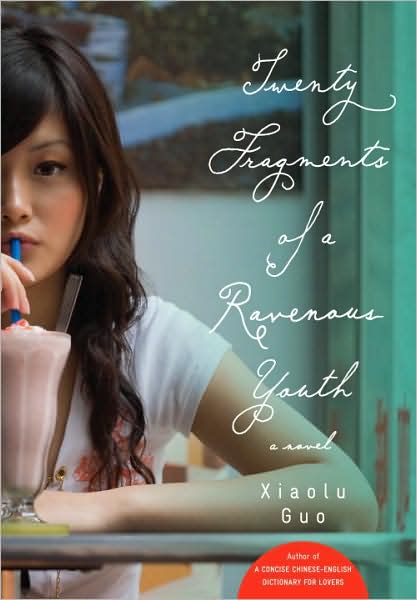
Let me offer you a word of advice. Don't go by the beautiful cover, it is highly deceptive.
Neither is Xiaolu Guo's protagonist half as slender or as pretty the girl on it nor is this book about a girl navigating her way through the world of dating and singles and finding her 'one true love' who sees her 'inner beauty'.

Twenty Fragments of a Ravenous Youth brings into focus the position of women in a country rapidly elevating itself to a position of profound importance in the global arena but curiously enough, lacking conspicuously in the human rights department.
It explores themes of isolation, urban boredom, the sheer tragedy of everyday life, personal freedom and the deep disconnect between an increasingly authoritative Communist regime and disillusioned citizens, in a quintessentially nonchalant manner.

Xiaolu Guo's heroine Fenfang speaks in a slangy Chinese, swears often and has extremely messy living habits. She is strangely apathetic to the happenings in her own life and has the rare ability of analyzing most aspects of it with a matter-of-factness that is as scary as it is unique.
After having quit the disturbingly monotonous life in the countryside where her parents are but humble farmers with little variety in their daily routines, a starry-eyed Fenfang comes to Beijing with dreams of becoming a film actress or a script-writer. But quickly she discovers, the city is not all that it is hyped up to be. Directors aren't interested in casting her as the lead, script-writers and producers won't even read stories 'written by a woman' let alone accepting them as scripts for tv shows. And the old-fashioned folks of her neighborhood who take pride in sporting red Communist armbands to boot, are disapproving of the smartly dressed, independent, young female who has the audacity to bring a man home at night.
Refusing to lose heart, Fenfang starts working as extras on film and tv drama sets and slowly but surely begins carving out a niche for herself. She makes peace with stalkers, violent, physically absent, insensitive boyfriends, the cockroaches in her apartment and even the police who arrest her just to deliver a lecture on ideal behavior expected of an 'unmarried woman' and the unreasonableness of a woman being too 'individualistic'.
But even in the midst of these bleakest of surroundings, she finds an answer to the eternally baffling question of what true freedom really means.

This book has tried to lay Beijing bare - reveal the ugly side of a city which still insists upon practising blatant sexism and vigilantly guarding obsolete ideals in the 21st century, while maintaining the facade of rapid infrastructural development.
And it has helped me come to the realization that it is indeed possible to merge pertinent socio-political issues seamlessly with an otherwise ordinary story of an ordinary girl.

Neither has Xiaolu Guo tried to present this book as highbrow literature nor has she made the effort to write long, verbose sentences replete with symbolism or imagery. Instead she has directed her energies at highlighting the predicament of the young, modern woman all over the world and especially in a country like China, where the so-called 'weaker sex' is still not in the driver's seat. And for me, this is an achievement she deserves praise for.

A 3.5 stars rounded off to a willing, impressed 4 stars.

Thursday, August 22, 2013

Review : Kitchen by Banana Yoshimoto

(Original review posted on Goodreads:- Jan 18,2013)

There's something about Japanese writers. They have the unparalleled ability of transforming an extremely
ordinary scene from our everyday mundane lives into something magical and other-worldly. A man walking along a river-bank on a misty April morning may appear to our senses as an ethereal being, barely human, on the path to deliverance and self-discovery.
There's something profoundly melancholic yet powerfully meaningful about the beautiful vignettes they create. No one else does surrealistic imagery better than Japanese writers.

Kitchen, by Banana Yoshimoto, is no exception to this convention.
Revolving around the theme of dealing with loss, Kitchen focuses on two young women as protagonists and their perceptions of life and death.
It tells us about how recurring personal tragedies shape and reshape our views on life and death, the kind of catharsis we wish for and the mechanisms we often end up resorting to, in order to keep our personal grief from spilling over into our everyday reality.
Kitchen is definitely the not the most ingeniously narrated tale ever. Rather it suffers from the monotony of brief, simple sentences that may not sit well with some readers who love eloquence.
But this simplistic mode of narration, helps it stay true to its original intention, that of recounting the story of ordinary people doing ordinary things yet coming to unexpected realizations about the great quandary of life.

4 out of 5 stars.

Tuesday, August 20, 2013

Review : The Casual Vacancy

(Original review posted on Goodreads:- January 15, 2013)

Well much has been said and written about this book already throughout the latter part of last year. But here's my twopence on Rowling's ambitious adult novel, which in my opinion has received a rather harsh reception.

This book is grey. As grey as grey can be.
It is an intense introspection on the bleakness of modern day urban life, the dynamics of various human relationships, which may seem ordinary on the surface but reveal complexities just beneath that showy exterior - where the basis of each one is some deeply personal interest and little else. Where every human action is steeped in the fundamental need for fulfillment of some ulterior, personal objective. And it is more about people of flesh and blood, like you and I, rather than a story.

Rowling takes her sweet little time (which costs many of the readers much of their patience) to establish an imaginary suburban neighborhood and its various quirky inhabitants - unscrupulous, prejudiced councilmen, hypocritical educators, pedophiles, violent, abusive fathers, problematic teenagers, promiscuous adolescent girls, drug addicts, drug dealers and pimps, victims of sexual abuse, rape, jittery, reluctant boyfriends, emotionally absent husbands and sexually frustrated, disgruntled wives. But Rowling's achievement lies in the fact that she makes all her characters appear as humane as possible without ever forcefully pushing any one of them either into the realm of abject villainy or highly romanticized heroism. They have their share of good and bad traits. Although, noticeably, the bad in them is much more pronounced.

Rowling dishes out reality in its most vicious and ugly form and leaves nothing to the imagination. She never tries to tone down the scale of the tragedy, everyday mundane life entails. The tragedies we either prefer to shove under the carpet or try and forget about by donning a mask of make-believe contentment.
Pagford is the dystopia of Rowling's imagination and each one of its residents are bizarre enough to be the subject of a psychoanalyst's case study.
In a simple sentence, The Casual Vacancy is Rowling's exegesis on human nature.

Initially I had decided on a meagre 3-star rating but towards the end, Rowling kicks up the ante a notch or two and gives us some some solid plot developments. Her characterization is beyond brilliant and a major asset to this story.
And it becomes quite a page-turner towards the end as the very disturbing narrative hurtles towards an unavoidably tragic ending.

This woman gave a generation of kids (like me) a story so special and awe-inspiring, that it became a part of their lives forever. There's no chance in hell that she can write anything mediocre or substandard.
But, maybe....just maybe I was nurturing hope, in some obscure corner of my heart, of something life-altering and magnificent from her once again.
No, I wasn't naive enough to expect another Harry Potter but I wasn't expecting her ambitious adult novel to leave such a bitterly sharp after-taste in my mouth either.
That made me take away the one remaining star.
Sorry, Jo. Maybe next time.

P.S:-I can't help but wonder, is TCV Rowling's commentary on contemporary England?
I certainly hope not.

4 out of 5 stars.

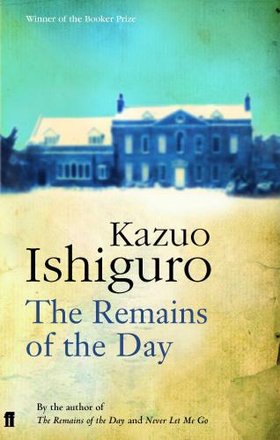
Review : The Remains of the Day

(Orginial review posted on Goodreads:- November 24, 2012)

When I had merely read about 30 or so pages of this book, I must confess I was debating whether or not to
continue with it, given the unbearably slow pacing of the plot.
And then when I had finally reached the end, I couldn't help but feel immensely thankful to my own better judgement against giving it up. Since by that time I had been reduced to a pathetic, blubbering mass of emotions and tears, teetering on the verge of a major breakdown and marvelling at the writer's remarkable achievement at the same time.

The Remains of the Day is Kazuo Ishiguro's ode to England - its bygone glories, numerous idiosyncrasies and fallacies.
Through the life of Stevens, the protagonist and an uptight butler to a distinguished Lord, Ishiguro takes us on a journey of a nation through two wars which crippled it financially and relegated it to the sidelines of international politics as another nation slowly rose to take its place. But it is not merely the tale of a tottering Britain but also a human drama centering around themes such as self-discovery, lasting regret, nostalgia, unfulfilled love and the enduring desire to start over anew.
Stevens is not merely a symbol of the inimitable sophistication that defines English culture but also an emblem of the undeniable hollowness of it. Of the unalterable mistakes committed in the course of a long and eventful journey - be it the journey of life of a man or one nation.

Even though the verbosity of Ishiguro's prose may tend to make the narrative monotonous from time to time, it is never too big an impediment to navigate around. In fact it is the elegant language which catapults this novel into the league of classic English literature. Besides the unhurried, tender nuances of Ishiguro's story-telling do not deserve any less.

Oh yes he most certainly deserved the Man Booker for this.

5 out of 5 stars.

Monday, August 19, 2013

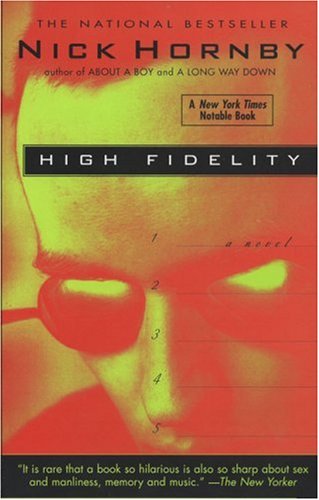
Review : High Fidelity by Nick Hornby


(Original review posted on Goodreads:- December 10, 2012)

High Fidelity is several things at once. 
It is a specimen of ladlit - romance and single life explained from the point of view of a man. And we have so few of those. 
It is a humorous reflection on life and its many failings.
And lastly, it is the tale of a Brit singleton in his mid thirties who is unrelentingly firm in his reluctance to grow into a man.
A man who is so caught up in his fantasies of the ultimate love one is destined to end up with, that he ignores the woman who truly cares for him and consequently ends up losing her.
So the novel begins with our protagonist, Rob Fleming, listing the 5 major break-ups of his life which either hurt him too much or ended up changing him as a person for good. And he takes vicious pleasure in informing the reader that Laura, the woman who just left him, doesn't make the top 5, doesn't even come close.
How could you not get sucked into a book which begins on such a promising note?

An owner of a dingy vinyl record shop named Championship Vinyl, Rob and his two employee-cum-sidekicks Dick and Barry stumble through the maze of life, more often than not clueless about what they are doing.
They debate merits and demerits of obscure bands and music artists and are generous in their display of disdain for the ones who love their Beatles, Billy Joel, Tina Turner, Elton John and the usuals. And these hilarious conversations centering around mundane things like tv shows, movies, music and women lend the plot much of its frivolity and humour. Especially Barry, who is described by Rob as a 'snob obscurantist', makes you laugh uncontrollably with his habit of belittling everything, his sneaky tactics of selling records of artists no one has heard of and his interactions with Dick.
And so the plot meanders through the zigzagging life of Rob, touches briefly upon the lives of all the women with whom he had been in love at some point of time and settles on his on-and-off relationship with Laura.

High Fidelity comes as close to portraying single life and romance as it actually is and not in the larger-than-life Hollywood rom-comish way. It talks about the things we all do in relationships - how we decide how much to reveal to the other person. How our feelings for a person waver time and again and how we often falter, unable to decide what we want. How we hurt the other person in the process. How we realize how precious a relationship was only after it has ended. And more importantly how we are ever afraid of making that feared transformation - be it from girl to woman or boy to man.

Nick Hornby's debut novel is a charming creation - it is like a music record by an artist you may not have heard of but you can relate to the music, nonetheless. 
And you can't help but want to play the record all over again. 

4 out of 5 stars.

Review : The Catcher in the Rye by J.D. Salinger

(Original review posted on Goodreads:- January 22, 2013)

The great C.S. Lewis had opined -
"A children's story that can only be enjoyed by children is not a good children's story in the slightest"
And who, indeed, would dare contradict him? I had kept myself away from the Chronicles of Narnia for a long time, believing I had already outgrown that phase of my life that would've endeared me to this famed set of fantasy tales written for children. How wrong I was!
Finally when I did read 'The Magician's Nephew', I wanted to slap myself for being so hopelessly prejudiced.


With 'The Catcher in the Rye', I'm faced with the same realization all over again.

Some books are written so well, so masterfully that you are bound to get the message the writer had slipped in skilfully somewhere between its pages for the perceptive reader to find and cherish like treasure, only if you care to lay off the pre-ordained feelings and biases.
Sure, I agree, nothing ever happens in this book. The prose, in Holden's own overused words, can be described as 'boring' and insipid in my own. But that is what Salinger had wanted it to be.

I'm pretty sure I wouldn't have liked Holden had I read this as a teen. I would've considered him a whiny, nitpicking pain in the rear. A kid trying to sound and behave like an adult and, of course, failing at it miserably.
But now that I'm a full-fledged adult, capable of knowing what I want and what I don't, I can understand Holden much better. I can't help but feel a sort of grudging respect for Holden's daring act of breaking away even if for a little while, from the compulsions and responsibilities of that life threw his way, the expectations of peers and adults surrounding him.
His voice is so full of pain, loneliness, resentment and all the amorphous emotions of that age, that it's near impossible not to relate to it.

A sense of pure isolation, a feeling of being adrift in the big, bad world with barely anything or anyone acting as an anchor. Faced with problems you previously did not even know existed, an ever-widening gap with the members of the opposite sex. A mass of confusing, blurry thoughts swirling inside your head that you would rather prefer to push away than disentangle one by one and analyze. Sometimes not being sure of what you want to do and what you are supposed to do. Stuck somewhere in a time-warp, on the brink of adulthood yet not quite so, not even close. Demanding to be treated with respect and dignity like an adult, yet to be loved as a child. I'm sure we have all gone through the same motions at some point of time in our lives.
Holden reminds us of that period even if we may not see in him the teenager each one of us had been, individually. He is simply a personification of those confusing, bitter, hazy years that precede the surer, firmer, more secure years.

And if we maybe honest enough with ourselves, we'll find a Holden all holed up somewhere in the darkest recesses of our psyche, eternally disdainful and critical of the people and things around us. It's just that we've gotten better at swallowing urges to lash out at the 'phoniness' of it all.
Holden's appeal is timeless. And I'm quite sure, I'll like The Catcher in the Rye when I read it years down the line.
And for this reason alone, this book rightly deserves the epithet of a true classic.
This is THE YA novel.

5 out of 5 stars.
Related Posts Plugin for WordPress, Blogger...