Showing posts with label Totalitarian Regimes-Fascism. Show all posts

Sunday, April 5, 2015

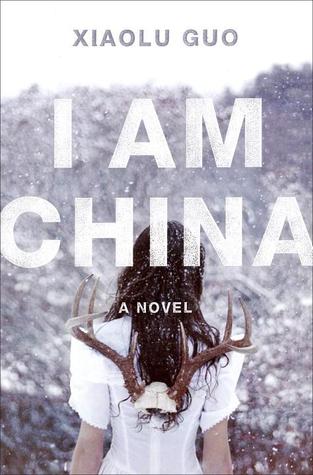
Review: I am China by Xiaolu Guo


Publishing date:-September, 2014

Publishing House:- Doubleday Books

Star rating:-

Seldom do I rue the absence of the solidity of a paperback I can clutch to my chest out of an overwhelming love, memorize the feel of its pages against my fingertips. My priorities lie in knowing what I do not, the means to the end irrelevant in this instance. The advent of the e-reader has negated the problem of the steadily shrinking space on the book shelf and helped me horde books without a care. And yet sometimes a kindle copy just isn't enough. The last time I had felt this familiar pang of kinship with a book right after turning over the last page was when Adichie left me feeling the weight of Biafra's senseless wartime violence (Half of a Yellow Sun). I procured a physical copy right after. 

I will do the same with this one too. Because imperfectly characterized and contrived as it is, this is the story I would want to associate modern China with. This is a book I would want to read again someday. 

All the cacophony around censorship and forgotten square massacres and totalitarianism aside, Xiaolu Guo's globe-trotting, no doubt most ambitious work till date tries to reclaim the dignity of the individual from the clutches of state ownership - a theme I have been desperately seeking out in my pick of literature from the land with less than satisfactory results. 

So far what I have gleaned from the works of writers from the mainland is mostly an overarching sense of dejection and bitterness - a gloomy preoccupation with rubbing old wounds raw.

Outside the bar, the midnight sky was lit by a vast cascade of fireworks, illuminating the solemn and dark Long Peace Avenue, the featureless Heavenly Gate Park, the foreboding Forbidden City, the drumming Bell Tower, and finally creating a fake light of day in Tiananmen Square. A new century of amnesia had arrived on China's earth.

But unlike the defeated, anguished voices of other contemporary Chinese authors, Guo's brims over with a valiant hope. Her Mu and Jian face the consequences of their political beliefs with an understated courage, hop across geographical boundaries to embrace the challenges of a hitherto unknown world outside their beloved China, even if to find themselves thwarted at various junctures. Driven out of their homeland by forces beyond their control and comprehension, they plunge headfirst into individual journeys of self realization, only their letters to each other tethering them to their shared reality in Beijing. And yet the same restlessness of being, the same grim disillusionment and feeble optimism color their evolving worldviews as they grapple with both hostility and acceptance in the humdrum heart of Europe and America. Experiences dismantle their prejudices about the west and the reckless abandon of youth gradually gives way to true wisdom. While Mu comes to acknowledge the purpose in Jian's subversive punk rock concerts in Beijing and his revolutionary zeal, Jian discovers merit in Mu's pacifist stance, her unrestrained love of life, art and literature. 

Art is the politics of perpetual revolution. Art is the purest revolution, and so the purest political form there is. A great artist is a great revolutionary.
Revolution = art, and art = perfect freedom. Right now, we have no revolution, no real art and no freedom.

As a lonely, unsociable Scottish translator unspools the many different threads of their past and present from a collection of letters and journal entries in her London flat, Mu and Jian's discordant voices harmonize in pitch and intensity across the barriers of time and space to meld into a symphony of human triumph. Their unbridled zest for life and liberty comes to symbolize the individual's quest for emancipation, to disentangle oneself from the myth of a national identity. Time, place and circumstances recede into the background. History's tenacious grip loosens. Mu and Jian's enduring love for one another finds its truest expression in the dream of a new China - one freed from the shadow of oppression.

I am China. We are China. The people. Not the state.

May this very dream survive.


**ARC received from Doubleday Books through Netgalley**
_____

Also published on Goodreads & Amazon.


 photo C136E66569D294E4D5DA2D8124D4FF69.png

Friday, January 3, 2014

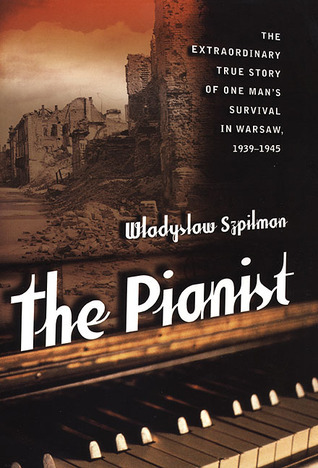
Review: The Pianist by Wladyslaw Szpilman

First published:- 1999
Star rating:- None

This is the first time I am reviewing a book that I have tried and failed to rate.

How do I decide on a rating anyway? Should I judge the prose? the content? the author's style of presentation? his narrative voice? the quality of the translation?
Do I even have the right to? 

Awarding a star rating to this man's unbelievably harrowing and miraculous tale of surviving a war which claimed the lives of 6 million of his fellow brethren for no reason at all, seems a more sacrilegious act than calling Infinite Jest a bad book on Goodreads. 

So I choose not to.

Wladyslaw Szpilman, a pianist working for the Polish radio station, takes us through the years of Nazi occupation of Poland and Warsaw, in particular, and the insensate violence that had the Jewish inhabitants of the city (the ones who were fortunate enough to be spared the concentration camps) living the most brutal and unforgiving of nightmares for a period of almost 5 years.

description
                                                 Wladyslaw Szpilman

Szpilman writes with a kind of unnerving indifference, as if this were someone else's tale of horrors he is narrating and not his own. It is obvious that since he had written this in 1946, immediately after the war, his senses may still have been numbed under the influence of the barbarous acts he had witnessed through the 6 years of the Occupation. His voice doesn't sound sarcastic, debilitated or even a little bit acerbic. Instead, he gives us a neat, uncluttered, unemotional, chronologically ordered account of events which saw him narrowly escaping certain death many, many times.

But this is not just his story. A surprise awaits the unsuspecting reader at the very end, in the form of Wilm Hosenfeld, a Nazi officer who saved Szpilman's life in the last few months of 1944. An astonishingly mild-mannered, generous soul who not only kept the knowledge of Szpilman's existence a secret from the other SS officers, but saved him from certain death out of starvation and the unbearable cold.

But true to the nature of war which justifies countering violence with more violence, Hosenfeld was taken as a prisoner of war when the Soviets finally recaptured Poland. He was tortured to death years later (1952) in some unnamed labor camp in the icy swathes of Stalingrad. His tormentors were especially cruel with him, angered by his claims of having saved the lives of many Jews and Poles during the Warsaw occupation. Which, of course, was nothing but the truth.*

description
                                             Wilhelm Adalbert Hosenfeld

It goes without saying, while reading this book I had no sense of time or any movement around me, I had no idea whether it was still daytime or whether night had fallen. Turning over the last page, when I finally took note of my surroundings I discovered my pillow was half-wet with tears and that I had a dreadful headache.

Some of the most poignant, haunting and reflective passages of the narrative are in Wilm's journal which was recovered years later and incorporated into Szpilman's memoir -

"Evil and brutality lurk in the human heart. If they are allowed to develop freely, they flourish, putting out dreadful offshoots...."

A mere German officer seems to have had the moral strength to admit - 

"Our entire nation will have to pay for all these wrongs and this unhappiness, all the crimes we have committed. Many innocent people must be sacrificed before the blood-guilt we've incurred can be wiped out. That's an inexorable law in small and large things alike."

And yet the "great" Der Führer, in front of whom a vast Empire bowed down at one point of time, could only choose the coward's way out by committing suicide in the end. 

A million stars to the courage of Wladyslaw Szpilman, who aided the Jewish resistance in the Warsaw ghetto, disregarding the constant threat to his own life. A million stars to his unflinchingly honest attempt at looking back at a terrible past. A million stars for enabling the citizens of the world to read, know and derive lessons from the story of his life. A million stars to Wilm Hosenfeld for holding on to his conscience at a time when morality and compassion were in short supply. 

And a million stars to the triumph of the human spirit. 

(So you see the correct rating of this book should be 5 million stars which is beyond the scope of any conventional rating system.) 

*Wilm Hosenfeld was posthumously recognized as a Righteous among the Nations in 2009 by Israel.

P.S.:- This review maybe updated after I watch the movie.


   photo C136E66569D294E4D5DA2D8124D4FF69.png

Friday, October 18, 2013

Review : Chronicle of a Blood Merchant by Yu Hua

First published:-1995
Star rating:- 

I have anemia and irrespective of what comprises my daily diet or the amount I consume, my body's ability to manufacture blood and hemoglobin remains permanently stunted. Which is why I have no choice but to take iron supplements regularly and without fail. 
Once I suspend this routine for a few days, the dizziness, the lack of vigour returns to haunt me with a vengeance. 

So perhaps, it is a travesty of the highest order that I will now proceed to empathize with the protagonist's compulsion of selling his own blood away like a commodity to procure a few Yuan for his family's well-being. 
I am supposed to wax eloquent about how moving an account this is of the mishaps that befall a family, mainly due to the policies implemented by a cruel, unfeeling administration divorced from the needs of the common man.
I do know a thing or two about being bloodless but then I have no first-hand knowledge of suburban and rural poverty in China preceding and succeeding the years of the Cultural Revolution. Hence, I don't deserve to frame a few pompous sounding sentences in a review depicting the hardships of Xu Sanguan and his family and express commiseration. Because come what may, I'll never be able to experience what it feels like to be in his shoes. Even if my family falls on hard times, I'll promptly be shooed away from hospitals or laughed at if I ever did try and sell/donate my blood.

How can I understand destitution, sitting here inside an air-conditioned room typing away patronizingly at a desktop after having read a book on my kindle? I don't know the first thing about working on an empty stomach in a silk factory. Or being forced to savour a bowl of thin corn flour gruel laced with sugar like the finest gourmet dish in existence during a terrible famine. Or having to sell blood and, in turn, risk selling my life away in order for my family to get over a crisis. Or having my life's basic structure re-modelled according to the whims of a delusional autocrat.

But what I do perceive with shocking certainty is the giant, looming shadow of Chairman Mao's legacy of despotism and how deeply it affects the work of writers from this fascinating country. 
It is becoming increasingly hard to imagine coming across literature from and about China devoid of any mention of the Communist Party's history of corruption and the blunt indifference with which they stripped away a generation of people of their dignity as human beings, treating them almost like laboratory mice.

Xu Sanguan goes through life, fights his daily battles with various adversities without knowing the first thing about Communism, Socialism or Capitalism. He only wishes to provide for his family and survive, remaining largely clueless about the political upheavals in his own country or their significance in the greater scheme of things. Forget politics, he only identifies with the English letter 'O' as a circle which denotes his blood group. Such is the extent of his guileless ignorance.

He can only know what being in the throes of starvation feels like and what it is like to be in perpetual need of one thing or another. Concepts like subversion, revolution, agitation or questioning the legitimacy of a regime or higher authority are alien to him.
And yet innocuous as his existence is, ripples of political disturbances outside the realm of his comprehension bring turbulence into his own minuscule sphere of existence. He suffers and we suffer along with him.

Chronicle of a Blood Merchant showcases no instances of ostentatious wordsmithy or lucid erudition. Instead, Yu Hua often resorts to crude metaphors to bring to life the rustic simplicity of the backdrop against which the story unfolds. But what catapults this into the league of great literature is its endearing honesty and its attempt at remaining true to the spirit of an age and a nation caught in a painful phase of transformation. Sanguan's bloodlessness is rife with underlying implications. It is his steady depletion of vitality which symbolizes the silent misery of a generation.

And yet, this book stresses not so much on an anti-communist rhetoric as much as it directs its energies at narrating a tale of blood ties and a family's quest for survival in the face of all imaginable trials and tribulations. A family which couldn't care less about Mao remaining in power or Mao being deposed. 

Because to the Xu Sanguans of China, all meaning in life lies embedded in a crock full of bug-free rice and a few Yuan which can buy them the luxury of gorging on fried pork livers and gulping down a few shots of cheap yellow wine.


4 stars out of 5.
 photo C136E66569D294E4D5DA2D8124D4FF69.png

Saturday, August 24, 2013

Review : Twenty Fragments of a Ravenous Youth by Xiaolu Guo

(Original review posted on Goodreads:- March 9, 2013) 


Sometimes I get this nagging suspicion that there's a greater conspiracy at work to make women writers all over the world feel unloved and unappreciated.
*cough* V.S. Naipaul *cough*

There's a deliberateness in the way most fiction authored by women is either labelled 'chick lit' and dismissed right away without a second thought or made light of under various other excuses.

Why else would this book have an average rating below 3.5 on Goodreads?

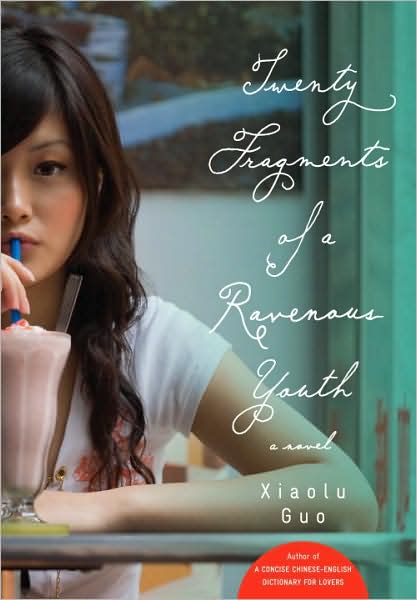
Let me offer you a word of advice. Don't go by the beautiful cover, it is highly deceptive.
Neither is Xiaolu Guo's protagonist half as slender or as pretty the girl on it nor is this book about a girl navigating her way through the world of dating and singles and finding her 'one true love' who sees her 'inner beauty'.

Twenty Fragments of a Ravenous Youth brings into focus the position of women in a country rapidly elevating itself to a position of profound importance in the global arena but curiously enough, lacking conspicuously in the human rights department.
It explores themes of isolation, urban boredom, the sheer tragedy of everyday life, personal freedom and the deep disconnect between an increasingly authoritative Communist regime and disillusioned citizens, in a quintessentially nonchalant manner.

Xiaolu Guo's heroine Fenfang speaks in a slangy Chinese, swears often and has extremely messy living habits. She is strangely apathetic to the happenings in her own life and has the rare ability of analyzing most aspects of it with a matter-of-factness that is as scary as it is unique.
After having quit the disturbingly monotonous life in the countryside where her parents are but humble farmers with little variety in their daily routines, a starry-eyed Fenfang comes to Beijing with dreams of becoming a film actress or a script-writer. But quickly she discovers, the city is not all that it is hyped up to be. Directors aren't interested in casting her as the lead, script-writers and producers won't even read stories 'written by a woman' let alone accepting them as scripts for tv shows. And the old-fashioned folks of her neighborhood who take pride in sporting red Communist armbands to boot, are disapproving of the smartly dressed, independent, young female who has the audacity to bring a man home at night.
Refusing to lose heart, Fenfang starts working as extras on film and tv drama sets and slowly but surely begins carving out a niche for herself. She makes peace with stalkers, violent, physically absent, insensitive boyfriends, the cockroaches in her apartment and even the police who arrest her just to deliver a lecture on ideal behavior expected of an 'unmarried woman' and the unreasonableness of a woman being too 'individualistic'.
But even in the midst of these bleakest of surroundings, she finds an answer to the eternally baffling question of what true freedom really means.

This book has tried to lay Beijing bare - reveal the ugly side of a city which still insists upon practising blatant sexism and vigilantly guarding obsolete ideals in the 21st century, while maintaining the facade of rapid infrastructural development.
And it has helped me come to the realization that it is indeed possible to merge pertinent socio-political issues seamlessly with an otherwise ordinary story of an ordinary girl.

Neither has Xiaolu Guo tried to present this book as highbrow literature nor has she made the effort to write long, verbose sentences replete with symbolism or imagery. Instead she has directed her energies at highlighting the predicament of the young, modern woman all over the world and especially in a country like China, where the so-called 'weaker sex' is still not in the driver's seat. And for me, this is an achievement she deserves praise for.

A 3.5 stars rounded off to a willing, impressed 4 stars.

Related Posts Plugin for WordPress, Blogger...