Showing posts with label Young Adult. Show all posts

Monday, October 6, 2014

Review: The Secret Place by Tana French

First published:- August, 2014

Published by:-Viking Adult

Star rating:- 


Few other books have conjured up the ghost of my teenage years as successfully as this one, dredged up the hazy remembrance of that first, most agonizing heartbreak, the subsequent amateurish cynicism summoned up to preclude the hassle of emotional hangups and the feeling of having only just the foggiest notion of how the world works.

It is awe-inspiring how Tana French continues to incorporate such authentic sociocultural commentary into narratives which are usually taken to be written for the sole sake of providing cheap thrills. So blame her if I end up sounding like a smitten fangirl every time I review a book of hers. She is just that good even when she is writing out a logically fallacious scenario.

The teenage girls of 'The Secret Place' are much more than what C-grade teenybopper flicks and stereotype-riddled YA books make them out to be. They are capable of as much cruelty as kindness, as much self-sacrifice as vindictive selfishness. Here, the conniving, bitchy and backstabbing blonde isn't a cardboard cutout 'mean girl' symbolizing pure evil just as the archetypal good girls aren't as puritan. And a private boarding school turns into a zone of ineluctable conflict of interest where the realm of the personal frequently dovetails into that of the collective forming the intricate web of high school politics which implicitly governs the place.

...a place like this is riddled with secrets but their shells are thin and it's crowded in here, they get bashed and jostled against each other; if you're not super-careful, then sooner or later they crack open and all the tender flesh comes spilling out.

More impressive is how the four girls who lie at the heart of the mystery do not let their budding sexualities define their lives, or even sacrifice individuality on the altar of some contrived requisites of 'coolness' which teenagers are prone to do since rarely do they know any better at that age. Instead, they defy odds to carve out a private utopia for themselves, a clique which doesn't require the glue of some common ideology to survive - a secret place neatly tucked away in an obscure corner of their minds where they can be wholly unabashed of the unflattering sides to their personalities, sure of the fact that they will have each other's backs even when the world goes to pieces. 

...the whole point of the vow was for none of them to have to feel like this. The point was for one place in their lives to be impregnable. For just one kind of love to be stronger than any outside thing; to be safe.

In a way, the narrative of friendship and loyalty in the aftermath of a terrible crime is reminiscent of an earlier book in the series -The Likeness - which in turn was inspired by Donna Tartt's The Secret History. So fans of any of the former will be sucked right in even if they may have reservations about stories involving teenagers, specially teenage girls who are forever being dumbed down by writers looking to make a quick buck. Ms French here, true to her gift for impeccable characterization, adds many dimensions to their personalities. 

As the common refrain goes, calling books of the Dublin Murder Squad series mere 'crime novels' is almost like an outrageous insult. And this one's certainly no exception in this regard. There are two parallel 'before' and 'after' narratives devoted to uncovering the truth of the same murder. A story of the tragic collapse of a close-knit group of teenage girls who, even while trapped in the complicated tangle of sexual politics, fight to ward off influences which threaten to destroy their fortress of solitude. A celebration of the bond of friendship, how powerful and all-consuming an affair it can be and how unpredictably it can turn dangerous and even life-threatening. And, in the end, a poignant tribute to those charged years of adolescence, a unique phase of our lives we look back on with equal parts terror and fondness.

They are a forever, a brief and mortal forever, a forever that will grow into their bones and be held inside them after it ends, intact, indestructible.
**I received an ARC from Viking Adult via Netgalley**
___

Also posted on Goodreads and Amazon.

 photo C136E66569D294E4D5DA2D8124D4FF69.png

Monday, November 11, 2013

Review: Ready Player One by Ernest Cline


Star Rating: 


The only thing about Ready Player One that I can even remotely appreciate is the nostalgia it might stir up in readers who grew up in 80s America. Cline, in his debut offering, uses his love and knowledge about yesteryear pop culture to cleverly mask its many technical shortcomings. He lays out a plot that guarantees fun - an elaborate 80s-themed treasure hunt in a futuristic virtual world. And judging by the high average rating on GR, he seems to have gotten away with it.

How "fun" this book is depends on how much you know, or want to know, about the movies and video-games and music of the 80s. Forget the west, I hardly know anything about Bollywood movies from that era. So reading this book was like being stuck in a fangirl/fanboy convention without a clue about what the gush-fest was for. My initial curiosity kept me entertained and Cline's long explanations made sure I could keep up but that lasted only for the first 30 percent. The onslaught of pop culture was so relentless that fun turned to exhaustion pretty quickly. My patience finally ran out around page 300 and I skipped straight to the rather-obvious end.

Let's keep the pop-culture aside and look at the rest.

Characters? Flatter than cardboard. One-dimensional. Painfully contrived.

Writing? I won't call it terrible, but it's not something worth appreciating either. Mediocre at best, annoyingly juvenile at worst. I've come across better sentence construction in fanfiction.

Plot? It is one long sequence of duex ex machinas. Crazy coincidences. Stumbling across lifesavers by chance. Inane plans that work out. Every. Single. Time.

World-building? If you're going to give me amazing virtual reality, you must first make me believe in a real world where such a thing can be thought of as feasible. But as detailed as the OASIS is, Cline's real world is just as vague. All I know is that it's 2044 and the Earth is ugly because there's climate change and energy crisis and starvation and all that. So everyone escapes by logging into the OASIS - something that requires a special console, haptic gloves and virtual-reality visors.
Yeah right.

What frustrates me most is the lost potential in the tale. We're talking about people who are so fully attuned to their virtual selves that they have no life outside the OASIS. There is so much to explore here - the psychology of these characters, the clash of identities, the perception versus reality debate. But Cline takes all that potential and throws it out the window. No wait, he mentions a lot of deep things and then leaves them be. Because how can thought-provoking and fun exist at the same time, no?

There is nothing wrong with fun. But there is also nothing spectacular about fun. Which is why I'm more than a little surprised with all the gushing reviews and high ratings. I expect this to be the most unpopular of all my unpopular opinions yet, but I believe Ready Player One is the most overrated book I've ever read.

1.5 rounded off


Thursday, October 10, 2013

Review : Paper Towns by John Green

I sit here at my desk, staring blankly at the notepad document wondering what kind of a review will be able to portray effectively all that I felt for this book and yet manage not to come off as an incoherent, mawkishly emotional discourse on the failings of life.
On the one hand, there's this hazy voice at the back of my head - the one voice embodying the spirit of the slightly snooty me who almost had me convinced that I won't find another good YA book to read again - telling me to single out all the minor flaws and inconsistencies, elaborate on them and dismiss John Green with a condescending, pat-on-the-back kind of review.
On the other hand, there's the voice of the the flawed, often conflicted, unsure but honest me - asking me to be generous instead of patronizing, to have the courage to admit that the poignant ending made me shed tears and that often, our heart craves for a heart-warming, bittersweet yet simplistic story that represents life itself, in its myriad manifestations, rather than endless pages of rich, flowery prose and little more.
I am honoring the intentions of the second voice. (I mostly go with the second voice. Please care to note the word 'mostly'.)

At a superficial level, Paper Towns, is not much apart from a regular YA novel. It's about American teenagers doing what teenagers do - survive high school, try to fit into social cliques, get into colleges, date, break up, date again, lose their virginities and so on and so forth.
Yet deeper beneath that surface, it is a story flavoured with the bittersweetness of life itself.
It is about an unremarkable, often ignored boy named Quentin whose presence is almost taken for granted by every one around him. And it is about his polar opposite - an exceptionally interesting girl called Margo, Quentin's neighbor, who is seen only as the quintessential popular girl at school. And it is about the pair of them discovering who they really are underneath that exterior of carefully preserved appearances through a long and convoluted process..
When Margo goes missing after a night of vengeance wreaked on a handful of people at school who 'betrayed' her, the only person truly interested in getting her back or finding out her whereabouts is none other than Quentin. Because, predictably, our male lead has a crush on Margo since he was a kid.
But how does he find her when she has disappeared supposedly without a trace? - Turns out Margo has left clues behind for only Quentin to piece together and figure out where she is headed and more importantly, why she has taken off abruptly anyway.
This puts Quentin at the head of a long, winding, physical and metaphysical journey of deconstructing the enigma that Margo Roth Spiegelman is, figuring out where she is and in the process of it all, coming closer to understanding himself and the people around him better.

As a woman who spent her adolescence in a country named India, let me say that American YA fiction makes us feel as if we're reading about people from an alternate plane of reality. While American teens go to prom, date, lose their virginity, smoke pot, go clubbing, (sometimes) engage in illegal activities, take a gap year after school and mainly act and behave like adults, Indian teens are busy taking tuitions to get into the premier engineering institute in the country.
Because our society holds a degree in engineering in the highest regard and sees it as a one-way ticket to the realm of financial eminence.
So it's more of an understatement to say that we do not relate to American teens - we read these YA novels partly out of bizarre fascination and partly out of curiosity.
But rarely do we stumble upon a YA book which is able to surmount the barriers of stiff cultural divides and sing to the universal human spirit.
Paper Towns is like that rare gem in a genre well-known for its banality. It is alternately frivolous in its portrayal of teenagers and melancholic in its ruminations on life, love and the way we choose to put labels on people without caring to know the real person under the disguise of the stereotype.
But it is not free from its quota of cliches and minor flaws. The pairing up of the school geek with the school beauty, her jock boyfriend and bitchy best friend and two additional nerdy boys as sidekicks of the male lead - these are but formulaic elements found in a run-of-the-mill YA novel.
Also, in real life a girl like Margo Roth Spiegelman is unlikely to exist and even though she insists on the contrary, her penchant for drama and actions appear to be desperate bids for more attention - a fact John Green doesn't gloss over by making the side characters point this out to Quentin time and again. There's also something very Holden Caulfield-ish about Margo, a thought I just couldn't get out of my head.
Not to mention, the whole premise comes off as a little unrealistic as well - Margo is repeatedly shown to be a near invincible character whose plans and designs seldom fail.
But even so, the strengths of this book do enough to overshadow its shortcomings. John Green's fast dialogue and witty one-liners make you smile.
"Getting you a date to prom is so hard that the hypothetical idea itself is actually used to cut diamonds."

"Girls dig you," he said to me, which was at best true only if you defined the word as girls as "girls in the marching band."

Some of the hilarious situations that Quentin and his friends find themselves in during the course of their road trip, made me laugh out loud multiple times. Which doesn't happen often.

Ben keeps bouncing his legs up and down.
"Will you stop that?"
"I've had to pee for three hours."
"You've mentioned that."
"I can feel the pee all the way up to my rib cage," he says. I am honestly full of pee. Bro, right now, seventy percent of my body weight is pee."

And what sealed my absolute, unwavering love for this book was the ending. The sheer poignancy of it will stay with me for a long time.
John Green dares to ponder on the difference between being in love with the idea of a person and being in love with the actual person, while staying within the limits of a genre not noted for its depth or emotional range.
And this is why, Paper Towns stays with the reader long after he/she has finished reading - as a great story and as a somewhat sentimental discourse on the imperfection of our lives.

 photo C136E66569D294E4D5DA2D8124D4FF69.png

Saturday, October 5, 2013

Review: Forgive Me, Leonard Peacock by Matthew Quick


Either this book failed to do what it set out to do, or I went in with the wrong expectations. Whatever the cause, Forgive Me, Leonard Peacock did not have any appreciable impact on me.

You see, I read this book hoping to gain some insight into the mind of a school shooter. Someone like Kevin Khatchadourian, just not so inherently evil. I wanted this book to scare me, stun me, make me question, make me think, maybe break my heart a little.

What I did not want this book to do (and what it essentially did) was give me a long list of excuses for why this guy was walking around with a gun in his bag.

Now, I'm not trying to undermine the gravity of the situation here. Leonard has had a tough life; has endured some horrible things. He's depressed and lonely, he's been bullied, and I understand how difficult that is to get through. But isn't that true for a lot of teenagers?? Not everyone lugs a P-38 to school though. Shouldn't there be something more? Something in the way Leonard's mind works? Something to do with the person that Leonard is rather than the circumstances?

The narrative is designed to make you feel sorry for Leonard. I'm afraid that had quite the opposite effect on me - my empathy meter was stuck at zero. This is going to sound highly insensitive but I felt like Leonard was constantly appealing to the sensitive side of me - See how intelligent I am but nobody appreciates me? See how nice a person I am but nobody talks to me? See how profound my questions are but nobody gives a damn? See how none of my friends, and not even my mother, remember my birthday? Doesn't my life suck? Don't you feel sorry for me? Don't you? Don't you? - and all I could do was watch impassively, with the occasional annoyed eye-roll.

There are only a handful of characters other than Leonard but I cannot tell you anything remarkable about them except that they all seem a little extreme. As much as I hope teachers like Herr Silverman exist, he is almost too good to be true. Leonard's mother is way too absent; she has pretty much abandoned her only son and never bothers to return his messages. Asher Beal is... horrible, supposed to be hated. The whats-her-name that Leonard has a crush on is a little too obsessed with Christianity.

Leonard himself never became a real person in my eyes. At the best of times, he was nothing more than a string of adjectives, too different and too disjoint to go together.

Quick's writing is okay but the structure of the book impedes the flow. The footnotes are more like footessays - long, meandering recollections that make you forget you're reading a footnote until you're suddenly pulled back to the main narrative, following which it becomes necessary to re-read a few lines to grasp the context again. Then there are these "Letters from the Future" that, looking back, are probably some of the most poignant moments the book has to offer, but because Quick doesn't bother explaining their importance until it's too late, you read them only with a growing sense of bewilderment, wondering why you're suddenly in the middle of a post-apocalyptic water-world.

The only point where I felt some semblance of an emotional connection was the very last chapter. It's nothing remarkable, but there is this desperation there that really hit me. It was when I wondered if I had it all wrong. Maybe Leonard was never the "shooter" but just another depressed teenager who, tired of fighting the world, had come dangerously close to giving up altogether.

I don't know if I'd recommend this book. If you can empathize with Leonard then maybe you'll love it. I couldn't, so I didn't.

Forgive Me, Matthew Quick. I'm not impressed.


2 out of 5 stars


Tuesday, September 17, 2013

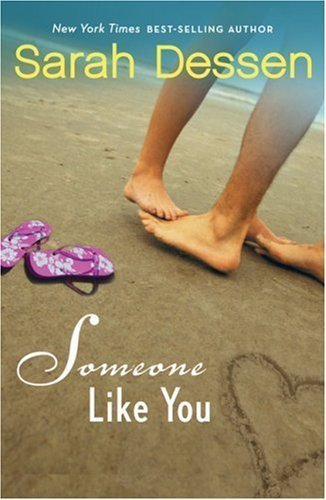
Sarah Dessen and More

Caution:- The following is essentially a review of Dessen's latest book 'The Moon and More', but written in a pretty non-conventional way. So prepare to feel a little exasperated if you were only looking for a plot summary, overview and general deconstruction.

In a parallel universe Sarah Dessen and I may have been intimate friends. But thanks to reality playing spoil sport and imposing barriers of physical distance, cultural and age differences, I can only ever dream of being on first name basis with her.

I discovered Dessen's books during a formative period in my life, in those much feared years when we are transitioning into adulthood from our hapless teens, and held onto her stories for dear life, every time I had to get over a period of depression (possibly induced by a break down of relations with a friend or someone more than a friend) or whenever serious literature lost its appeal in my eyes. Perhaps, this is the point where you start scoffing at YA, lose interest in this review and proceed to ask -

"How much of an insight into real life problems can a mere YA writer provide us with?"

My answer is, you'll be surprised to know.

Prior to my fortunate discovery of Dessen's works, I had a very skewed view of American teens, believing them to be animals prowling the jungle called high school, all replicas of stereotypical characters (the jock-bullies, hot blonde cheerleaders, shy, geeky brunettes, bespectacled nerds who often have their heads flushed down toilets, Goths, social rejects and so on and so forth) shown in mediocre tv shows.

So it will be an understatement to say that Sarah Dessen made me heave a sigh of relief. For the first time ever, I realized all American teens may not be the violent brutes or weirdos I had naively assumed them to be, that they may not be that much apart from their Indian/Asian counterparts, and maybe just as humane and flawed as we are. They have their own moments of mute desperation, struggle to come to terms changes about to materialize and more importantly their relationships with their parents are not close to nonexistent. (contrary to beliefs held by a wide majority of Indians). In other words, Dessen's books throw light on real issues plaguing teens - drug addiction, sexual awakening, destitution, homelessness, unplanned pregnancy, irresponsible/abusive parents.

Her protagonists are adolescent young girls, usually hailing from broken families (raised by divorced/estranged/single parents) who navigate the many challenges life brings them face to face with as they attempt to transition into responsible adulthood. They are soft-spoken, do not throw unnecessary tantrums but go about their business exuding a quiet confidence, deal maturely with first stirrings of romantic attraction instead of melting into gooey puddles, learn a few life lessons all within the scope of a few hundred pages.

Dessen manages to make the story of their lives come alive. As if this was happening somewhere in time, in some other part of the world completely alien to my Indian self. And I was being given a privileged peek into the unfolding of a series of events neither too dramatic nor tinged with a touch of unreality.
There's no dramatic reunion between emotionally absent father and estranged daughter, there's no hot sexual tension existing between the romantic leads, there's no promise of a forever after. There are no violent arguments between disagreeing parents and rebellious kids either.

Dessen understands well that life is a bundle of imperfections. So instead of giving us a too-good-to-be-true antidote to all problems, a neat tying up of all loose ends, she gives us hope.
Hope for a future where the possibility of that neat tying up of all loose ends remains alive.

Her style is minimalistic. She never pretends that she is writing anything but YA or does not give into the temptation of showcasing her command over words or sentence construction, unlike a certain John Green who often goes overboard in his enthusiasm to create a line of distinction between other YA writers and himself. She only tells a story in her own simple, elegant yet understated manner, expecting us to read, enjoy and understand.

But I guess I have outgrown that period of attachment with Dessen's headstrong but dignified young adult heroines. I can no longer devour her stories with a kind of pleasant smile playing about my lips or shed tears as easily as I used to.

Even though I liked Emaline's tale of coming of age or the way she learnt how to hold on to her past while embracing a future, I did not retain anything from the story as soon as Emaline's last summer of high school life ended. I guess I am no longer the confused, disoriented girl struggling to find her place in life like most of her protagonists. And I am no longer as young as I used to be.

(A 3.5 stars to The Moon and More.)

But even so, Sarah Dessen and I go way back. She has been my companion since when I had willfully shunned the company of people I knew in real life. And I still can't seem to resist the urge to squeal like a little girl every time she responds to my tweet. So if she writes another book, I'll most certainly read it if not for anything else then for old times' sake. And who knows? Maybe I'll enjoy it too.


 photo C136E66569D294E4D5DA2D8124D4FF69.png

Tuesday, September 3, 2013

Review: An Abundance of Katherines by John Green

(Original review posted on Goodreads: March 10, 2013)

Here are some things I’ve realized after reading AAoK:

1. John Green is a talented, clever writer with a great sense of humor.

2. Contrary to what I’d like to think, I’m still math-phobic.

3. I’ll never, ever date a has-been child prodigy. Or a washed-up genius. Or a whiny guy who speaks 11 languages. Or whatever it is that Colin’s supposed to be.


An Abundance of Katherines is a hilarious book but it did not make me laugh. Okay, maybe a little but that was more like snorting-in-mild-amusement than full-fledged laughing. I found the humor a little tiresome. But then, I’m the kind of girl who cracks up at things that normal people don’t find even remotely funny so maybe there’s something wrong with me and not the book.

AAoK has a nerdy, heartbroken hero (irritating), some cussing in Arabic (gets taxing after a while), jokes about man-boobs and fractured balls (not really my idea of humor), a lot of math (scary) that strangely looks interesting (I wouldn’t know for sure since I skipped those parts).

Colin really got on my nerves. Whining and theorem-making are not exactly things I’m fond of, and that’s all Colin does (in addition to spewing out random facts). I wish the narration was in first-person; it would have made things more interesting.

The footnotes were a relief. I loved them – even the ones that had math. In fact, they were my sole motivation for trudging through the pages.

This was my first John Green novel and well... I’m not terribly impressed. I hope TFioS and Looking for Alaska fare better.
I’ll leave you with one of those rare lines that actually made me laugh:

“He tried not to sob much, because the plain fact of the matter is that boy-sobbing is exceedingly unattractive. Lindsey said, “Let it out, let it out,” and then Colin said, “But I can’t, because if I let it out it’ll sound like a bullfrog’s mating call.” ”

2.5 rounded off to 3


Review: No And Me by Delphine de Vigan

(Originally reviewed on Goodreads: Jan 24, 2013)

“How do you find yourself at the age of eighteen out on the streets with nothing and no one? Are we so small, so very small, that the world continues to turn, immensely large, and couldn’t care less where we sleep?”

Four years ago, on my way home one night, I met a girl in the train. She was a kid really, selling cheap jewellery. I was standing by the exit, waiting to get down at the next stop. The train jerked, she dropped her stuff and I helped gather it all up – maybe that’s how we got talking. It was a conversation that lasted less than a minute because I had to get down soon, but I remember asking her where she lived. She said:

“Hamara toh koi thikaana nahi hai didi. Hum toh bas idhar-udhar so jaate hai. Kismet ho toh platform par.”

Translation :
“People like me don’t have destinations. We sleep here and there; on platforms when we’re lucky.”

I can’t stop thinking about that encounter ever since I began reading No and Me.

I liked this book a lot. I think I would have liked it just as much even if I hadn’t met that homeless girl that night. No and Me has an impressive subject, two brilliantly sketched characters and a beautifully written story. It’s amazing how this book, which I stumbled across by chance, has left such a deep-seated impression on me.

I won’t say that the book is perfect. A lot of the things that happen are too convenient. Plus the book ends so suddenly that it’s bound to leave a lot of readers feeling high and dry. But that does not really matter – not to me at least.

For me, No and Me isn’t so much about the story as the strangely beautiful bond it explores between the two girls – Lou and Nolwenn. Two girls, who live in starkly different worlds within the same city. Two girls, who try to help each other and make promises they can’t keep. Two girls, who can never fit into each others’ worlds, no matter how hard they try.

And just like that incident in the train, this book doesn't really make me sad; rather, I feel tormented, ill-at-ease and thoughtful. I feel guilty that I never asked her name. I wonder where she is now, where she’s sleeping tonight.

No and Me deserves a lot more readers than it gets.

“Before I met No I thought that violence meant shouting and hitting and war and blood. Now I know that there can also be violence in silence and that it’s sometimes invisible to the naked eye. There’s violence in the time that conceals wounds, the relentless succession of days, the impossibility of turning back the clock. Violence is what escapes us. It’s silent and hidden. Violence is what remains inexplicable, what stays forever opaque.”

3.5 rounded off to 4


Saturday, August 31, 2013

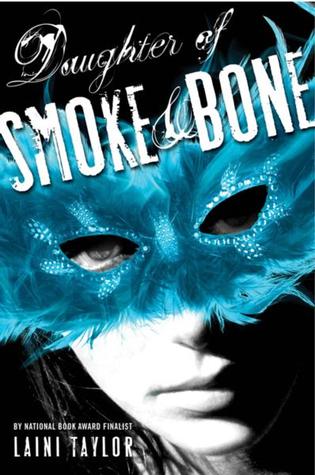
Review : Daughter of Smoke and Bone by Laini Taylor

(Review originally posted on Goodreads:- November 16, 2012)

Dear Ms Taylor, there's not even a shred of doubt in my mind about your ability to tell a story
in the most enigmatic and captivating fashion. You have made your characters appear straight out of our exaggeratedly romanticized fantasies where everything is grandiosely beautiful - even the most evil and terrifying things. Your Prague is every bit as surreal and out of this world as Eretz.
The same can be said about your prose. It is mesmerizingly soothing and reading this book felt like listening to a delightful piece of musical composition where no note feels jarring or misplaced.
But even so, I'm sorely disappointed. DoSaB has no tale to tell. While the beautiful writing, kept me going smoothly at least till the middle point, I kept waiting for something...anything... to happen. But nothing ever did, except at the very end and by that time it didn't matter anymore.

The brilliantly conceived set-up is there. The characters, albeit very stereotypical ones, are there. The language and similes and metaphors and all kinds of literary embellishments are there. 
But where's a good story? Where's character development? Where's the suspense? Where's the mystery? Where's the drama? Where's the romance? 

At least a quarter of the book is devoted to flashbacks and memories. Another quarter to Karou and Akiva angsting over each other. Another quarter to Karou and her chimaera family (which was the best part in my opinion). And another to Karou's hair and Akiva's eyes.
I'm not kidding. I should've counted the number of times the writer alluded to Karou's blue hair and the similes she devoted to its description. Same with Akiva's eyes and his ethereal, impossible beauty.
Sure sure we get it, Laini. They're both surreally beautiful beyond what our feeble imaginations can conceive. Can you please move on now?

Another thing which irked me beyond measure was the love story. I was supposed to be mooning over Akiva and Karou, feeling sympathy for their fate of star-crossed lovers. Instead I felt detached and some measure of annoyance. 
Why did they fall in love with each other again?
Uh they just did. Just like that. I can't remember why but they just did. And it's supposed to be romantic and heart-breaking except that I just don't feel it is.

Last but not the least, the thing which finally caused me to abandon hope for this book was its dilly-dallying between two heroines (although both are one and the same). We start the book thinking it's all Karou. Then Madrigal comes barelling into the story from nowhere and pushes her completely out of the picture. From then on, it's all her. 

And just when I was developing some sort of liking for her, she is gone. Poof! And Karou is handed back to me as unceremoniously as possible, when I can't quite figure out whether I want her back again.

An eloquently-worded novel, but not a good story. Certainly not worth spending rare hours of free time over.

2 out of 5 stars.

Photobucket

Monday, August 19, 2013

Review : The Catcher in the Rye by J.D. Salinger

(Original review posted on Goodreads:- January 22, 2013)

The great C.S. Lewis had opined -
"A children's story that can only be enjoyed by children is not a good children's story in the slightest"
And who, indeed, would dare contradict him? I had kept myself away from the Chronicles of Narnia for a long time, believing I had already outgrown that phase of my life that would've endeared me to this famed set of fantasy tales written for children. How wrong I was!
Finally when I did read 'The Magician's Nephew', I wanted to slap myself for being so hopelessly prejudiced.


With 'The Catcher in the Rye', I'm faced with the same realization all over again.

Some books are written so well, so masterfully that you are bound to get the message the writer had slipped in skilfully somewhere between its pages for the perceptive reader to find and cherish like treasure, only if you care to lay off the pre-ordained feelings and biases.
Sure, I agree, nothing ever happens in this book. The prose, in Holden's own overused words, can be described as 'boring' and insipid in my own. But that is what Salinger had wanted it to be.

I'm pretty sure I wouldn't have liked Holden had I read this as a teen. I would've considered him a whiny, nitpicking pain in the rear. A kid trying to sound and behave like an adult and, of course, failing at it miserably.
But now that I'm a full-fledged adult, capable of knowing what I want and what I don't, I can understand Holden much better. I can't help but feel a sort of grudging respect for Holden's daring act of breaking away even if for a little while, from the compulsions and responsibilities of that life threw his way, the expectations of peers and adults surrounding him.
His voice is so full of pain, loneliness, resentment and all the amorphous emotions of that age, that it's near impossible not to relate to it.

A sense of pure isolation, a feeling of being adrift in the big, bad world with barely anything or anyone acting as an anchor. Faced with problems you previously did not even know existed, an ever-widening gap with the members of the opposite sex. A mass of confusing, blurry thoughts swirling inside your head that you would rather prefer to push away than disentangle one by one and analyze. Sometimes not being sure of what you want to do and what you are supposed to do. Stuck somewhere in a time-warp, on the brink of adulthood yet not quite so, not even close. Demanding to be treated with respect and dignity like an adult, yet to be loved as a child. I'm sure we have all gone through the same motions at some point of time in our lives.
Holden reminds us of that period even if we may not see in him the teenager each one of us had been, individually. He is simply a personification of those confusing, bitter, hazy years that precede the surer, firmer, more secure years.

And if we maybe honest enough with ourselves, we'll find a Holden all holed up somewhere in the darkest recesses of our psyche, eternally disdainful and critical of the people and things around us. It's just that we've gotten better at swallowing urges to lash out at the 'phoniness' of it all.
Holden's appeal is timeless. And I'm quite sure, I'll like The Catcher in the Rye when I read it years down the line.
And for this reason alone, this book rightly deserves the epithet of a true classic.
This is THE YA novel.

5 out of 5 stars.

Sunday, August 18, 2013

Review : Nick and Norah's Infinite Playlist by Rachel Cohn and DavidLevithan


(Original review written :- April 12, 2009)

I never really expected a book, each of whose pages are strewn with f-words to impress me. But uncannily enough this piece of young adult fiction by Rachel Cohn and David Levithan did. This book is about two teenagers each of whom are going through a difficult phase in their lives and how one night of togetherness helps change their views towards love, life and the future ahead.

Nick, the conventional 'nice guy' and the bassist of a band which doesn't have a fixed name, has just recently been dumped by his girlfriend Tris after he confessed that he loved her. Norah,on the other hand, is a loner despite having been in a relationship with the chauvinistic and the self-centred Tal for the last 3 years. She is the straight-A student, the feisty and a tad spoiled daughter of the hot-shot CEO of a record company and the chaperone of her best friend Caroline who is quite the party animal and gets drunk at every opportunity she gets. Norah is the witty, intelligent kind of girl who can't exactly be called hot but is beautiful in her own way if you notice carefully. Thus these two people meet on an eventful night while Nick and his band (they were calling themselves 'The Fuck-Offs' for the night...ridiculous huh?I know -_-) were performing in a certain club where Norah also happened to be present along with Caroline. And after Nick comes up to Norah and fake-propositions her with this corny line - “I know this is going to sound strange, but would you mind being my girlfriend for the next five minutes?” and she accepts his ludicrous proposal, their whirlwind journey through the night begins - a night during which they discover that their notions about love were prejudiced and learn how to deal with the demons of their past.

Norah who had been in only one relationship all her life instantly takes a liking to the decent and well-mannered Nick. Nick however finds it hard to get over Tris and entertain the idea of having a new girl in his life. Eventually though he comes around and realizes that Norah could be more than just his 'music soul-mate'. And all of this happens during the course of a single night as these two teenagers make their way through different clubs and gigs in Manhattan.

So now why do I like this book? The story seems like it has all the hackneyed themes of a typical young adult or 'chick lit' novel.
I think this is juvenile fiction at it's best. Because Nick and Norah are actual teenagers here who do not adhere to cliched portrayals of American teens who indulge in drugs, sex and alcohol in various high school dramas or tv shows. They have their own strong points and weaknesses. They are good and they are bad, at the same time. Profanity is a regular part of their vocabulary, yet there is nothing offensive about the way they hurl swear words at each other or others. It's almost like part of a tough guy/girl act on their part to hide the sadness that lies underneath the exterior.

Another thing that I liked about this book is that despite being a romance novel it never gets too mushy or cloyingly sweet. It's not the kind of romance where boy and girl meet, fall in love and get married after overcoming different kind of obstacles.
Nick and Norah discover how an ordinary night can turn out to be nothing short of spectacular and exciting when one has the right kind of company. It's almost as if forever is trapped somewhere inside that night where Nick and Norah and their relationship have endless possibilities. It could be that they end up married someday with a son named Salvatore as Norah muses ('Salvatore' was printed on Nick's jacket which he offers Norah). But for the moment, for the night ,it doesn't matter. This night is theirs and theirs only. And perhaps, it will stretch itself into both of their future lives.
Narrated alternatively by Nick and Norah, the story is fast-paced and the dialogue, witty and sarcastic. A recommended read for teenagers and also for readers who like their romance novels without the dose of mush.

P.S:- I watched the movie after finishing with the book but as usual was disappointed. Michael Cera and Kat Dennings made a good lead pair but the screenplay was bad - even yucky in parts (Caroline and her chewing gum-eww). For Heaven's sake why don't the directors follow the original storyline of the novels? I, for one, feel the end-product will turn out to be much better if they followed this simple rule.

Related Posts Plugin for WordPress, Blogger...