Showing posts with label Short Stories. Show all posts

Saturday, July 5, 2014

Review: Law of Desire: Stories by Andrej Blatnik

First published:- 2000

About to be republished on (after being translated into English):- July 15th, 2014

Republished by:- Dalkey Archive Press

Star rating:-

Short stories are such a tricky thing to get right and such a hassle to review. 
Before you have even settled down into the comfort of one minor narrative, a new one with brand new settings is silently demanding your undivided attention. A tiny slip in your concentration could result in that elusive thread of some unnameable, intangible emotion that you are struggling to disentangle from the jumble of lives and internal monologues, zipping past you with the agile grace of an eel. 
And having turned over the last page, you are facing the difficult prospect of making out all the discordant notes from the individual stories and combining them into a common refrain which captures the general mood of the collection. Unless the author can profess to being at par with one of those world-renowned masters and mistresses of the short story format (Munro, Maupassant, Carver, Lydia Davis, Gogol and so on) who have got it down so pat that each one of their stories stand out and leave permanent markings etched on to the slippery sands of memory, he/she has an uphill task ahead. 

I can vouch for the fact that Andrej Blatnik's stories cannot be shoehorned into any known category of writerly acuity. There's no single overarching theme that strings the whole collection together. And not all the stories can be commended on their execution or even thematic clarity. While some of the short stories give off a surrealistic Italo Calvino-esque vibe by blurring the boundaries between real and absurd, some of the others remind me of Murakami with their efficient juggling of nameless, wryly witty narrators who shirk responsibilities, intriguingly secretive women and emotional isolation. The remaining deal with themes as varied as PTSD-afflicted, psychologically scarred young men returning from the battlefield, the beauty and terror of fatherhood, the tragedy of young children adjusting to a newly motherless household and even something as eerie and nihilistic as a runaway convict resigned to his fate of being turned into a human sacrifice in an African village.

"The man feels the open dome of the sky descending, embracing him, he senses the universe closing in, he smells the brittle tail of comets, the gravity of distant worlds brushes his cheek. Galaxies open up and beckon him in. The man knows: This is the beginning; this is just the beginning."

The stories seem to be weakly delineated on purpose, the characters having no qualities that make an impression worth remembering, their lives appearing to be hazy silhouettes that never truly come into focus, just remaining out of reach for you to draw your own conclusions, which is precisely how short stories should be. But there's something more which accentuates their uniqueness, a disorienting effect that Blatnik manages to induce in the reader - an all-too-familiar sorrow, a feeling of unfulfillment arising out of a failure to communicate, and the concomitant cruelty of everyday lives of people trapped in the labyrinth of the urban jungle.

So even though I had my mind virtually made up to go with a 3.5 stars rounded off to a 3, I am conceding another one in the hopes that an above-average rating will help this Slovenian writer gain a wider readership, especially now that he has been translated. He really does deserve all the attention he can get.

**I received an ARC from the Dalkey Archive Press via Netgalley**


Also published on Goodreads and Amazon.

   photo C136E66569D294E4D5DA2D8124D4FF69.png

Saturday, June 28, 2014

Review: Speedboat by Renata Adler

First published:- 1976

Republished:- March 19th, 2013 by NYRB

Read in:- June, 2014

Star rating:-

Much of life does not make a lot of sense in the moment it is occuring. Only in posterity, when we dwell on memories, are we able to see past happenings in a clearer light. The passage of time helps us tame the inveterate romanticism of first perceptions and lets the realization sink in that some things are just what they appear to be and further efforts at figuring out some deeper significance are going to remain futile forevermore. Scattered fragments of time spent with people in places glow like fireflies in the dark but the dots never connect. No hidden, congruous patterns emerge. Some moments stand out in the multitude and bring us pleasure, sorrow, mirth, intrigue or some other keenly felt emotion while the rest merge with the void and perish.

Renata Adler's writing is thoroughly deserving of all the accolades because of her earnestness at remaining faithful to dull realities, everyday mundane things that we eagerly discard in favor of the exaggerated glamour of tragedy or romance. Her fictional love interests are ordinary and unexciting, her protagonist is just another city girl in the endless sea of anonymous faces, and her sardonically narrated observations utterly devoid of the artistic grandeur found in the trademark melancholic novel on urban alienation. 

Just as the traditional narrative of the novel is subverted without any pretensions in 'Speedboat' which, true to life, refuses to stitch together ephemeral moments into a much bigger collage of the human consciousness, the short story format is also ingeniously shunned. Adler's aphoristic 'stories' (for lack of a more apposite term) are just what they are - anecdotes on events and conversations recounted somewhat dispassionately and left unexplained, minor departures from the cyclical nature of routine-bound life laid bare for the readers to dissect and derive their quota of 'reading between the lines'from. The random handsome, young man encountered on the subway on your way to work who monopolized your attention for the length of the journey, the quarter found in the backseat of a cab that you surreptitiously picked up after wrestling with your conscience for a while, the ailing woman on the verge of certain death in the hospital ward who said she was doing fine on being asked how she was - these are but some of the many discrete snapshots of our collective lackadaisical existence in the backdrop of any nameless metropolitan city of the world and not just Adler's New York.

"The idea of hostages is very deep. Becoming pregnant is taking a hostage-as is running a pawnshop, being a bank, receiving a letter, taking a photograph, or listening to a confidence. Every love story, every commercial trade, every secret, every matter in which trust is involved, is a gentle transaction of hostages. Everything is, to a degree, in the custody of every other thing."

Her depiction of idiosyncratic urban life as she knew it is one of the most life-like I have ever come across and, possibly, ever will.


   photo C136E66569D294E4D5DA2D8124D4FF69.png

Saturday, June 21, 2014

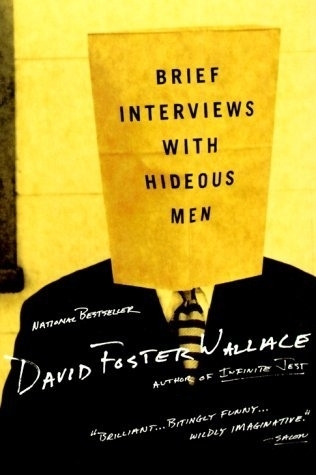
Review: Brief Interviews with Hideous Men by David Foster Wallace


First published:- 1999

Read in:- April, 2014

Star rating:-

To call these meanderings and sub-meanderings of a brilliant mind short stories, will be akin to putting a leash on DFW's creativity with the aid of conventional terminologies and thereby undervaluing the sheer inventiveness on display in this compelling collection. 
In course of my limited venturings into DFW's literary landscapes I have arrived at one crucial inference. That to read DFW is to transgress the very act of simply reading through and discover a newer way to commune with his chain of thoughts, to work your grey matter just a tad bit harder to truly grasp what he has intended for you to understand. And that's an exercise I am all too happy to engage in especially if it sharpens my senses and compels me to achieve a state of oneness with the narrative without sparing a second thought to any of my other parallel reads.
Reading him is like being given the unique opportunity to listen in on one of the greatest minds that ever existed speaking from some imaginary podium and letting that same mind direct my own to follow pathways that it didn't even know existed. It's like making yourself a part of the virtual reality he has recreated through his words and believing in the truth of it without trying to compartmentalize his writing.

Hideous men (and, occasionally, women) and the alarmingly convoluted inner workings of their still hideous minds string this collection together. Some of the 'short stories' are mere snapshots of eponymous interviews of seemingly disturbed individuals, ranging from hippie youths who have devised Machiavellian plans to seduce and subsequently ditch women with psychopathic precision to adolescents with elaborate masturbation fantasies creepy enough to make you involuntarily shudder, while some are little snippets which merely detail the secret inner lives of certain individuals which always remain carefully concealed behind an ingeniously orchestrated charade. Add some metafictional commentary inserted sporadically as footnotes of considerable length, in several of which the author even challenges the potential reader to weird pop quizzes, and you have a hazy idea of what this collection has to offer. But even so, I probably haven't even grazed the tip of the iceberg of DFW's gift for redefining narrative structures. 

Given that I am accustomed to more or less linear narratives, consisting of immaculately crafted sentences which put more emphasis on superficiality of actions and emotions, it is a bit of a surprise to find myself being drawn to a writer who sought to expose the raw core of every pretension. Sometimes while reading I was even tempted to flip a coin to decide whether he was being ironic or simply acknowledging some disturbing reality in a matter-of-fact tone.

"He ruled from that crib, ruled from the first. Ruled her, reduced and remade her. Even as an infant the power he wielded! I learned the bottomless greed of him. Of my son. Of arrogance past imagining. The regal greed and thoughtless disorder and mindless cruelty - the literal thoughtlessness of him."

The man's perspicacity is so palpable in everything he writes and his sincere attempts at perfect reconstruction of thought processes and the true motivations at work behind every human gesture so obvious, that I can't help but be charmed. The 5 stars are probably a dead giveaway of my veritable moony-eyedness. 

Belying expectations the footnotes did not annoy. The infinite digressions merely served to intensify my fascination with the way DFW's mind worked.
But can it be said that DFW left behind a body of work which can be given the label of 'proper literature'? The answer to the question depends on the way you choose to constrict your definition of 'proper literature' or whether you choose to constrict it at all. 

The man was a genius and his suicide only translates into a profound loss for all the good which remains in the world of publishing. And I doff my hat in honor of the creative freedom he refused to sacrifice while writing.


   photo C136E66569D294E4D5DA2D8124D4FF69.png

Wednesday, April 9, 2014

Review:The Frangipani Hotel: Stories by Violet Kupersmith

First published:- April 1st, 2014

Published by:- Spiegel & Grau

Star rating:- 

What your mind dredges up from memory and consciousness upon the utterance of the word 'Vietnam' is wholly predictable. That naked girl child of Trảng Bàng fleeing a napalm attack in terror, her scream silenced by the stillness of the well-known picture you have glanced at time and again or the grotesque image of blood-soaked bodies heaped by the side of a rice field in My Lai that continued to burn like a stinging slap across the face of the American administration long after the troops had pulled out of Vietnam. But the sheer tragedy of a nation being whittled down to the status of being defined by an ill-famed proxy war and a trendy word with an 'ism' at the end, has its roots in our collective apathy. 

Marguerite Duras' Indo-China (as described in her fictionalized memoir The Lover) was a place inextricably linked to the abuse of her childhood years, a cultural melting pot, an eerie and exotic landscape which served to simultaneously heighten and assuage her mental anguish, a nation still resigned to being seen as just another jewel in the crown of Europe. But Violet Kupersmith's Vietnam is the hum of the life force coursing through her veins; the horror and beauty that this culture encompasses, a hand-me-down from her ancestors. And it is this Vietnam, we have not cared enough to know, which inhabits these short stories. The tinge of paranormal intrigue and the elements of suspense are merely there to help you keep turning the pages with ease but it is the landscape itself which towers above the set of native Vietnamese characters and the Vietnamese diaspora in the U.S., metamorphosing into a humanly protagonist narrating a melancholic tale of personal woes.

The water nymph boarder of Hotel Frangipani, the ailing old Mrs Tran whose time on earth runs out while waiting for her now-American daughter and grand-daughters to visit her from far off Houston, the soldier-turned-calligrapher who cannot banish the horrifying memories of accidentally killing a civilian girl while serving the Viet Cong, the septuagenarian who involuntarily undergoes a morbid transformation into a giant python at times and ends up recounting the story of his life to a random Vietnamese American teen, the white girl who works at the American consulate in Ho Chi Minh are many among the imaginary guides that Ms Kupersmith designates to familiarize readers with an assortment of folktale-ish stories with elements of horror as the common running theme.

To quibble, some of the stories have been fashioned in an amateurish way in which character tropes such as the thoughtful, unattractive, fat sister and the insensitive, skinny one and the ignorant, condescending American tourist abound. But the structural and thematic integrity of the remaining stories made up for the flaws of the former and caused my 3 stars to be elevated to 3.5 stars.

Subtlety isn't Ms Kupersmith's strongest suit but her writing serves as a good example of potency of theme and plot surpassing the need for linguistic adornments at times and a rude reminder of my little to no knowledge of Vietnam sans the 'war', an oversight which needs to be remedied post haste. 


___

Review also posted on Goodreads & Amazon.

 photo C136E66569D294E4D5DA2D8124D4FF69.png

Sunday, September 22, 2013

Review : A Schoolboy's Diary and Other Stories by Robert Walser

Faced with the prospect of reviewing a collection of short stories, which is probably my least favorite writing chore ever, I am choosing the easy way out. I am so taken with the quiet, restrained beauty of Walser's writing that I am most unwilling to disassemble his short stories into separate assessing criteria like style, essence, prose, plot, imagery and so on.

So what I'll do is convince you, dear random uninitiated reader, to pick up this little gem, flip through its pages and discover for yourself the treasures embedded within without trying your patience by going into excruciating details. And by letting Walser speak on my behalf.

The initial few short stories are written from the point of view of a school boy in the format of essays on various topics ranging from school, poverty, careers to friendship, politeness, nature and so on.
It is astonishing to note that despite the glaringly trite nature of these subjects, Walser manages to bring something new to the stories by adding a distinct touch of his own. His tone fluctuates between mildly sardonic and wistful to complacent and observant but unassuming.

Sample what he has to say about "school" -

"School is the unavoidable choker around the neck of youth, and I confess that it is a valuable piece of jewelery indeed. What a burden we would be to our parents, workers, passersby, shop owners, if we didn't have to go to school!"

And this is what he says about 'Politeness'-

"The more big and important a polite person is, the more benevolence his civility has."

His thoughts on anger and conflict -

"Not only boys can bear grudges against other boys in such a way, so too just as well can grownups against grownups, mature adults against mature adults, and I would venture to say, nations against nations. A vengeance or revenge can collect in the heart of a nation due to self-regard that has been injured in various ways, and it grows and grows, without end, becomes more and more pressing, more and more painful rises up like a high mountain no longer to be cleared away, obstructs any mutual understanding, inhibits warm, healthy, reasonable reciprocal communication, turns into twitching nervous fury, and is so tyrannical and degrading that it can one day no longer be reined in and cries out wildly for bloody conflict."

There are references to nature, changing seasons and vivid descriptions of lush, green landscapes in the Swiss countryside aplenty.


"Autumn was beautiful, with its brownish melancholy that seemed attractive and happily right to me, while in May the blossoming trees and all the singing and wonderful smells plunged into sadness."

The short stories included in the latter half of the book seem to be written from different perspectives like that modest young men about to enlist in the army or confused, lost writers trying to seek validation in a life fraught with failures and rejections. (This is vaguely autobiographical I believe.)

"Restlessness, uncertainty, and a premonition of a singular fate may have been what led me, in my sequestered isolation, to pick up my quill and attempt to create a reflection of myself."

Here are a few of his excellent ruminations on reading -

"A book bewitches and dominates us, it holds us spellbound, in other words it exerts a power over us, and we are happy to let such tyranny occur, for it is a blessing. Anyone captivated and gripped by a book for a given time does not use that time to initiate gossip about his dear fellow man, which is always a great and crude mistake."
And ahem, book snobs please do take note of this -

"I have sometimes heard people talk about so-called harmful reading, e.g., infamous Gothic novels. That's another story we shall avoid getting into but we can say this much: the worst book in the world is not as bad as the complete indifference of never picking up a book at all. A trashy book is not nearly as dangerous as people sometimes think, and the so-called really good books are under certain conditions by no means as free of danger as people generally like to believe. Intellectual things are never as harmless as eating chocolate or enjoying an apple tart or the like. In principle, the reader just has to know how to cleanly separate reading from life."

Walser's short sentences gave me the impression of beads of morning dew collecting on blades of grass, the evanescent beauty of which evaporates away before we even have time enough to bask in its resplendence. But for as long as the novelty lasts, it is the most exquisite thing in the world. He is not overly pedantic yet his writing exudes immense charm and clarity.

"But soon enough he was cheerful again. Love of humanity and the sorrows thereof, a lust for life and the pain therefrom, rose exquisitely up like tall ghostly shapes in the pale, golden air of the summer evening. Softly the figures seemed to wave to him."

To conclude, this is a thoroughly delightful collection but I'll hold out on that 5-star rating until I read a full-fledged novel of his.

4 out of 5 stars (more of a 4.5)

**special thanks to Netgalley for a copy of the e-edition**

 photo C136E66569D294E4D5DA2D8124D4FF69.png
Related Posts Plugin for WordPress, Blogger...