Showing posts with label Best-sellers. Show all posts

Sunday, November 24, 2013

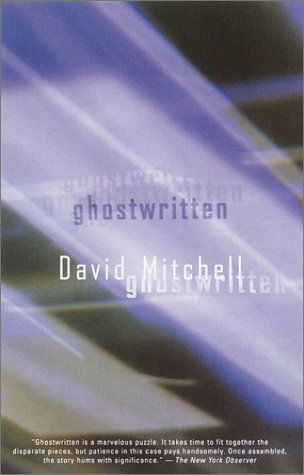
Review : Ghostwritten by David Mitchell

First published:-August 19, 1999
Star Rating:-

"I wonder what happened to him, I wonder what happened to all of them, this wondering is the nature of matter, each of us a loose particle, an infinity of paths through the park, probable ones, improbable ones, none of them real until observed whatever real means, and for something so solid matter contains terrible, terrible, terrible expanses of nothing, nothing, nothing..."

Ordinary human lives, sometimes crisscrossing, sometimes briefly touching, sometimes swiftly passing each other by through the fabric of space and time, creating imperceptible ripples on the surface of some invisible lake of our collective consciousness that eventually lead up to an event of cataclysmic significance....

Everything considered, Ghostwritten is an imperfect masterpiece. In the sense it makes its far-reaching ambitions of being viewed as a tour de force of its generation apparent at the onset but when one sets about to allow oneself keener examination of all its narrative intricacies, it smacks of amateurishness. If, at its best, Ghostwritten is a fascinating meditation on the hollowness of human lives, human fallacies, urban alienation, intertwined fates and our unslakable thirst for validation in the 21st century then at its worst it is a rather complicated mess of styles and themes usually identified with two masters of the craft - Calvino and Murakami. I'd, thus, refrain from calling it masterful and call it the work of a master in the making instead.

There is something so blatantly Murakami-esque about this book, that I am tempted to label Mitchell as Murakami Lite and this is supposed to serve more as a mild chiding rather than approbation of any form. It is like Murakami's ghost (excuse the unintended pun) continuously haunts Mitchell's characters and their lives, his voice reverberating in their unvoiced musings, innermost stream of thoughts, conversations and his invisible presence subtly influencing the magical-realist aspects of the book. So much so there's even a minor character who fleetingly mentions spotting his own doppelganger on the streets of London one day. I almost began anticipating the appearance of talking cats or strange sheep men after this point, although thankfully none were found in the end. 
But regrettably enough, this book failed to give me any of those goosebumps-inducing moments of pure intrigue which I have often come to categorize along with the effects produced by Murakami's surrealistic vignettes. 

It is also quite obvious Mitchell has distilled the essence of Calvino's Invisible Cities into his own deconstruction of modern day cities like Tokyo, Hong Kong, St Petersburg, London and New York in a 20th-21st century set up. The concept of islets of human existence huddled together in their own miniature niches, disparate yet suffering from similar fates, their ideas of the city they dwell in coalescing clumsily to impart the city its true identity, comes into play here but not under the guise of Calvino's beautifully rendered symbolism. 

Prior to picking up this book, I had heard so much about Mitchell and the widespread adoration he enjoys especially among my Goodreads friends, I was expecting something life-altering and unforgettable. And despite the narrative sweep and all-encompassing nature of the subjects Mitchell touches upon here, Ghostwritten seems to be neither of the aforementioned. At least not in my opinion. And as the novelty of the interconnection among the short story length snippets wears off with the gradual progress of the narrative, the lack of finesse in Mitchell's writing becomes all the more prominent.

"God knows darn well that dabbling in realpolitik would coat his reputation with flicked boogers."
(Ugh?)
Inclusion of quite a few crude metaphors like the one above just felt jarring to the overall tone of the novel.

I hope Cloud Atlas is more accomplished.


 photo C136E66569D294E4D5DA2D8124D4FF69.png

Monday, November 11, 2013

Review: Ready Player One by Ernest Cline


Star Rating: 


The only thing about Ready Player One that I can even remotely appreciate is the nostalgia it might stir up in readers who grew up in 80s America. Cline, in his debut offering, uses his love and knowledge about yesteryear pop culture to cleverly mask its many technical shortcomings. He lays out a plot that guarantees fun - an elaborate 80s-themed treasure hunt in a futuristic virtual world. And judging by the high average rating on GR, he seems to have gotten away with it.

How "fun" this book is depends on how much you know, or want to know, about the movies and video-games and music of the 80s. Forget the west, I hardly know anything about Bollywood movies from that era. So reading this book was like being stuck in a fangirl/fanboy convention without a clue about what the gush-fest was for. My initial curiosity kept me entertained and Cline's long explanations made sure I could keep up but that lasted only for the first 30 percent. The onslaught of pop culture was so relentless that fun turned to exhaustion pretty quickly. My patience finally ran out around page 300 and I skipped straight to the rather-obvious end.

Let's keep the pop-culture aside and look at the rest.

Characters? Flatter than cardboard. One-dimensional. Painfully contrived.

Writing? I won't call it terrible, but it's not something worth appreciating either. Mediocre at best, annoyingly juvenile at worst. I've come across better sentence construction in fanfiction.

Plot? It is one long sequence of duex ex machinas. Crazy coincidences. Stumbling across lifesavers by chance. Inane plans that work out. Every. Single. Time.

World-building? If you're going to give me amazing virtual reality, you must first make me believe in a real world where such a thing can be thought of as feasible. But as detailed as the OASIS is, Cline's real world is just as vague. All I know is that it's 2044 and the Earth is ugly because there's climate change and energy crisis and starvation and all that. So everyone escapes by logging into the OASIS - something that requires a special console, haptic gloves and virtual-reality visors.
Yeah right.

What frustrates me most is the lost potential in the tale. We're talking about people who are so fully attuned to their virtual selves that they have no life outside the OASIS. There is so much to explore here - the psychology of these characters, the clash of identities, the perception versus reality debate. But Cline takes all that potential and throws it out the window. No wait, he mentions a lot of deep things and then leaves them be. Because how can thought-provoking and fun exist at the same time, no?

There is nothing wrong with fun. But there is also nothing spectacular about fun. Which is why I'm more than a little surprised with all the gushing reviews and high ratings. I expect this to be the most unpopular of all my unpopular opinions yet, but I believe Ready Player One is the most overrated book I've ever read.

1.5 rounded off


Thursday, November 7, 2013

Review : The Awakening by Kate Chopin

First published:-1899
Star rating:-

Often, I have witnessed a few women, who proceed to talk about misogyny, sexism, or give their views on a piece of feminist literature, starting their discourse with something along the lines of "I'm not much of a feminist...but". As if it is best to put a considerable distance between themselves and this feared 'word' at the onset and deny any possible links whatsoever. As if calling herself a feminist automatically degrades a woman to the position of a venom-spewing, uncouth, unfeminine, violent creature from hell whose predilections include despising all males on the planet with a passion and shouting from the rooftops about women's rights at the first opportunity. 

Attention ladies and gentlemen! Feminism is not so cool anymore, at least not in the way it was in the 80s or 90s.
Don't ask what set off that particular rant but yes I suppose the numerous 1-star reviews of this one could have been a likely trigger. 

So Edna's story gets a 1 star from so many people (on Goodreads in case you are wondering where) because she is a 'selfish bitch' who falls in love with another man who is not her husband, doesn't sacrifice her life for her children and feels the stirrings of sexual attraction for someone she doesn't love in a romantic way. Edna gets a 1 star because she dares to put herself as an individual first before her gender specific roles as wife and mother. 

But so many other New Adult and erotica novels (IF one can be generous enough to call them 'novels' for lack of a more suitable alternative term) virtually brimming with sexism, misogyny and chock full of all the ugly stereotypes that reinforce society's stunted, retrogressive view of the relationship dynamics between a man and woman, get 5 glorious stars from innumerable reviewers (majority of whom are women) on Goodreads, the most popular bookish social networking site on the internet.

This makes me lose my faith in humanity and women in particular. 

Edna Pontellier acknowledges her awakening and her urge to break away from compulsions imposed on her by society. She embraces her 'deviance' and tries to come to terms with this new knowledge of her own self. She desires to go through the entire gamut of human actions and emotions, regardless of how 'morally wrong', unjustified or self-centered each one of them maybe. 

Because THAT is the whole point of feminism. 

"Feminism is the radical notion that women are people." - Rebecca West


A woman to be recognized as a human being first - imperfect, flawed, egocentric, and possibly even as a bad mother and an irresponsible wife. Just like the way society accepts a bad husband as a bad husband, a bad father as a bad father and moves on after uttering a few words of negative criticism. Somehow being a bad father is reasonably acceptable, but being a bad mother is blasphemous.

Edna's husband is equally responsible for abandoning their children as she is. He limits his role as a father to performing minor tasks like buying them bonbons, candies and gifts and lecturing his wife on how they should be raised without bothering to shoulder some of her burden. As if raising children is the sole forte of the mother and the father can nonchalantly evade all responsibility.

I have seen readers being kind to unfaithful literary husbands, being sympathetic to their existential dilemmas (case in point being Tomas and Franz in 'The Unbearable Lightness of Being' which I am currently reading) and even trying to rationalize their incapability of staying in monogamous relationships. But oh heaven forbid if it's a woman in the place of a man! Women are denied entrance into the world of infidelity or sex without romantic love (and when they are allowed they are stuck with labels like 'slut', 'whore', 'tart' and so on). They need to be absolute models of perfection without fail - angelic, compassionate, thoughtful, always subservient, forever ready to be at your service as a good mother and a good wife and languish in a perpetual state of self-denial with that forced sweet smile stuck to their faces. Double standards much? 

Edna is flawed and hence, very humane. Edna is all of us. And her cold refusal to let societal norms decide the course of her life, reduce her to the state of mere mother and wife only makes her brave in my eyes, not selfish. 


[Wikipedia extract:- 
The Awakening was particularly controversial upon publication in 1899. Although the novel was never technically banned, it was censored. Chopin's novel was considered immoral not only for its comparatively frank depictions of female sexual desire but also for its depiction of a protagonist who chafed against social norms and established gender roles.]


 photo C136E66569D294E4D5DA2D8124D4FF69.png

Saturday, October 12, 2013

Review: The Wind-Up Bird Chronicle by Haruki Murakami

If I were to use only one word to describe this book, I would type the word 'brilliant' a million times with each letter in CAPITALS and fill up the entire word length of this particular space.

In all its sensitivity, emotional depth and keen understanding of the complications of the human mind, this is a stellar work of literature and a tour de force in itself. I cannot go ahead and say it is Murakami's magnum opus (it is not his longest novel), since I haven't finished with all his translated works and besides he is only 63 and I expect him to keep writing books for as long as it matters, each one better than the last. But I'm forced to admit that of the 7 Murakami books I have had the fortune to read so far, this one stands out as the most gripping, most cerebral yet compassionate commentary on loneliness and human misery. 

In this particular novel, Murakami stitches together a handful of seductively beautiful vignettes to form a magnificent larger than life image, that does not only represent a story of a particular individual but recounts the tales of many. Seemingly unconnected at first, these numerous subplots coalesce together in a solid clincher of an ending - a humongous task but performed with elan by the masterful surrealist.

It is a story of a marriage which is falling apart slowly but steadily, a moving depiction of the horrors inflicted on humanity during Japan's occupation of Manchuria and the forgotten battle of Nomonhan, a mystery thriller, an exploration of the inherent darkness within each one of us and a man's path to self discovery all combined into one.

Newly out of work, Toru Okada is leading a peaceful life with his wife Kumiko when his carefully organized world starts to crumble bit by bit. His wife goes missing without a hint, the sociopathic brother-in-law he despises with a passion is emerging as a compelling figure in Japanese politics and he begins encountering queer characters one after the other, each of whom seem to be twisted individuals but guide him towards solving the mystery of his wife's sudden disappearance. And thus begins a most intriguing tale of Okada's journey through an intricate labyrinthine path stretching across time and space, the real and the surreal, where he goes through a set of bizarre but enlightening experiences.

It is difficult for me to say anything more about the plot simply because it is impossible to summarize a Murakami novel or to express all the emotions a reader goes through in such a short review. Honestly I could write a whole damn book if I'm to review every aspect of one particular Murakami novel.

All this time I had subconsciously developed an intense desire of knowing Murakami's opinions on Japan's infamous role in World War II. This book surprised me pleasantly by giving me exactly that and I'm not disappointed with his view. 
Instead of taking a stand, Murakami describes a few scenes of extreme violence with precision and calculated neutrality and pushes the reader to form his/her own opinion. He does not try to absolve the Japanese of the unmentionable crimes they committed against the Chinese but at the same time offers a very human perspective of the trail of death and devastation. For example, when a Japanese veterinarian, serving as the director of a zoo in Manchukuo is being made to watch the gruesome killing of 4 Chinese rebels with bayonets, Murakami sums up his feelings in the line:-

'He became simultaneously the stabber and the stabbed.'
I don't think he could have created a more moving picture of the ruthlessness of war or the unimaginable horrors it spawns. If the Japanese were ruthlessly brutal, so were the rest - the Soviets, the Mongols and every single human being who killed or tortured another in the name of war. He also hints at the accountability of those at the helm of matters, seated somewhere in their immaculately decorated offices, dressed in dapper suits, making decisions which alter the course of humanity for the worse and bring about disastrous consequences for the rest to face.

This is perhaps the only Murakami novel which has a very strong element of mystery at heart and which ends with a satisfactory resolution of sorts. 


Final rating :- 5 stars and no less. Hell, I could've given it a 10 stars out of 5 if possible.

P.S:- So Murakami didn't win the Nobel this year either, but that's okay because in the heart of every devoted Murakami lover, he has been given the Nobel a million times over already.


 photo C136E66569D294E4D5DA2D8124D4FF69.png

Thursday, October 10, 2013

Review : Paper Towns by John Green

I sit here at my desk, staring blankly at the notepad document wondering what kind of a review will be able to portray effectively all that I felt for this book and yet manage not to come off as an incoherent, mawkishly emotional discourse on the failings of life.
On the one hand, there's this hazy voice at the back of my head - the one voice embodying the spirit of the slightly snooty me who almost had me convinced that I won't find another good YA book to read again - telling me to single out all the minor flaws and inconsistencies, elaborate on them and dismiss John Green with a condescending, pat-on-the-back kind of review.
On the other hand, there's the voice of the the flawed, often conflicted, unsure but honest me - asking me to be generous instead of patronizing, to have the courage to admit that the poignant ending made me shed tears and that often, our heart craves for a heart-warming, bittersweet yet simplistic story that represents life itself, in its myriad manifestations, rather than endless pages of rich, flowery prose and little more.
I am honoring the intentions of the second voice. (I mostly go with the second voice. Please care to note the word 'mostly'.)

At a superficial level, Paper Towns, is not much apart from a regular YA novel. It's about American teenagers doing what teenagers do - survive high school, try to fit into social cliques, get into colleges, date, break up, date again, lose their virginities and so on and so forth.
Yet deeper beneath that surface, it is a story flavoured with the bittersweetness of life itself.
It is about an unremarkable, often ignored boy named Quentin whose presence is almost taken for granted by every one around him. And it is about his polar opposite - an exceptionally interesting girl called Margo, Quentin's neighbor, who is seen only as the quintessential popular girl at school. And it is about the pair of them discovering who they really are underneath that exterior of carefully preserved appearances through a long and convoluted process..
When Margo goes missing after a night of vengeance wreaked on a handful of people at school who 'betrayed' her, the only person truly interested in getting her back or finding out her whereabouts is none other than Quentin. Because, predictably, our male lead has a crush on Margo since he was a kid.
But how does he find her when she has disappeared supposedly without a trace? - Turns out Margo has left clues behind for only Quentin to piece together and figure out where she is headed and more importantly, why she has taken off abruptly anyway.
This puts Quentin at the head of a long, winding, physical and metaphysical journey of deconstructing the enigma that Margo Roth Spiegelman is, figuring out where she is and in the process of it all, coming closer to understanding himself and the people around him better.

As a woman who spent her adolescence in a country named India, let me say that American YA fiction makes us feel as if we're reading about people from an alternate plane of reality. While American teens go to prom, date, lose their virginity, smoke pot, go clubbing, (sometimes) engage in illegal activities, take a gap year after school and mainly act and behave like adults, Indian teens are busy taking tuitions to get into the premier engineering institute in the country.
Because our society holds a degree in engineering in the highest regard and sees it as a one-way ticket to the realm of financial eminence.
So it's more of an understatement to say that we do not relate to American teens - we read these YA novels partly out of bizarre fascination and partly out of curiosity.
But rarely do we stumble upon a YA book which is able to surmount the barriers of stiff cultural divides and sing to the universal human spirit.
Paper Towns is like that rare gem in a genre well-known for its banality. It is alternately frivolous in its portrayal of teenagers and melancholic in its ruminations on life, love and the way we choose to put labels on people without caring to know the real person under the disguise of the stereotype.
But it is not free from its quota of cliches and minor flaws. The pairing up of the school geek with the school beauty, her jock boyfriend and bitchy best friend and two additional nerdy boys as sidekicks of the male lead - these are but formulaic elements found in a run-of-the-mill YA novel.
Also, in real life a girl like Margo Roth Spiegelman is unlikely to exist and even though she insists on the contrary, her penchant for drama and actions appear to be desperate bids for more attention - a fact John Green doesn't gloss over by making the side characters point this out to Quentin time and again. There's also something very Holden Caulfield-ish about Margo, a thought I just couldn't get out of my head.
Not to mention, the whole premise comes off as a little unrealistic as well - Margo is repeatedly shown to be a near invincible character whose plans and designs seldom fail.
But even so, the strengths of this book do enough to overshadow its shortcomings. John Green's fast dialogue and witty one-liners make you smile.
"Getting you a date to prom is so hard that the hypothetical idea itself is actually used to cut diamonds."

"Girls dig you," he said to me, which was at best true only if you defined the word as girls as "girls in the marching band."

Some of the hilarious situations that Quentin and his friends find themselves in during the course of their road trip, made me laugh out loud multiple times. Which doesn't happen often.

Ben keeps bouncing his legs up and down.
"Will you stop that?"
"I've had to pee for three hours."
"You've mentioned that."
"I can feel the pee all the way up to my rib cage," he says. I am honestly full of pee. Bro, right now, seventy percent of my body weight is pee."

And what sealed my absolute, unwavering love for this book was the ending. The sheer poignancy of it will stay with me for a long time.
John Green dares to ponder on the difference between being in love with the idea of a person and being in love with the actual person, while staying within the limits of a genre not noted for its depth or emotional range.
And this is why, Paper Towns stays with the reader long after he/she has finished reading - as a great story and as a somewhat sentimental discourse on the imperfection of our lives.

 photo C136E66569D294E4D5DA2D8124D4FF69.png

Friday, September 27, 2013

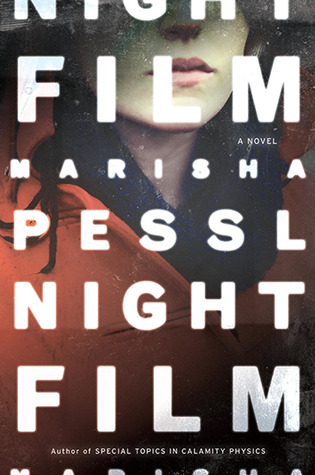
Review: Night Film by Marisha Pessl

(Originally reviewed on Aug 29, 2013 at Goodreads)

Night Film
opens with one hell of a prologue - easily the best I have ever come across. Those opening pages exude such authentic creepiness that it becomes impossible to not keep turning the pages, to not want to know more about the enigma of the reclusive legendary Hollywood director, Stanislas Cordova. This, I believe, is Pessl's greatest achievement here. With multimedia inclusions and some tight writing, she manages to do in a handful of pages what so many authors spend entire books trying; she manages to intrigue the reader, to lure him in, to make him take the bait.

I blew through this not-so-slight book in less than 3 days. That should give you an idea of the reading frenzy I was in.

So why the low rating??

Because once the frenzy ended and I put the book down, I realized I wasn't wowed by the actual plot or blown away by that ending and all it did or didn't imply.

The only feeling I was left with was an intense desire to watch a Cordova movie.

So the book certainly didn't fail. I wasn't bored or unaffected but the effect it did have was not really the kind Pessl intended, which is why I can't say it succeeded either.

Night Film follows a disgraced investigative reporter, Scott McGrath, as he digs into the mystery surrounding Ashley Cordova's suicide. Ashley, daughter of horror-film director Stanislas Cordova and a former piano prodigy, jumps to her death in downtown New York. Scott (who is such an unremarkable character that I'm struggling to find words to describe him) teams up with two twenty-something sidekicks (who are equally unremarkable and on top of that, annoying) as he runs around chasing clues, trying to hunt the truth that shifts and eludes like the patterns in a kaleidoscope.

The plot is one long treasure hunt centered around Cordova and while the chase is thrilling, I couldn't care less about the people I was forced to team up with. Every time Scott and his sidekicks took a break to ponder over their personal dilemmas, I would start to skim till the words 'Ashley' or 'Cordova' popped up again.

Night Film is not the kind of book that gives you the correct answer. What it gives you instead are multiple answers to the same question and leaves you to speculate which one is correct, if there even is such a thing as correct. If truth is a notion, how can anything be true? While the idea is great in theory, it did not hit me like I wanted it to. My reaction at the end was, "Who cares what the answer is when it doesn't change anything?" but I guess that has more to do with the kind of person I am. Maybe I'm someone who cares more about the effects and not the causes.

The writing is... good. If you ignore the inconsistency and the overuse of unnecessary italics, that is. There were some great parts writing-wise but no line or quote stood out enough to stay with me.

Overall, I'd definitely recommend Night Film. It did not blow me away but it was gripping enough to make me sacrifice sleep. This book is an experience and while the impact may differ from person to person, I think it is an experience worth having.


3 out of 5 stars


Tuesday, September 17, 2013

Sarah Dessen and More

Caution:- The following is essentially a review of Dessen's latest book 'The Moon and More', but written in a pretty non-conventional way. So prepare to feel a little exasperated if you were only looking for a plot summary, overview and general deconstruction.

In a parallel universe Sarah Dessen and I may have been intimate friends. But thanks to reality playing spoil sport and imposing barriers of physical distance, cultural and age differences, I can only ever dream of being on first name basis with her.

I discovered Dessen's books during a formative period in my life, in those much feared years when we are transitioning into adulthood from our hapless teens, and held onto her stories for dear life, every time I had to get over a period of depression (possibly induced by a break down of relations with a friend or someone more than a friend) or whenever serious literature lost its appeal in my eyes. Perhaps, this is the point where you start scoffing at YA, lose interest in this review and proceed to ask -

"How much of an insight into real life problems can a mere YA writer provide us with?"

My answer is, you'll be surprised to know.

Prior to my fortunate discovery of Dessen's works, I had a very skewed view of American teens, believing them to be animals prowling the jungle called high school, all replicas of stereotypical characters (the jock-bullies, hot blonde cheerleaders, shy, geeky brunettes, bespectacled nerds who often have their heads flushed down toilets, Goths, social rejects and so on and so forth) shown in mediocre tv shows.

So it will be an understatement to say that Sarah Dessen made me heave a sigh of relief. For the first time ever, I realized all American teens may not be the violent brutes or weirdos I had naively assumed them to be, that they may not be that much apart from their Indian/Asian counterparts, and maybe just as humane and flawed as we are. They have their own moments of mute desperation, struggle to come to terms changes about to materialize and more importantly their relationships with their parents are not close to nonexistent. (contrary to beliefs held by a wide majority of Indians). In other words, Dessen's books throw light on real issues plaguing teens - drug addiction, sexual awakening, destitution, homelessness, unplanned pregnancy, irresponsible/abusive parents.

Her protagonists are adolescent young girls, usually hailing from broken families (raised by divorced/estranged/single parents) who navigate the many challenges life brings them face to face with as they attempt to transition into responsible adulthood. They are soft-spoken, do not throw unnecessary tantrums but go about their business exuding a quiet confidence, deal maturely with first stirrings of romantic attraction instead of melting into gooey puddles, learn a few life lessons all within the scope of a few hundred pages.

Dessen manages to make the story of their lives come alive. As if this was happening somewhere in time, in some other part of the world completely alien to my Indian self. And I was being given a privileged peek into the unfolding of a series of events neither too dramatic nor tinged with a touch of unreality.
There's no dramatic reunion between emotionally absent father and estranged daughter, there's no hot sexual tension existing between the romantic leads, there's no promise of a forever after. There are no violent arguments between disagreeing parents and rebellious kids either.

Dessen understands well that life is a bundle of imperfections. So instead of giving us a too-good-to-be-true antidote to all problems, a neat tying up of all loose ends, she gives us hope.
Hope for a future where the possibility of that neat tying up of all loose ends remains alive.

Her style is minimalistic. She never pretends that she is writing anything but YA or does not give into the temptation of showcasing her command over words or sentence construction, unlike a certain John Green who often goes overboard in his enthusiasm to create a line of distinction between other YA writers and himself. She only tells a story in her own simple, elegant yet understated manner, expecting us to read, enjoy and understand.

But I guess I have outgrown that period of attachment with Dessen's headstrong but dignified young adult heroines. I can no longer devour her stories with a kind of pleasant smile playing about my lips or shed tears as easily as I used to.

Even though I liked Emaline's tale of coming of age or the way she learnt how to hold on to her past while embracing a future, I did not retain anything from the story as soon as Emaline's last summer of high school life ended. I guess I am no longer the confused, disoriented girl struggling to find her place in life like most of her protagonists. And I am no longer as young as I used to be.

(A 3.5 stars to The Moon and More.)

But even so, Sarah Dessen and I go way back. She has been my companion since when I had willfully shunned the company of people I knew in real life. And I still can't seem to resist the urge to squeal like a little girl every time she responds to my tweet. So if she writes another book, I'll most certainly read it if not for anything else then for old times' sake. And who knows? Maybe I'll enjoy it too.


 photo C136E66569D294E4D5DA2D8124D4FF69.png

Tuesday, September 10, 2013

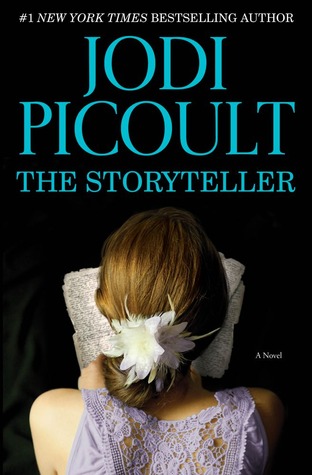
Review: The Storyteller by Jodi Picoult

(Original review posted on Goodreads : June 27, 2013)

The first few chapters of The Storyteller introduce us to Sage Singer - a twenty-something baker who is struggling with scars both emotional and physical. Following an accident that maimed half her face, Sage suffers from very low self-esteem, lives and works like a recluse and settles for being some guy's mistress.

Had I not read the blurb, I would have assumed that I was reading one of those chick-lit stories where an insecure girl with too much emotional baggage meets a guy who loves her for who she is.

400 pages later, that is EXACTLY what The Storyteller turned out to be.

What a bummer.

I'm not saying that The Storyteller doesn't talk about the Holocaust or doesn't do justice to it. In fact, the best parts are the flash-backs from WW2. I'll give credit where it's deserved - Jodi Picoult has researched the whole thing extremely well. And yet, the Holocaust angle always felt secondary to me. It did not get the attention it deserved. Or rather, undue attention was given to trivial plot-points.

Take the baking, for example. There is a ton of absolutely pointless information. What Sage bakes. Why she bakes. How she bakes. How gluten works. How brioche is made. Yadda yadda yadda.

Another useless detail that is hard to ignore - Sage's sisters are called Pepper and Saffron.
There's nothing technically wrong with those names except that they serve no purpose in the book whatsoever and stick out like a sore thumb.

All the side-characters were unrealistic and absolutely weird, again, for no reason other than grabbing undue attention. Who the hell speaks only in Haiku?? What kind of nun (or ex-nun) paints Jesus with the face of Bradley Cooper?? What is this, some Sophie Kinsella novel??

All that time Picoult wasted on meaningless digressions could have been better spent in developing Josef and Sage's friendship, which felt rather sudden and underwhelming to me.

There's another story about a vampire (No, I'm not joking.) that is narrated in parallel. It has allegorical meaning in the context of the book. I wish this story was kept separate, maybe like a prologue/epilogue to each part. It's jarring to go from SS officer in one chapter to blood-thirsty vampire in the next.

Now, the good part. Minka's harrowing tale of surviving the Holocaust is without question, the highlight of The Storyteller. The meticulously detailed descriptions make it nearly unbearable to read, but those 150 odd pages tell a supremely compelling story. For that one section, I'd say Brava, Ms Picoult.

Sadly, even Minka's story cannot save The Storyteller from my 2-star shelf. What should have been about Josef and Minka focused too much on Sage and Leo.


2 out of 5 stars


Wednesday, September 4, 2013

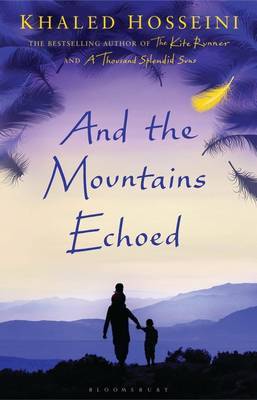
Review: And the Mountains Echoed by Khaled Hosseini

(Original review posted on Goodreads: May 31, 2013)


Here's something you should know about Khaled Hosseini: All his stories have more or less, the same ingredients.

It always starts with Afghanistan in its pre-war days. The protagonists are children, guileless and innocent. Then the invasion happens. People separate, the bonds between them torn apart either by fate or by design. Many gut-wrenching chapters later, there's some kind of reunion but with a catch - there's something amiss, something unfulfilled, like a testimony to the unfairness of life.

To be honest, I'm not a fan of formulaic things. Yet, when it's Hosseini telling a story, I listen. I give in. I let his words curl around me like a blanket. I fall in love. And when it's all over, I clutch the book to my chest and weep like a child.

Because formula or no formula, Khaled Hosseini just knows how to tell a story. He knows what to say and how to say it. It's like an art he has mastered - and no matter how many times he does it, the impact of it never fades.

And the Mountains Echoed is an ode to siblinghood and all the joys and heartbreaks that come with it - the anguish of separation, the guilt of envy, the comfort of companionship, the burden of responsibility. Unlike his previous books, Hosseini adopts a short-story approach for this one. There are multiple narratives in multiple time-frames spread across several different countries, all connected by a common link to Afghanistan.

The writing is beautiful, as always. Sample this:

"All my life, I have lived like an aquarium fish in the safety of a glass tank, behind a barrier as impenetrable as it has been transparent. I have been free to observe the glimmering world on the other side, to picture myself in it, if I like. But I have always been contained, hemmed in, by the hard, unyielding confines of the existence that Baba has constructed for me, at first knowingly, when I was young, and now guilelessly, now that he is fading day by day. I think I have grown accustomed to the glass and am terrified that when it breaks, when I am alone, I will spill out into the wide open unknown and flop around, helpless, lost, gasping for breath."

And the Mountains Echoed was one of my most anticipated books this year and it did not disappoint. That being said, it pales in comparison to his previous works - The Kite Runner and A Thousand Splendid Suns. Maybe it was the multiple POV thing. With so many characters and so many stories, it's inevitable that some would hit harder than the rest. Personally, I found the first half more emotionally striking - Abdullah, Nabi and Parwana's stories all made me tear up. I missed Afghanistan in the later segments.

And in case it wasn't obvious enough, I just wanted to say that I love Khaled Hosseini. If it weren't for him, I would have foolishly associated Afghanistan with just the Taliban. It's shocking how little I know about this country even though it's so close to mine.

Thank you for the culture-cum-history lessons, Mr. Hosseini. And even if your next book adheres to the formula, I'll still read it and in all likelihood, cherish it.

4 out of 5 stars


Tuesday, September 3, 2013

Review: Perfume: The Story Of A Murderer by Patrick Suskind

(Original review posted on Goodreads: Oct 7, 2012)


Perfume is a book in a league of its own. It’s unconventional, terrifying and creepy; yet at the same time, dazzling, mesmerizing and strangely hypnotic. Whether I hate it or love it is irrelevant (and honestly, I’m still not sure), because I know that this is a great book. I knew that five minutes after I started reading.

Perfume is a very bizarre tale about a very bizarre murderer, who kills not for sadistic pleasure or monetary gains, but simply in the pursuit of achieving his dream – creating the best perfume in the whole of France, which, quintessentially, is the scent of an adolescent beautiful virgin. But what sets this book apart, aside from the brilliant narration, is the fact that the story solely focuses on Grenouille – his life, his obsession, his single-minded devotion to his craft. No thoughts are spared for the victims or the actual killings; it’s only the scent-induced high that matters.

Grenouille is a character you are supposed to hate. The author never tries to bring about any semblance of humanity in him. In fact, he introduces Grenouille as ‘a gifted abomination’; ‘a tick waiting to bore and bite into animal flesh’. Yet, as much as I loathed him, there were times when I caught myself feeling sorry for him. And it unsettled me because for a long time, I couldn’t figure out why I would feel that way since the book projects Grenouille as nothing less than a monster. But there’s something about how fanatically devoted he is to his passion, how his whole life is centered around scent, that's eerily touching.

The narration is brilliant, as long as Grenouille stays in the picture. Once or twice, however, the author shifts focus to other people, like the perfumer who mentors Grenouille in Paris. And that is when I felt the narration slip a little, going off on tangents. The pace of the book also drops towards the middle.

However, the end more than made up for all that. The story truly came alive in the last 15 chapters and it gripped me with an infectious mix of thrill and paranoia that made it impossible to put the book down. And OMG, the end!! I never saw it coming. It was jaw-dropping, shocking, and very, very clever. In fact, if I had to rate just the concluding chapters, I would give them a 5-on-5.

The writing is exceptionally good. The words are brilliantly chosen, and put together in a way that gives them a dreamlike quality, especially when the author describes scents. And obviously, he does that a lot.

Perfume made my skin crawl and left me reeling. But it also left me spellbound at the sheer ingenuity of Patrick Suskind’s vision. Equal parts creepy and creative, Perfume might not be a book for everyone but it is a great piece of literature regardless.

4 out of 5 stars


Saturday, August 24, 2013

Review : The Stand by Stephen King

(Original review posted on Goodreads:- Feb 02, 2013)


One of the reasons why I would never club Stephen King together with any of the other best-selling writers of his generation (Grisham, Archer, Patterson, Sheldon and so on) is this :-
None of them match King's calibre as a story-teller.They don't even come close.

If somebody spins an intriguing tale, his characters get in the way of my enjoyment of it.
If somebody excels at characterization, his plotting is rather unconvincing.
If somebody plots a story well, then his writing turns out to be flat.
(And if you're unlucky enough, some of them mess everything up.)

But Stephen King, possesses that rare talent of getting everything right - the story, the unraveling of the plot, the imagery, the underlying implications, the characters, the backdrop, the world-building, the writing - down to the very last detail. 
He can grasp your attention at the onset, reel you in slowly but surely, give you nerve-wracking moments of pure anxiety, make you visualize a scene exactly the way he must have imagined it, feel for the characters in his story as if they were people of flesh and blood you were familiar with and, at some point, render you completely incapable of discerning between reality and the make-believe world of his imagination. And you're caught in the same nightmare as the characters of his book are plunging deeper into with every passing moment. 

The Stand is one such Stephen King creation. Arguably known as his best written work yet, The Stand, I'm happy to inform readers, deserves every bit of the praise and adulation it continues to receive worldwide till this day. 
Now don't get me wrong. The book is nothing new when you glance at the blurb. It is nothing you haven't already read or known about because it is the story your mom/dad/grandma must have read to you as a kid - while you listened moon-eyed with wonder and awe, overcome with emotions you couldn't quite fathom. 
It is the ever-fascinating and timeless tale of good triumphing over evil that you have come across enough times yet can never possibly get over. 
It is that same story, but with a distinct Stephen King-esque flavour.
Add a dystopian, post-apocalyptic, anarchic world in the grip of an epidemic that claimed most human lives to the eternal conflict between good and evil, and the summation result will lead to The Stand.
But it is so much more than this simple one-sentence summary. Every character, every plot device, every written scene has been constructed and put together so fastidiously in this book that at the end of it one feels that the reader is assigned with the task of collecting and preserving every piece of the gigantic puzzle to form this humbling, larger-than-life image the author had begotten.
Everything is done so ingeniously, that the mesmerized reader can only sit back and watch this spectacle of gargantuan proportions unfolding right in front of his/her mind's eyes. 
Horror, psychological ramifications of events, political intrigue, war, chaos in the absence of a centralized administration, a crumbling world order, basest of our human tendencies - King doesn't shy away from exploring the entire gamut of human actions and emotions in a world where nothing of the old establishments has survived.

This man can write. There's no doubt about it.

In terms of sheer volume, scale and narrative sweep, it is an epic. In a way it is The Ramayana, The Mahabharata, The Iliad and The Odyssey or a concoction of all the elements that transformed each one of these stories into epics the world will never cease to look upon with the utmost respect. 
It is the story that never becomes stale despite the number of years you insert between the time you read it first and read it for the umpteenth time in some other form. It is the story that transcends barriers of language, culture, religion and history and will always be told and retold in possible ways imaginable, for as long as humanity survives.
It is the story you are bound to be won over by even if you're snotty enough to swear by your copy of Ulysses and frown upon the Stephen Kings of the world of writing simply because they don't have much of a chance of ever winning the Man Booker or Pulitzer or *gasp* the Nobel Prize.
It is the story of good, evil and everything in between. It is the story of love and hatred, loyalty and betrayal, sin and redemption, fate and co-incidence, rationality and the inexplicable. Of unalterable mistakes and innocence lost. Of the goodness of the human heart and the face of the Devil.
At 1100+ pages, it was rather much too short. 
I almost wished for it to never end. 
But then again one can always re-read to start the cycle of awesomeness all over again.


5 awestruck stars out of 5.

Tuesday, August 20, 2013

Review : The Casual Vacancy

(Original review posted on Goodreads:- January 15, 2013)

Well much has been said and written about this book already throughout the latter part of last year. But here's my twopence on Rowling's ambitious adult novel, which in my opinion has received a rather harsh reception.

This book is grey. As grey as grey can be.
It is an intense introspection on the bleakness of modern day urban life, the dynamics of various human relationships, which may seem ordinary on the surface but reveal complexities just beneath that showy exterior - where the basis of each one is some deeply personal interest and little else. Where every human action is steeped in the fundamental need for fulfillment of some ulterior, personal objective. And it is more about people of flesh and blood, like you and I, rather than a story.

Rowling takes her sweet little time (which costs many of the readers much of their patience) to establish an imaginary suburban neighborhood and its various quirky inhabitants - unscrupulous, prejudiced councilmen, hypocritical educators, pedophiles, violent, abusive fathers, problematic teenagers, promiscuous adolescent girls, drug addicts, drug dealers and pimps, victims of sexual abuse, rape, jittery, reluctant boyfriends, emotionally absent husbands and sexually frustrated, disgruntled wives. But Rowling's achievement lies in the fact that she makes all her characters appear as humane as possible without ever forcefully pushing any one of them either into the realm of abject villainy or highly romanticized heroism. They have their share of good and bad traits. Although, noticeably, the bad in them is much more pronounced.

Rowling dishes out reality in its most vicious and ugly form and leaves nothing to the imagination. She never tries to tone down the scale of the tragedy, everyday mundane life entails. The tragedies we either prefer to shove under the carpet or try and forget about by donning a mask of make-believe contentment.
Pagford is the dystopia of Rowling's imagination and each one of its residents are bizarre enough to be the subject of a psychoanalyst's case study.
In a simple sentence, The Casual Vacancy is Rowling's exegesis on human nature.

Initially I had decided on a meagre 3-star rating but towards the end, Rowling kicks up the ante a notch or two and gives us some some solid plot developments. Her characterization is beyond brilliant and a major asset to this story.
And it becomes quite a page-turner towards the end as the very disturbing narrative hurtles towards an unavoidably tragic ending.

This woman gave a generation of kids (like me) a story so special and awe-inspiring, that it became a part of their lives forever. There's no chance in hell that she can write anything mediocre or substandard.
But, maybe....just maybe I was nurturing hope, in some obscure corner of my heart, of something life-altering and magnificent from her once again.
No, I wasn't naive enough to expect another Harry Potter but I wasn't expecting her ambitious adult novel to leave such a bitterly sharp after-taste in my mouth either.
That made me take away the one remaining star.
Sorry, Jo. Maybe next time.

P.S:-I can't help but wonder, is TCV Rowling's commentary on contemporary England?
I certainly hope not.

4 out of 5 stars.

Monday, August 19, 2013

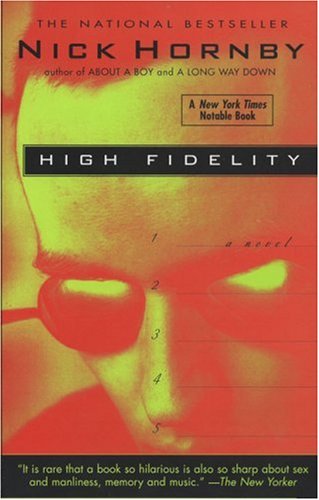
Review : High Fidelity by Nick Hornby


(Original review posted on Goodreads:- December 10, 2012)

High Fidelity is several things at once. 
It is a specimen of ladlit - romance and single life explained from the point of view of a man. And we have so few of those. 
It is a humorous reflection on life and its many failings.
And lastly, it is the tale of a Brit singleton in his mid thirties who is unrelentingly firm in his reluctance to grow into a man.
A man who is so caught up in his fantasies of the ultimate love one is destined to end up with, that he ignores the woman who truly cares for him and consequently ends up losing her.
So the novel begins with our protagonist, Rob Fleming, listing the 5 major break-ups of his life which either hurt him too much or ended up changing him as a person for good. And he takes vicious pleasure in informing the reader that Laura, the woman who just left him, doesn't make the top 5, doesn't even come close.
How could you not get sucked into a book which begins on such a promising note?

An owner of a dingy vinyl record shop named Championship Vinyl, Rob and his two employee-cum-sidekicks Dick and Barry stumble through the maze of life, more often than not clueless about what they are doing.
They debate merits and demerits of obscure bands and music artists and are generous in their display of disdain for the ones who love their Beatles, Billy Joel, Tina Turner, Elton John and the usuals. And these hilarious conversations centering around mundane things like tv shows, movies, music and women lend the plot much of its frivolity and humour. Especially Barry, who is described by Rob as a 'snob obscurantist', makes you laugh uncontrollably with his habit of belittling everything, his sneaky tactics of selling records of artists no one has heard of and his interactions with Dick.
And so the plot meanders through the zigzagging life of Rob, touches briefly upon the lives of all the women with whom he had been in love at some point of time and settles on his on-and-off relationship with Laura.

High Fidelity comes as close to portraying single life and romance as it actually is and not in the larger-than-life Hollywood rom-comish way. It talks about the things we all do in relationships - how we decide how much to reveal to the other person. How our feelings for a person waver time and again and how we often falter, unable to decide what we want. How we hurt the other person in the process. How we realize how precious a relationship was only after it has ended. And more importantly how we are ever afraid of making that feared transformation - be it from girl to woman or boy to man.

Nick Hornby's debut novel is a charming creation - it is like a music record by an artist you may not have heard of but you can relate to the music, nonetheless. 
And you can't help but want to play the record all over again. 

4 out of 5 stars.

Review : The Girl with the Dragon Tattoo by Stieg Larsson

(Review written originally on:- June 18, 2011)

Never has a book made me experience one too many conflicting emotions side by side. Never has a book managed to infuriate, astound, shock, disgust, terrify yet charm me at the same time. The international best-seller named The Girl With The Dragon Tattoo or Män som hatar kvinnor (as it is known in Swedish) deserves every bit of the craze and the recognition it has achieved worldwide since its first publication in 2005. I have about zilch intention of giving away even a brief overview of the plot but for the sake of a
review I must. Hence.....

Mikael Blomkvist is an investigative journalist and co-owner of the monthly magazine Millenium who had just lost a libel lawsuit filed against him by the Swedish business tycoon Hans-Erik Wennerström. His reputation at stake, he decides to distance himself from the magazine's management and publishing bodies. Around the same time he is offered a freelance assignment by Henrik Vanger, patriarch of the affluent Vanger family and CEO of Vanger Enterprises, which deals with cracking the mysterious case of his great-niece Harriet Vanger, who had disappeared without a trace 36 years ago. Facing a prison term of about 3 months and no better alternative in sight, Blomkvist decides to take up the job. At the same time we're introduced to the other protagonist, Lisbeth Salander, a 24-year old, introverted, delinquent-like woman whose outward physical appearance replete with piercings and tattoos, repel most people she comes in contact with. An ingenius hacker who is also blessed with a photographic memory, she has the ability of digging up little-known yet vital information about public figures and documenting them with uncanny precision. She is assigned to do a thorough background check on Blomkvist by an aide of Henrik Vanger's. Eventually in the chain of events, she comes to work as an assistant for Blomkvist and helps him solve the intriguing case of Harriet Vanger and uncover a long chain of gruesome murders and aggravated sexual assaults against women spread throughout Sweden in turn. 

 To be honest, it is impossible to summarize an explosive novel like The Girl With The Dragon Tattoo in a paragraph or two. It will merely serve as an insult to the genius of Stieg Larsson, who has masterfully crafted a story out of the lives of Swedish corporate honchos, sexual sadism, misogyny, investigative reporting, journalistic values with a little bit of love thrown in as well. Hence it is a book you must read no matter how much you cringe at the graphic detailing of some of the crimes depicted. In any case you'll be compelled to read on as the mysteries continue to deepen till the very end.

Going by the writing style, Reg Keeland's translation seems to have managed to capture the underlying darkness of the story. I can only imagine how Larsson's original narration must have been like. There's a multitude of characters in the book and almost each one of them have been portrayed meticulously through their action or inaction. But none of them stand out as much as Lisbeth Salander's does. A victim of a violent sexual crime herself, she exacts retribution from her perpetrator in the most fitting way possible without having to resort to the law in which she doesn't place any faith in. Lisbeth is someone who'll hit back even harder and take control of a situation rather than be intimidated. She is socially awkward, incapable of developing long-term relationships with people or trust anyone, possibly due to the nature of her abnormal childhood years. She is perceived as a mentally retarded, repugnant woman by most and her inner brilliance always goes unnoticed. But then again Lisbeth is not one to care about what other people think of her. It is possibly because Blomkvist deals with her like he'd deal with any other normal human being, that Salander finds herself unable to treat him with the same calculated coldness she had always shown towards others.

Coming to the fallacies of the book, I must admit I couldn't find any. I was a bit surprised to find a mild love story angle developing towards the end as love is always an unnecessary baggage in thriller novels. However I understood the author's need to humanize Lisbeth, or at least offer her some sort of a balm to cast a calming effect on her tormented soul which she skilfully conceals underneath a mask of stoicism. Nothing more apt than love to achieve such a purpose. With the help of an inherently macabre theme of sexual violence, Larsson has tried his best to make the readers comprehend the brutality of a crime like rape or sodomy. And this seems to have been the main purpose of this book, given that Lisbeth's character has been named after a girl whom Larsson witnessed being gang-raped as a young boy.

 Thank you Stieg Larsson for deciding to publish the novels, otherwise the world would've missed out on one of the greatest trilogies in the mystery/thriller genre ever written.

5 glorious stars.


Sunday, August 18, 2013

Review : The Lost Symbol by Dan Brown


(Orginial review written on:- October 3, 2009)

Before I begin let me inform you all that this is not to be considered a conventional book review. Without giving out a summary or spoilers (I'm sure many still haven't read it) I'd try to sum up my views on Dan Brown's latest installment.
So then let's start at the beginning. The fact that I got hold of this book on the very day it released worldwide and yet managed to finish reading it only yesterday should,in itself, be considered a miracle. That's because if a book manages to capture my interest I usually devour it within a single day(at the most 2 days) no matter how lengthy it might be. But unfortunately I read The Lost Symbol over a span of a week.
This probably speaks volumes of how unimpressed I'm with Dan Brown this time.

Anyway without digressing any further let's come to the plot:-

To tell you the truth this novel has no actual plot because it had no aim from the very beginning.
So what does this book have then?

The answer consists of - Robert Langdon, his long time friend and mentor Peter Solomon who's in mortal danger,a deluded lunatic as the bad guy (just like always), Peter Solomon's beautiful sister as Langdon's companion for the night who's conducting some highly important research work on Noetic Sciences (just another replacement for Vittoria Vetra or Sophie Neveu), Freemasons, the CIA and of course an all-too-familiar routine of figuring out hidden codes, symbols, puzzles so as to thwart the villain's plans and save the world from disaster before it's too late.

Okay that's all good. But what is Robert Langdon doing here? - Half the time he is arguing quite uselessly with the other characters saying he doesn't believe in an ancient Masonic legend, around which the entire plot revolves.
I think a man who had discovered Mary Magdalene's tomb in his earlier adventure should have a more broad-minded perspective than that.
The time he spends deciphering few codes spans only 15-20 pages of the 339 page book(e-book). The rest of it is filled with too much information about the Masons, Solomon family stories and the warped thoughts of the psychopath villain.

Even though Angels and Demons had quite a far-fetched plot it never failed to make the reader gasp. Atleast it had some edge-of-the-seat suspense to offer. Also the age-old animosity between the Illuminati and the Church provided quite an intriguing backdrop.
Same with The Da Vinci Code. The controversy surrounding the Holy Grail, Mary Magdalene and the Merovingians was spicy enough to keep the reader enthralled till the very end.
But the Masons are not that interesting.
On one hand they are an ancient brotherhood dedicated to searching for light (symbolizing supreme knowledge) amidst darkness and on the other hand they're protecting an ancient wisdom for centuries which supposedly has the power to bring about man's ultimate enlightenment.
Contradictory isn't it?
And why keep something secret that is supposed to benefit mankind?
Uh yea right 'cause it might fall into the wrong hands and result in disasters of unimaginable proportions.
As if the world isn't already in chaos and on the verge of destruction. We could sure do with some ultimate knowledge (or whatever) in these troubled times.

Unlike his previous adventures Langdon does not make a startling discovery at the very end. Nobody gets to know what the Ancient Mysteries actually are. Brown only provides us with a brief overview which is not enough. And this is where the readers are bound to feel disappointed.

I think maybe it's time to put Robert Langdon to rest. We've had enough of religious symbology, secret societies and historical controversies. Though I won't mind another Deception Point or Digital Fortress.(I liked these 2 novels much better than your latest work Mr. Brown)

2 stars out of 5.

Related Posts Plugin for WordPress, Blogger...