First published:- February, 2015
Star rating:- 2.5/5
There was a time when I was still an optimistic seeker of doctrinal wisdom blissfully entertaining the certainty that there would at least be one religious doctrine fashioned by humans in the whole wide world which would not delight in depriving members of one half of the human race of any political and social standing. I was naive then. My ardor in this regard cooled considerably once I came across information that even Buddha helpfully classified seven kinds of wives (as recorded in the Anguttara Nikaya found within the Sutta Pitaka) of which the wife who meekly takes a beating from her husband, never argues back and remains as slavish as possible is defined as the ideal one.
2.5/5
There was a time when I was still an optimistic seeker of doctrinal wisdom blissfully entertaining the certainty that there would at least be one religious doctrine fashioned by humans in the whole wide world which would not delight in depriving members of one half of the human race of any political and social standing. I was naive then. My ardor in this regard cooled considerably once I came across information that even Buddha helpfully classified seven kinds of wives (as recorded in the Anguttara Nikaya found within the Sutta Pitaka) of which the wife who meekly takes a beating from her husband, never argues back and remains as slavish as possible is defined as the ideal one.
So is there any organized religion in the world which does not cheerfully preach, propagate and advocate misogynistic ideas and practices? If there is, do let me know. Meanwhile, I delight in evolving my personal belief systems to deal with pangs of short-term nihilism and remaining as religion-free as possible even though, to my dismay, every time I'm required to fill a government-printed form, I am hard-pressed to tick the 'Hindu' box.
Organized religion has all the elements of organized crime, except for compassion. If you offend a crime boss who has no compassion, he will have you beaten up and sometimes killed. If the crime boss wants you to go to hell, he will have you killed after you have committed a sin so you have had no time to repent (i.e. you get yours as you leave a whorehouse or have just eaten pork, or have neglected to kill a female relative who has disgraced the family). Organized religion, however, does show some compassion. Still, in my mind, crime bosses and the guy called God have a lot in common: revenge, rage, and punishment are essential to their mission.
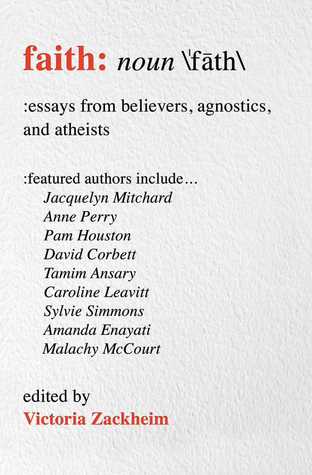
I requested this collection on Netgalley expecting to discover other, disparate ways of viewing faith and institutional religion and maybe challenging discussions on the intersection between religious philosophy and recent developments/intelligent speculation in the domain of astrophysics and the cosmo-sciences but nope. Instead what I got was a collection of maudlin musings on life and its trials and tribulations. It doesn't help either that most of the writers were raised in a Judeo-Christian tradition which means most of the articles lose their sheen of novelty after a while with similar anecdotes of childhood rites of initiation into a state of knowledge about organized religion re-appearing time and again. Catholic school, baptism ceremonies, obsession with collecting Virgin Mary statues, bar mitzvah experiences, traumatic memories of having to endure indoctrination at an early age and so on and so forth. A majority of the believers narrate experiences of dealing with life-threatening situations and losing loved ones to cancer and other terminal illnesses which is perfectly understandable because nobody really seeks out 'God' unless hardships and despair wrestle their way into life but after a while these reminiscences just wore me out.
And then there are the more ridiculously cringe-worthy interpretations of faith - one contributor literally going on and on about her miserable love life and the fact that no man wants to be with her for the long haul.
For believers, Faith is a remedy; for atheists, it's a smoke screen obscuring as shameful the essence of being human: our fallibility.
The only essays which made any impression were by Tamim Ansary, Amanda Enayati, and Aviva Layton. All of them are secular humanists/decriers of institutional religion of course but that does not mean their writings do not showcase a keen interest in giving the benefit of the doubt to all sides of the debate. Ansary, who identifies as a secular mystic, refreshingly does not go into saccharine-flavored tales of personal woes and triumph, instead choosing to recount a simple anecdote about a few moments spent in the heart of nature with his youngest daughter which helped him appreciate the fact that to be alive, for however brief a blink in the unending spiral of time, is to be close to the mystery of all creation. Amanda Enayati's touching piece documents her tryst with a most harrowing period in the history of Iran in an almost Marjane Satrapi-ish fashion except her voice is devoid of the latter's signature humor. Another plus was getting to know about the surprisingly liberal tenets of the Bahá'í faith, a minority monotheistic sect whose members were ruthlessly persecuted during the Iranian Revolution of '79. Aviva Layton's ruminations held nothing special unless one counts her wonderfully unsentimental description of the aftermath of personal loss and her logically argued repudiation of superstitious ideas about heaven and hell.
To conclude, it's not like all the other remaining essays were completely unpalatable or anything but the very fact that I scarcely remember anything about them speaks for itself.
__
Also posted on Goodreads & Amazon.

First published:-
October, 2014
Translated by:-
Euan Cameron
Publisher:- Houghton Mifflin Harcourt
Star rating:-

Call this a book of mirages and mirrors that distort the contours of visible reality all the time. Call it a lament for the inevitability of change that erases all the landmarks to a place that anchors one to a past self. Call it a psychological thriller, a faux-noir in which people materialize out of thin air to serve as clues to lead the joyless protagonist to a truth too terrible for him to comprehend all at once. (Faux noir because Modiano ingeniously deploys its signature leitmotifs to subvert the genre. The token crook is merely a shady character, the token gangster's moll/seductive siren becomes a sympathetic confidante and the token mystery transforms into a disconcerting odyssey through the maze of time and memory.) But an adroitly spun yarn as this one transcends the imposed boundaries of any such labeling with ease and surprising grace.
One can tell the Nobel committee usually doesn't mess around at least when it comes to this greatest of honours reserved for literary achievement. Only pure artistry could have produced something as perfect as this - a combination of strategically placed expository bits, a dreamy, sublime narrative voice reflecting both a subconscious longing and antipathy for lost time, a melding together of reality and delusion, an overlapping of the worlds of 'was' and 'is', and a cautious but sure-footed unravelling of plot. The last time something this unambiguously postmodern in tone and form had brought me such pure reading pleasure was when I happily surrendered before Ali Smith's rhetorical playfulness in There But for The.
There, on the pavement, in the light of the Indian summer that lent the Paris streets a timeless softness, he once again had the feeling that he was floating on his back.
Author Jean Daragane's world is populated by ghosts - ghost-like individuals who hover over his reality to lead him to places and people he has forgotten and, in all likelihood, does not want to recall, the specter of self-written words that elude his feeble grasp on memory, ghost of a city's turbulent past intruding on the equanimity of the present, ghost of those nauseous years of the Occupation that one cannot shake off despite best efforts. And these myriad ghosts proliferate at the back of his mind to warp his sense of time, creating a stark dissonance between reality and memory that usher in a renewed sense of dislocation. In a way, he seems like a vagrant spirit himself, adrift in life like flotsam after a devastating tsunami, alienated from the rituals of work, love, relationships. But this deceptive placidity of the surface of his consciousness is disturbed by a phone call out of the blue which sets into motion a chain of fated meetings and ridiculous coincidences which eventually allow him to find a way back into his past, a journey he undertakes with considerable reluctance and disguised trepidation. I'll leave you to summon the curiosity to find out where this journey eventually leads him.
It would appear, he often used to say to himself, that children never ask themselves any questions. Many years afterwards, we attempt to solve puzzles that were not mysteries at the time and we try to decipher half-obliterated letters from a language that is too old and whose alphabet we don't even know.
Like a true master of the craft, Modiano only ever mentions the War in passing, subtly inserting roadsigns which point to the ineffaceable marks of damage on a Paris which itself appears like a figment of Daragane's imagination at times, as if it might flicker out of focus any moment to reappear in a pale imitation of an unrecognizable former avatar. But the memory of war lingers on in the desolation of rue de l'Arcade and the boulevard of Champs-Élysées witnessing the flow of time like a dispirited sentinel, in Daragane's uneasy perambulations through the courtyard of Louvre and the mist-laden autumn air of the rue de l'Ermitage. An amnesia sets in when the currents of time gradually whittle down the tangible reminders of a tragic event into unfamiliar forms but reality forgotten is never reality expunged.
...And yet he now wondered whether he had not dreamed this journey, which had taken place over forty years ago.
Daragane's Paris is tied inextricably to the past just as he finds himself colliding with the vision of an abandoned, forgotten child navigating the unfamiliar nooks and corners of an unknown neighborhood, perhaps, pained and relieved in equal measure to have finally remembered that which he was so intent on forgetting. I could not have wished for a more befitting sense of closure for our traumatized narrator.
**with thanks to Netgalley and Houghton Mifflin Harcourt for an ARC**
__
Also posted on Goodreads & Amazon.
To be published:-
April, 2015
Published by:-
Blank Slate Press
Star rating:-
 It is nigh impossible to banish the specter of sky-high expectations for a book which proudly advertises itself as the When Harry Met Sally for the millenial generation. That movie has been comfort food for the lonely and the lovelorn and the ones navigating the treacherous waters of friends-and-a-little-morerelationships for decades now.
So potential readers and Nora Ephron fans, better be forewarned that the central characters here are not even pale imitations of Harry Burns and Sally Albright. Neither does Malcolm possess Harry's infuriatingly self-assured persona nor does Joanna manage to embody Sally's quirkiness and emotional vulnerabilities. More often than not they come off as people with no discernible character traits - they flicker in and out of focus like shadowy silhouettes in a hazily lit room. Their friendship is never fleshed out for the reader's benefit. In fact the only conversations they have are completely devoid of any wit or substance and merely border on good-natured flirtation.
Malcolm and Joanna meet at a party and make out without even exchanging proper greetings first. Malcolm flies out to Kazakhstan the very next day for 2 years with the Peace Corps during which time they maintain a correspondence through hand-written letters - yes you read that right - not emails or the phone because nothing puts a dampener on romance like modern technological innovations! When Malcolm shifts back to Portland after the designated time period, they keep hovering around each other, doing the mating dance without actually acting on their mutual attraction. They make bad decisions which would have been acceptable had they not appeared as deliberately manufactured unrealistic plot contrivances to delay their eventual union.
Long story short this is a bit like Harry Met Sally but not quite. It tries to sell the illusion of an unorthodox, fantasy love instead of conveying the truth of how relationships work in reality which brought Nora Ephron's creations universal adulation in the first place. However, on the plus side, there's no casual sexism here - Malcolm does not patronize Joanna like Harry aggressively dismisses Sally's opinions in the movie. (But then we are no longer in the 90s) It has all the trappings of a regular chicklit novel except without the mediocre writing and the abundance of idiotic cliches. And quite readable if not compulsively so.
As long as you are not craving for Nora Ephron-level insight into the quotidian comedy and heartbreak of relationships but light reading which does not require complete suspension of disbelief, Rebecca Kelley will keep you entertained.
__
**with thanks to Blank Slate Press and Netgalley for the ARC**
___
Also published on Goodreads and Amazon.