Showing posts with label Brain Fodder. Show all posts

Sunday, August 3, 2014

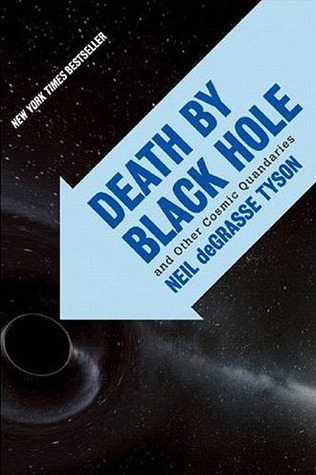
Review: Death by Black Hole and Other Cosmic Quandaries by Neil deGrasse Tyson

First published:- 2006


Star rating:-


Neil deGrasse Tyson is a force to reckon with. 


description

But he is not Carl Sagan. 

While Sagan must have smiled down kindly on your meek acknowledgement of ignorance regarding, say, black holes, Tyson will have most probably given you the stink eye or aimed a sarcastic jibe at your apathy, before proceeding to explain why black holes still remain a topic of much speculation in the community of astrophysicists worldwide.

Tyson does not pull any punches in this collection of essays while slamming the news media, who more often than not, come off as ill-informed hacks doing a shoddy job of reporting facts in the field of space science, forever (stupidly) claiming how scientists are baffled by so-and-so new developments. 
"Scientists cannot claim to be on the research frontier unless one thing or another baffles them. Bafflement drives discovery."

Or snidely commenting on the Hollywood exercise of producing multi-million dollar sci-fi films which badly butcher the scientific aspects of such ventures by inserting factually incorrect observations in scenes and dialogues. (there's a brilliant anecdote concerning James Cameron's 'Titanic' in this regard and the Contact film gets an honorable mention for its adherence to proper science if one overlooks a minor gaffe)
"I am glad that, in the end, the humans win. We conquer the 'Independence Day' aliens by having a Macintosh laptop computer upload a software virus to the mothership. [] The entire defense system for the alien mothership must have been powered by the same release of Apple Computer's system software as the laptop computer that delivered the virus."

Or criticizing the mad dash for extending the frontiers of space science during the Cold war years, when the spirit of scientific inquiry was sidelined in favor of a dangerous game of political one-upmanship, a kind of puerile assertion of 'our scientists are better than yours'. Or openly chastising revered names from ancient Greece like Aristotle whose inaccurate assumptions about the unchanging nature of stars and the geocentric universe helped the Catholic Church in propagating falsities for centuries with impunity. (He doesn't even spare Newton forGod's Higgs Boson's sake who, unable to satisfactorily explain the ordered behavior of the solar system despite the many often conflicting gravitational forces at work, had cited God's need to step in to correct things in his famed 'Principia')

While Sagan may have adopted a more benign, less aggressive tone in course of addressing issues of religious dogma being at loggerheads with scientific reasoning and aversion to science and mathematics among the general populace, NDT takes the approach of pure, unadulterated logic and demolishes one popular misconception after another (for e.g.:-the North Star is not the most brilliant star in the night sky or how everything that goes up doesn't come down) with a brute force which I am certain will not sit well with some sensitive readers who are easily offended. 

Being born in a country whose space research organization head performs pujas and makes ritualistic offerings prior to launching a 'Mission to Mars', I can't say I fault NDT's acerbic tone or his distaste for those who are hell-bent on unifying science and religion without even realizing that finding common ground between both is akin to attempting to exceed the velocity of light.

But if NDT lacks Sagan's sage-like demeanour and his rich, authorial voice (Sagan's prose is much more refined no doubt), his excellent sense of humor almost compensates for their absence - 
"The good thing about the laws of physics is that they require no law enforcement agencies to maintain them, although I once owned a nerdy T-shirt that loudly proclaimed, "OBEY GRAVITY."
"The only people who still call hurricanes 'acts of God' are the people who write insurance forms."
(and Michele Bachmann, just saying)

And occasionally there's a sop thrown in for the literary-minded (particularly the postmodernist fiction lover) - 
"The physicist Murray Gell-Mann, who in 1964 proposed the existence of quarks, and who at the time thought the quark family had only three members, drew the name from a characteristically elusive line in James Joyce's Finnegans Wake:'Three quarks for Muster Mark!'"

The more frivolous aspects of the essays aside, among the astrophysics-related topics NDT centers his discussions around, the ones which were relatively new to me are the concepts of hypernovae, gamma ray bursts, dark matter and dark energy, the uncertainty surrounding the string theory and the probability of the annihilation of Earth through ill-fated, cosmic encounters with errant asteroids, the unavoidable, impending collision of our galaxy with the Andromeda galaxy which is the nearest one heading towards us at a speed of more than 100 kilometers per second.

description
The Andromeda Galaxy

Since this is a collection of 42 essays which were published in the 'Natural History' magazine, some repetition of concepts and names creeps in occasionally but that merely helps you refresh memories of what you just read a few pages back, not exactly a shortcoming I am keen to quibble over. 

4 stars, because Tyson seems a little too bitter about artists who exercise 'artistic license' to distort certain astronomical facts in their paintings. Besides I am certain there is a lot of 5-star-worthy goodness in the rest of NDT's works left for me to discover in the future.



   photo C136E66569D294E4D5DA2D8124D4FF69.png

Saturday, June 21, 2014

Review: Brief Interviews with Hideous Men by David Foster Wallace


First published:- 1999

Read in:- April, 2014

Star rating:-

To call these meanderings and sub-meanderings of a brilliant mind short stories, will be akin to putting a leash on DFW's creativity with the aid of conventional terminologies and thereby undervaluing the sheer inventiveness on display in this compelling collection. 
In course of my limited venturings into DFW's literary landscapes I have arrived at one crucial inference. That to read DFW is to transgress the very act of simply reading through and discover a newer way to commune with his chain of thoughts, to work your grey matter just a tad bit harder to truly grasp what he has intended for you to understand. And that's an exercise I am all too happy to engage in especially if it sharpens my senses and compels me to achieve a state of oneness with the narrative without sparing a second thought to any of my other parallel reads.
Reading him is like being given the unique opportunity to listen in on one of the greatest minds that ever existed speaking from some imaginary podium and letting that same mind direct my own to follow pathways that it didn't even know existed. It's like making yourself a part of the virtual reality he has recreated through his words and believing in the truth of it without trying to compartmentalize his writing.

Hideous men (and, occasionally, women) and the alarmingly convoluted inner workings of their still hideous minds string this collection together. Some of the 'short stories' are mere snapshots of eponymous interviews of seemingly disturbed individuals, ranging from hippie youths who have devised Machiavellian plans to seduce and subsequently ditch women with psychopathic precision to adolescents with elaborate masturbation fantasies creepy enough to make you involuntarily shudder, while some are little snippets which merely detail the secret inner lives of certain individuals which always remain carefully concealed behind an ingeniously orchestrated charade. Add some metafictional commentary inserted sporadically as footnotes of considerable length, in several of which the author even challenges the potential reader to weird pop quizzes, and you have a hazy idea of what this collection has to offer. But even so, I probably haven't even grazed the tip of the iceberg of DFW's gift for redefining narrative structures. 

Given that I am accustomed to more or less linear narratives, consisting of immaculately crafted sentences which put more emphasis on superficiality of actions and emotions, it is a bit of a surprise to find myself being drawn to a writer who sought to expose the raw core of every pretension. Sometimes while reading I was even tempted to flip a coin to decide whether he was being ironic or simply acknowledging some disturbing reality in a matter-of-fact tone.

"He ruled from that crib, ruled from the first. Ruled her, reduced and remade her. Even as an infant the power he wielded! I learned the bottomless greed of him. Of my son. Of arrogance past imagining. The regal greed and thoughtless disorder and mindless cruelty - the literal thoughtlessness of him."

The man's perspicacity is so palpable in everything he writes and his sincere attempts at perfect reconstruction of thought processes and the true motivations at work behind every human gesture so obvious, that I can't help but be charmed. The 5 stars are probably a dead giveaway of my veritable moony-eyedness. 

Belying expectations the footnotes did not annoy. The infinite digressions merely served to intensify my fascination with the way DFW's mind worked.
But can it be said that DFW left behind a body of work which can be given the label of 'proper literature'? The answer to the question depends on the way you choose to constrict your definition of 'proper literature' or whether you choose to constrict it at all. 

The man was a genius and his suicide only translates into a profound loss for all the good which remains in the world of publishing. And I doff my hat in honor of the creative freedom he refused to sacrifice while writing.


   photo C136E66569D294E4D5DA2D8124D4FF69.png
Related Posts Plugin for WordPress, Blogger...