Showing posts with label Poetry. Show all posts

Saturday, August 30, 2014

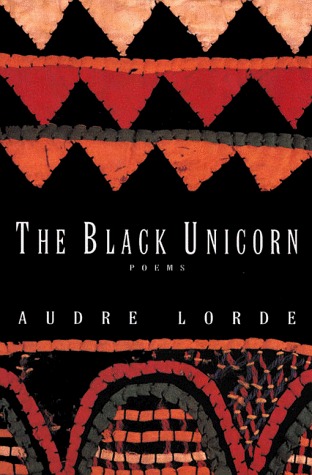
Review: The Black Unicorn: Poems by Audre Lorde


First published:-1978

Star rating:-

These poems are like shards of glass refracting the blurred image of some sombre new insight into the human condition - the agony of love, the pangs of coming to grips with the idea of racial segregation in a world one previously thought had no demarcations, the pervasive pessimism of living as reaffirmed by the morning newspaper, an elegy to the memories of a childhood friend whose time on earth ran out too soon, the melancholic ruminations of a prostitute, the absurdity of children of today being raised like slaughterhouse pigs to be sent to the war-front tomorrow. 
Coming in and out of cities
untouched by their magic
I think without feeling
this is what men do
who try for some connection
and fail
and leave
five dollars on the table.

If the annals of literature are to be consulted, most of these are time-worn subjects which other more renowned poets have regurgitated throughout their distinguished careers, after molding them in accordance with their perceptions of the world and its many idiosyncrasies. And yet Audre Lorde's words, imbued with despondency, regret, hope and fortitude at the same time, tempt you to read them again and again. Her lines flow effortlessly despite their innate simplicity, maintaining an enviable rhythmic symmetry, rendering the reader's tendency to puzzle over esoteric references unnecessary since there are almost none. 
There are a handful of poems here, in praise of the female and androgynous forms of divinity worshipped by the inhabitants of the historical kingdom of Dahomey and the Yoruba people of western Nigeria, which bring to light the oft-overlooked aspects of the cultural ethos of African people. But there's a conveniently provided glossary of African terms at the end to better facilitate complete understanding of these. 

You were not my first death.
but your going was not solaced by the usual
rituals of separation
the dark lugubrious murmurs
and invitations by threat
to the grownups' view
of a child's inelegant pain
so even now
all these years of death later
I search through the index
of each new book
on magic
hoping to find some new spelling
of your name

The implications hidden between her verses do not reinforce a kind of self-obsessed confessionalism as often found in Sylvia Plath or Anne Sexton's works or the heavy-handed inclusion of so many allusions that the poet's urge to communicate is buried under towering ambitions of dismantling poetic conventions. 

Sometimes, her words give the impression of mildly cryptic messages casually scribbled at the back of a notebook, perhaps, while she may have been staring out of her window distractedly. Sometimes, they are her anguished lament, her impassioned protest, wrenched out of her by the brutality of the world or the injustice perpetually dished out to those clinging to the lowermost rungs of the societal ladder for dear life. Her 'Power', one of the most influential and well-known poems from her entire oeuvre, simmers with a righteous rage, intense enough to blow a hole through the edifice of 'white supremacist patriarchy' aside from being a tribute to the memory of young Clifford Glover, a 10-year-old African American boy shot dead by a white cop on duty in South Jamaica, Queens, New York in '73, who was later acquitted by a white-majority jury with a single black female judge.

Today that 37-year-old white man with
13 years of police forcing
has been set free
by 11 white men who said they were satisfied
justice had been done
and one black woman who said
"They convinced me" meaning
they had dragged her 4'10" black woman's frame
over the hot coals of four centuries of white male approval
until she let go of the first real power she ever had
and lined her own womb with cement
to make a graveyard for our children.

Lorde remains one of the few poets in American history who had to contend with the tyranny of conforming to the demands of too many labels conferred on persecuted minorities - black woman in a white man's world, radical feminist, lesbian, civil rights activist. And yet she managed to breach the boundaries of these individual identities by singing in a richly resonant voice whose musicality still holds the power of bridging gaps, relaying the stories of the voiceless and the marginalised, healing the scars left by turbulent times and smoothening out our countless differences across continents and timelines. 
In my eyes, that makes her a hero more than a poet.


____

   photo C136E66569D294E4D5DA2D8124D4FF69.png

Monday, July 21, 2014

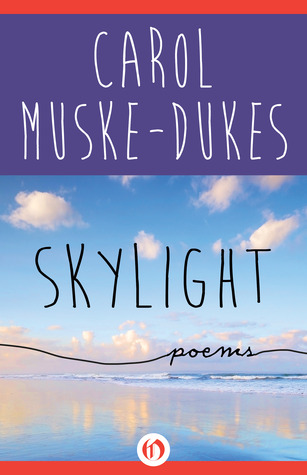
Review: Skylight: Poems by Carol Muske-Dukes

First published:-1981

Republished:- By Open Road Media on June 10, 2014

Star rating:- 

One of my pet gripes with poetry is on full display in this poet's works - losing so much of time re-reading lines, fishing out implications from the layers of metaphor thrust upon allusion thrust upon circumlocution that in the battle between the reader's enthusiasm for emotionally connecting with the verses and sheer exasperation, exasperation wins. 
Poetry is meant to be savoured - the rhythm, the flow, the delicate alignment of pretty words combined with some semblance of purpose all taken in together - and not decrypted like some hidden code through multiple readings. It doesn't matter if the occasional pair of lines succeed in concealing their intent, their true significance, perhaps, too exclusive to the poet's inner life or too obscure to aid our understanding. But there should be a limit to this sort of penchant for inserting excessive imagery and hyperbole.

Don't take my complaints too seriously though. Finding poetry that hits just the right note is actually like finding the right shoe fit and hence the criteria that go into its determination will differ from reader to reader. Besides I had problems with only a few of the poems. Most of the remaining ones are exceptionally well-written and make their points with so much subtlety that you are more likely to miss them unless you keep your eyes peeled. 

I had no idea Carol Muske-Dukes (former Poet Laureate of California) had such a good knowledge of Indian history and an even firmer grasp over our cultural sensibilities. (Color me impressed) 
Her 'Ahimsa' on the Jallianwala Bagh massacre (which is still regarded as one of the most barbaric things done to us by the British and which caused Tagore to reject his knighthood) is elegiac and deeply philosophical.

"Say you walked in the shadowy garden
in Amritsar, before night descended,
tried to imagine the massacre, that crazy saint
Gandhi and the people on their knees to a god
less civilized than he. You would
disagree, agree....
violence teaches nothing."

While 'War Crimes', a reflection on rape (a subject which Adrienne Rich versifies with more finesse, no doubt, in her Diving Into the Wreck) is wrenching and cerebral. 

"...that the great nerve
which runs from head to pelvis
which makes us courteous
shy
scrupulous
makes us touch another with gentleness
would tremble
till it was plucked
held in the pliers
then in the fire
shriveling in that little violence
of heat and light
which in another form
we often refer to
as love."

The variation in her themes is another noteworthy aspect of her range as a poet - subjects from abuse of young children, a daughter's view of her painter father, a child with a stuttering problem, an opium addict mourning the loss of his wife/lover, real estate, to the last set of poems which seem to be meditations on grief make appearances in this collection.

No points for guessing that the poems on India-related subjects, an old man in Benares carrying his dead wife in his arms to her pyre, the one on sexual violence and androgyny are my favorites from the collection. Yes I am predictable like that.


**I received an ARC from Open Road Integrated Media via Netgalley**

_____

Also posted on Goodreads and Amazon.

   photo C136E66569D294E4D5DA2D8124D4FF69.png

Tuesday, February 18, 2014

Anaïs Nin, my beloved witch

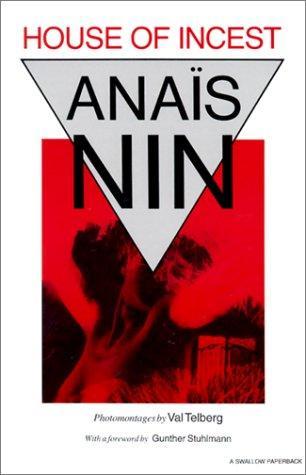
Anaïs Nin has been a favorite author for a while now. So today I'll just use this space to review two of her books at one go:-
House of Incest


First published:- 1936 (Nin's first work of fiction)

Star Rating:-

What do they say about pretty words strung together into passages pregnant with symbolism and implications, some of them beyond the grasp of a dilettante like me? How do they compartmentalize Anaïs Nin's writing? 
'Erotica' they like to call it, perhaps, putting focus on the sexual imagery Nin invokes with the flair of her pen. 

But I would rather not enclose Nin's genius inside the banal prison of a genre like erotica. Her words, like splotches of the most exotic water color, coalesce into an abstract painting of such acute beauty that one can only stare at the phantasmagorical picture that forms in front of the mind's eye, with a deep sense of wonderment. 

Her words are magic. Her words instill life into the seemingly lifeless form of a road stretching ahead. Her words transform a taboo subject like incest into a fathomable, even an acceptable reality of our existence and temporarily divorce us from the social conventions, of the material world, as we know them. Her words whisk us away to a secluded, floating world where only surreal landscapes of Nin's imagination sprawl far and wide in all their majestic splendour. And the reader can only be a besotted traveller enjoying a one-of-a-kind sojourn - soaking up all the incomprehensible loveliness of Nin's prose in small bursts.

"I felt only the caress of moving - moving into the body of another - absorbed and lost within the flesh of another lulled by the rythm of water, the slow palpitation of the senses, the movement of silk..
Loving without knowingness, moving without effort, in the soft current of water and desire, breathing in an ecstasy of dissolution.
I awoke at dawn, thrown up on a rock, the skeleton of a ship choked in its own sails."


Her words accord a kind of literary immortality to so many hackneyed humane emotions and sentiments.

"But Jeanne, fear of madness, only the fear of madness will drive us out of the precincts of our solitude, out of the sacredness of our solitude. The fear of madness will burn down the walls of our secret house and send us out into the world seeking warm contact. Worlds self-made and self-nourished are so full of ghosts and monsters."


Her words are exquisite poetry. 

____

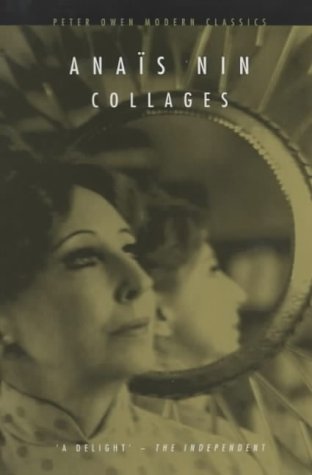
Collages


First Published:-1964

Star Rating:-


Anaïs Nin is my beloved witch, capable of making the nebulous frontiers between imagination and reality dissolve away into oblivion with one well-maneuvered flourish of her metaphorical pen, her personalized magic wand. Or I see her in my mind's eye, as a lovely but shabbily dressed seamstress, patiently weaving a patchwork quilt of exquisite beauty out of the gossamer strands of time. 

Does art imitate life or does the opposite hold true? 
Where does life begin? Where does it end? What lies in between? What does it all mean?
Anaïs Nin attempts to answer these hazy, unanswerable questions by giving us a snapshot of the perpetual movement of time and the phantasmagorical spectacle of humanity caught in its web, establishing without a doubt that there's no end, no beginning and no middle. Life is ad infinitum.

Dreams and reality collide in her writing, exploding in a dazzling array of fireworks illuminating the obscure part of our consciousness, giving us brief flashes of the realm in which the ultimate truth lies cocooned in the protective covering of the mundane, slumbering peacefully - the truth about life and beauty, love and lust, happiness and grief, the extraordinary and the common.

Collages is exactly what its title implies and much more than what our feeble imaginations can conceive upon the utterance of this word. It is not about a nation or a set of natives, a single protagonist or many, one life event or a set of discrete occurrences. Anaïs Nin renders perfect delineation unnecessary, makes clearly visible lines of divide vanish without a trace. Instead, vignettes, eerie and abstract, tangible and solid, merge and fall into each other, clumsily yet seamlessly, to create a surreal painting, a collage of the human consciousness holding the random admirer in thrall, glaringly all-encompassing in its wild, colorful abandon even though the viewer strives to make sense of it. But isn't life just like this baffling, bizarre work of art that Anaïs Nin begets? Comprehension stays forever out of reach. Even when we feel it floats mid-air at arm's length, attempts at trying to grasp it remain thwarted.

As Renate pours her beautiful, meaningless dreams into her empty canvasses, falls in and out of love with Bruce, drifting through space and time, touching the lives of many we get an impression of life's fluid grace and its capacity of encasing the infinite. The diseased, old man who shuns the company of his loved ones, preferring to live in a cave by the sea with a few seals as companions, the heart-broken French consul's wife who grieves for her broken marriage and vindictively contemplates finding a Turkish lover, the clairvoyant film critic who describes for Renate the scenarios written by struggling writers which never saw the light of the day, Nobuko who fights to free herself from the suffocating, rigid civility of the Japanese way of life - these are but a handful among the many myriad shades and facets of humanity shuttling in and out of Renate's life causing vague but perceptible upheavals. The quietly floating gondolas of Venice, the ochre-hued sand dunes of an African desert, the peaks of Peru and palaces of Marrakesh, upscale avenues of New York and streets of Arcadia, California all make fleeting appearances in this stunning collection of interlinked snippets, dismantling in the process all man-imposed barriers between nations and cultures and presenting to the reader an eerily arresting picture of life in all its glory and imperfection.

I don't care about Anaïs Nin being mostly recognized as a writer of literary erotica since I beg to differ on the subject of this categorization. I don't care about the fact that she shared an incestuous relationship with her father. But what I definitely care about is discovering and appreciating more of her splendidly assembled collages.


   photo C136E66569D294E4D5DA2D8124D4FF69.png

Sunday, December 29, 2013

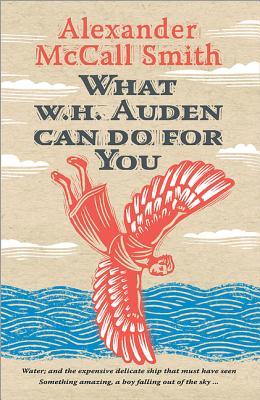
Review: What W.H. Auden Can Do For You by Alexander McCall Smith

First published:- 2013
Published by:- Princeton University Press

Star rating:-


How should we like it were stars to burn 
With a passion for us we could not return? 
If equal affection cannot be, 
Let the more loving one be me.


My association with W.H. Auden and his literary output has been restricted to the occasional browsing through poets.org which gave rise to a somewhat fickle love for Lullaby (which I couldn't help but read more than once) and As I walked Out One Evening. But somehow the lines faded away from memory as soon as I closed the browser window, sometimes mere beautiful words and perfect cadence aren't sufficient to stimulate further intellectual curiosity. But Alexander McCall Smith's near fanboyish enthusiasm for one of the greatest English poets of the 20th century has forced me to reconsider my views on Auden and maybe even provided the much needed push to delve into his oeuvre further.

This is not literary criticism per se, but rather a mixed bag of Smith's views on the poet's personal life, his body of work and the way his worldviews figured in his poetry. It goes without saying, literature students may find this book vastly redundant as it contains nothing that hasn't already been recorded by academicians who have analyzed and dissected Auden's poetry from all probable angles. And Smith acknowledges this right at the beginning, very clearly stating that his intention behind writing this has been to offer a tribute to Auden who was, in a way, his personal literary icon.

There are separate chapters devoted to Auden's early years at Gresham's School, another one in the long tradition of stiff upper-lipped English boarding schools, and later at Oxford, his lifelong friendship with Christopher Isherwood who had been inspired to write the renowned Goodbye to Berlin after Auden's visit to Berlin in 1928, his homosexual dalliances, his desire to drive an ambulance during Spanish Civil War which resulted in one of his celebrated, but subsequently disowned, poems 'Spain'(vehemently denounced by George Orwell who of course was accredited with a deeper understanding of the politics of the Civil War), his growing admiration for socialism in the wake of the rise of fascism in Europe prior to the Second World War and his eventual disillusionment with Communism. 

Auden's poetry is widely criticized as a hollow compilation of sublime imagery and flowery writing with little to no depth but Smith, in the tradition of most Auden lovers, defends the sanctity of his work with assertions like the following:- 

"'In Praise of Limestone' contributes greatly to the appeal of what he wrote. It is easy on the ear - and ease here has no pejorative implications: the fact that something is easy to listen to does not make it less intellectually significant."

"There are plenty of poets, especially those given to the writing of confessional verse, who are ready to tell us about their particular experience of love. We listen sympathetically, and may indeed be touched or inspired by their insights. But few poets transcend the personal when talking about love. They are talking, really, about how they felt when they were in love; Auden digs far deeper than that. He talks about love and flesh as it can be experienced by all of us - he transcends the specific experience in a particular place and time, to get to the heart of what we are."

Smith also makes a significant point in regard to Auden's disposition as a poet, he was known to acknowledging misrepresentations of facts in his earlier poems instead of quietly hoping for the work in contention to be erased from public memory like the other writers of his time did. He humbly acknowledged whenever he was wrong and was extremely self-critical.

To conclude, this is a fine book to gift to the random Auden devotee and perfect for introducing Auden to a neophyte who knows virtually nothing about the great Anglo-American poet (like myself for instance).


Also published on Goodreads and Amazon.
   photo C136E66569D294E4D5DA2D8124D4FF69.png
Related Posts Plugin for WordPress, Blogger...