Showing posts with label OMG aliens. Show all posts

Sunday, August 3, 2014

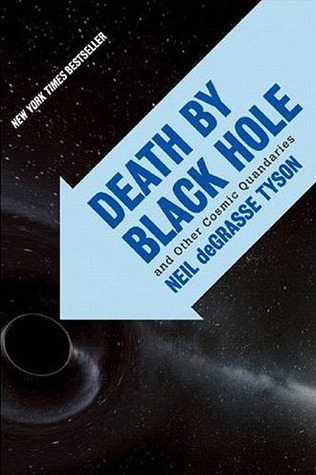
Review: Death by Black Hole and Other Cosmic Quandaries by Neil deGrasse Tyson

First published:- 2006


Star rating:-


Neil deGrasse Tyson is a force to reckon with. 


description

But he is not Carl Sagan. 

While Sagan must have smiled down kindly on your meek acknowledgement of ignorance regarding, say, black holes, Tyson will have most probably given you the stink eye or aimed a sarcastic jibe at your apathy, before proceeding to explain why black holes still remain a topic of much speculation in the community of astrophysicists worldwide.

Tyson does not pull any punches in this collection of essays while slamming the news media, who more often than not, come off as ill-informed hacks doing a shoddy job of reporting facts in the field of space science, forever (stupidly) claiming how scientists are baffled by so-and-so new developments. 
"Scientists cannot claim to be on the research frontier unless one thing or another baffles them. Bafflement drives discovery."

Or snidely commenting on the Hollywood exercise of producing multi-million dollar sci-fi films which badly butcher the scientific aspects of such ventures by inserting factually incorrect observations in scenes and dialogues. (there's a brilliant anecdote concerning James Cameron's 'Titanic' in this regard and the Contact film gets an honorable mention for its adherence to proper science if one overlooks a minor gaffe)
"I am glad that, in the end, the humans win. We conquer the 'Independence Day' aliens by having a Macintosh laptop computer upload a software virus to the mothership. [] The entire defense system for the alien mothership must have been powered by the same release of Apple Computer's system software as the laptop computer that delivered the virus."

Or criticizing the mad dash for extending the frontiers of space science during the Cold war years, when the spirit of scientific inquiry was sidelined in favor of a dangerous game of political one-upmanship, a kind of puerile assertion of 'our scientists are better than yours'. Or openly chastising revered names from ancient Greece like Aristotle whose inaccurate assumptions about the unchanging nature of stars and the geocentric universe helped the Catholic Church in propagating falsities for centuries with impunity. (He doesn't even spare Newton forGod's Higgs Boson's sake who, unable to satisfactorily explain the ordered behavior of the solar system despite the many often conflicting gravitational forces at work, had cited God's need to step in to correct things in his famed 'Principia')

While Sagan may have adopted a more benign, less aggressive tone in course of addressing issues of religious dogma being at loggerheads with scientific reasoning and aversion to science and mathematics among the general populace, NDT takes the approach of pure, unadulterated logic and demolishes one popular misconception after another (for e.g.:-the North Star is not the most brilliant star in the night sky or how everything that goes up doesn't come down) with a brute force which I am certain will not sit well with some sensitive readers who are easily offended. 

Being born in a country whose space research organization head performs pujas and makes ritualistic offerings prior to launching a 'Mission to Mars', I can't say I fault NDT's acerbic tone or his distaste for those who are hell-bent on unifying science and religion without even realizing that finding common ground between both is akin to attempting to exceed the velocity of light.

But if NDT lacks Sagan's sage-like demeanour and his rich, authorial voice (Sagan's prose is much more refined no doubt), his excellent sense of humor almost compensates for their absence - 
"The good thing about the laws of physics is that they require no law enforcement agencies to maintain them, although I once owned a nerdy T-shirt that loudly proclaimed, "OBEY GRAVITY."
"The only people who still call hurricanes 'acts of God' are the people who write insurance forms."
(and Michele Bachmann, just saying)

And occasionally there's a sop thrown in for the literary-minded (particularly the postmodernist fiction lover) - 
"The physicist Murray Gell-Mann, who in 1964 proposed the existence of quarks, and who at the time thought the quark family had only three members, drew the name from a characteristically elusive line in James Joyce's Finnegans Wake:'Three quarks for Muster Mark!'"

The more frivolous aspects of the essays aside, among the astrophysics-related topics NDT centers his discussions around, the ones which were relatively new to me are the concepts of hypernovae, gamma ray bursts, dark matter and dark energy, the uncertainty surrounding the string theory and the probability of the annihilation of Earth through ill-fated, cosmic encounters with errant asteroids, the unavoidable, impending collision of our galaxy with the Andromeda galaxy which is the nearest one heading towards us at a speed of more than 100 kilometers per second.

description
The Andromeda Galaxy

Since this is a collection of 42 essays which were published in the 'Natural History' magazine, some repetition of concepts and names creeps in occasionally but that merely helps you refresh memories of what you just read a few pages back, not exactly a shortcoming I am keen to quibble over. 

4 stars, because Tyson seems a little too bitter about artists who exercise 'artistic license' to distort certain astronomical facts in their paintings. Besides I am certain there is a lot of 5-star-worthy goodness in the rest of NDT's works left for me to discover in the future.


   photo C136E66569D294E4D5DA2D8124D4FF69.png

Friday, April 4, 2014

Review: Cosmos by Carl Sagan


First published:- 1980

Star rating:-

I wonder what Carl Sagan may have thought of 9/11 and the world in the new millennium, a strife-torn place which is being shaken up and shaken out every moment. I imagine the civil but slightly horrified and slightly bemused tone he may have employed while talking about the Iraq and Afghanistan wars and the antics of the Bush administration which have become such excellent fodder for stand up comedians the world over. And I can almost detect the note of boyish enthusiasm in his voice while he may have spoken of the Higgs Boson and explained the reasons behind the incorrect observation readings of the 'neutrinos being speedier than light particles' experiment that had made the headlines a few years ago.

I can only imagine because he wasn't there to witness these watershed events and he isn't here to offer comment, criticism or share his inexhaustible repository of knowledge with us any longer. His time in the Cosmos had run out within two decades of the publication of this work - a testament to his own belief in the staggering inferiority of our evanescent lifetimes in the scheme of the universe(s). 

"Our familiar universe of galaxies and stars, planets and people, would be a single elementary particle in the next universe up, the first step of another infinite regress."

It would be nice if I could summarize each one of the 13 chapters of 'Cosmos' and give readers the lowdown on our painstakingly slow but rewarding crawl through the fabric of space and time, the civilizational hurdle race towards a finish line which we can neither begin to envision nor fully comprehend yet. 
I could write a review in the conventional format, leaving you with a gentle nudge to read this book as soon as you can.

Or, instead, I could simply write about how, despite being more than 30 years outdated, Carl Sagan's voice of reason rings truer than ever, cutting through the heart of all the din and chaos of our troubled times. I could just tell you how Sagan's deep and abiding love for nature and humanity reverberates in every page of this work and how our scientific endeavours across timelines and geographical boundaries, across the unending void which surrounds us on all sides, symbolize our collective pursuit of knowledge.

"There is no other species on Earth that does science. It is, so far, entirely a human invention, evolved by natural selection in the cerebral cortex for one simple reason: it works. It is not perfect. It can be misused. It is only a tool. But it is by far the best tool we have, self-correcting, ongoing, applicable to everything. It has two rules. First: there are no sacred truths; all assumptions must be critically examined; arguments from authority are worthless. Second: whatever is inconsistent with the facts must be discarded or revised."

The Cold War is a now defunct appendage of our history, the Soviet Union is no more, America has achieved a milestone in its race relations by welcoming its first Black President. But turmoil in the world order persists - the nuclear arms race between the Americans and the Soviets has been replaced by a newer dance of dominance in the Asia Pacific region. The world is as much embroiled in a mesh of steadily growing list of challenges as it was in the past, if not more. Preposterous decrees issued by fanatical outfits, blatant human rights violations, infringement on freedom of speech and expression, diplomatic arm-wrestling, the ever-enthusiastic decriers of science, 'War on Women', the shouts of the global-warming deniers reign supreme still. The players may have changed faces but the game of petty one-upmanship in the arena of global politics still continues unabated.

Which is why Sagan's rousing call for all of mankind to unite under the identity of citizens of the Cosmos and not as citizens of a nation moves me to the core of my being. His recapitulation of our scientific advancements achieved against the tide of adverse circumstances, of the victories won in the face of persecution by religious authority, impresses upon us a sense of urgency - that with the exponential increase in the defense budgets of the global powers, the incentive given to the greatest minds of our times to devote time and energy to unraveling the mysteries of the Cosmos is reduced. As the concept of 'nuclear deterrence' receives a pat on the back, the global arms sales numbers continuing to soar despite hollow promises of arms control, more and more scientists are being engaged in improving weapons technology rather than validating the fact of our existence against the intimidating presence of the stars, galaxies and universes. The NASA budget cuts of recent times are proof of this ignominy.
Is it to this end that the ancient advanced cities like Alexandria, the destroyed civilizations of Ionia and the Aztecs and pioneers such as Eratosthenes, Democritus, Aristarchus, Hypatia, Leonardo da Vinci, Copernicus, Galileo, Johannes Kepler, Tycho Brahe, Christiaan Huygens, Issac Newton and Albert Einstein worked tirelessly for? To further intensify mutual national antagonism and increase our probability of complete self-annihilation?

Sagan thinks not.

"Our loyalties are to the species and the planet.We speak for the Earth. Our obligation to survive is owed not just to ourselves but also to that Cosmos, ancient and vast, from which we spring."

This is why I can't help but agree quite heartily with someone who says 'If I had a religion, I would be a Carl Saganian.'

"If a human disagrees with you, let him live. In a hundred billion galaxies, you will not find another."

If there is only one worldly diktat we must abide by with unquestioning faith, let it be this one.


   photo C136E66569D294E4D5DA2D8124D4FF69.png
Related Posts Plugin for WordPress, Blogger...