Sunday, March 30, 2014

Review: Kokoro by Natsume Sōseki

First published:- 1914

Star rating:-


A languid, melancholic dream of a novel which pierces the heart of the reader with its quiet intensity.

Cautious in its narrative tread on the ground of contentious issues, delicate in its broaching of subjects like the indignity of death, sin and redemption, existentialist ennui, self-recrimination and misanthropy, 'Kokoro' is a masterful recounting of a tragedy which unfolds against the backdrop of the dying years of the Meiji era. As Emperor Meiji breathes his last taking along with him the anachronistic echoes of an obsolete way of life rigidly shackled by the conservatism of the isolationist years, a hesitant Japan steps into the welcoming embrace of modern day materialism while simultaneously waging an inner war with the self-denying Confucian ideologies of its past. 

A mysterious and scholarly middle-aged man only referred to as 'Sensei' meets our young protagonist in a chance encounter and the unique mentor-protege bonding, that forms between them subsequently, brings an indescribable joy and solace to both. While 'Sensei' eventually summons the courage to confess to past wrongdoings in a letter to the young man he barely knows and attains a kind of salvation through a self-imposed exile from society, his unnamed protege learns to look past the horror and agony of slow bodily death and accept the natural order of things. A powerfully written spiritual inquiry into the corruption of the human soul, an elegant acknowledgement of the juxtaposition of mournful endings and optimistic beginnings and a testimony to the fragility of human lives.


   photo C136E66569D294E4D5DA2D8124D4FF69.png

Monday, March 24, 2014

Review: The Prime of Miss Jean Brodie by Muriel Spark

First published:- 1961

Read in:- January, 2014

 Star rating:-


Henry Louis Vivian Derozio is a name possibly not known or cared for beyond the frontiers of India. 
At the tender age of 17 this man of Anglo-Indian descent, possessing a sharp intellect and an even sharper tongue, was already a Professor of English Literature and History, busy influencing a group of eager, well-bred young men hailing from affluent Bengali families in Calcutta. He became a leading figure in the age of socio-cultural reform movements in Bengal in the dawn of the 19th century through his dissemination of Western philosophical and scientific ideas at a time when our society was stagnating in a cesspool of ignorance and blind prejudices. And his close-knit group of brilliant young students of the Hindu College who were referred to by the smart moniker of'Derozians', much in the same manner of the ill-famed 'Brodie set' of TPOMJB, were viewed with as much suspicion as unacknowledged respect. But following the pattern of reception of new ideas which are regarded 'radical' and therefore dangerously subversive in their times, Derozio was expelled from the Hindu College and this in turn applied an abrupt brake on the Young Bengal movement. 

As much as my teenage self had looked upon the Derozio name and his legacy with a kind of starry-eyed deference, post-acquaintance with a fictional educator as sociopathic and ambiguous as Miss Jean Brodie, I am forced to view this whole idea of an inspirational teacher weaning a student away from conventional methods of learning with utmost skepticism. No I do not intend to overlook Derozio's small but significant contribution to the collective betterment of our society of the times which in turn greatly aided the nationalist movement later on. But maybe, it will be wise to probe deeper for the unadulterated truth rather than be so guilelessly accepting. I am sure both Muriel Spark and Derozio himself would have approved.

Young, impressionable minds being shaped according to someone else's personal standards of nauseating elitism and if one is unlucky enough to fall under the spell of some conniving Miss Jean Brodie in her prime, being sucked right into a sinister trap. 
What a slippery slope this is! This setting about to correct the course undertaken by a young learner under the facade of challenging conformity, with a perverse sense of authoritarian entitlement. 


'I know better than you, therefore you must follow my instructions.' 


In the way of Miss Jean Brodie's attempts at manipulating adolescent girls into competing with each other to be made a part of her venerated 'crème de la crème', people of insidious intent devise ways of propagating some attractive piece of ideology with confident pronouncements of it being the 'path of righteousness' and all that familiar drivel. 

Which is why I now realize how treacherous traversing this distance between not knowing and knowing a little better is - there's no way to fill up the vacuum of ignorance other than with information in any form that is available nearby and you better hope that pedagogical influence of the likes of the magnetic Miss Jean Brodies of the world does not hold free reign in the vicinity at the time.

"Give me a girl at an impressionable age, and she is mine for life."

It's been a while since something quite as innocuous sounding as the above claim has left me feeling so deeply unsettled.


   photo C136E66569D294E4D5DA2D8124D4FF69.png

Sunday, March 16, 2014

Review: The God of Small Things by Arundhati Roy


First published:- 1997

Read in:- January, 2014

Star rating:- 


As I stand just outside the compound with the untended garden, an uninvited, random visitor, the darkened Ayemenem House resembles a haunted mansion, belying the truth of the lives it once nurtured with maternal protectiveness in its cozy interiors. Derelict. Abandoned. Forgotten.
But I remember, you see. I remember the lives lived, and the loves which were birthed by circumstances, loves which breathed for a while before perishing on the altar of conformity. 
I remember Chacko and Sophie Mol. Ammu and Velutha. Rahel and Estha. 

And, most of all, I remember You. You, the painter of this portrait of a family's downward spiral into oblivion. You, the creator of this life-sized painting of a city and a nation, and all of human civilization in turn.
I see You as an iconoclast, persistent in your demand for liberties we are too submissive to dream of acquiring. You ask for things so heedlessly, so powerfully. The right to love whom we want and how much we want. The right to be equal. The right not to be discriminated against. The right not to be left languishing in solitude, battling painful memories. The right not to lose, at any cost, one's faith in the goodness in human beings.
You are the rebel we never considered becoming. We do not have courage like yours, you see. 
(Your opinions aired on national television are so often misinterpreted. Deliberately. Craftily.)

The sun, inside of You that refuses to be subdued by the drear of political machinations, by the evil lurking in the human heart, by the sham of 'development' perpetrated under the helpful charade of inexistent liberty, equality, fraternity, by every one saying 'No no no, you ask for too much. The world cannot ever be a fair place.', sent a little light my way.
That light gives me hope. Your Small God gives me hope.

He augurs that the overlooked small, mundane cruelties will only snowball into a tragedy of life-altering proportions later on, a gigantic boulder hurtling down the slope of a mountain crushing everything in its path into an unrecognizable gory pulp of flesh and blood. Small God's wrath will eventually consume Big God's apathy and reduce it to mere cinders.
I hope your Small God is right.

You speak the esoteric language of children, whose inner worlds are but their own, beyond the reach of the sharpened claws of the Love Laws - worlds which are free and infinite, where fables, dreams and terrifying realities churn into a nonsensical lovely mass, worlds untethered to earthly considerations. The two-egg twins' interlinked worlds, which stubbornly rejected the continued tyranny of the cycle of injustices perpetuated outside, were the same.
Their combined muteness throbbed with the dull ache of longing, loss and irreparable damage. Their collective passivity stood out as a blistering denouncement of humanity always coming second to zealously preserved blind prejudices. And You spoke through Rahel and Estha's silence which rung much louder than a giant church bell chiming away nearby.

We stew in our own insecurities and the irrelevance of small personal outrages, unable to take a step forward, helpless captives in the iron grip of the status quo of the world. While You, Ms Roy, take up your pen and fearlessly hail The God of Human Dignity, Empathy and Love - The God of Small Things.

So in this space, I thank that God for the Arundhati Roys of the world.


   photo C136E66569D294E4D5DA2D8124D4FF69.png

Sunday, March 9, 2014

Review: The Handmaid's Tale by Margaret Atwood

First published:-1985

Read in:- August, 2013

 Star rating:-

Consider this not a ground-breaking work of literature. Consider this not a piece of fiction boasting an avant-garde mode of narration. 
Consider it not a commentary on the concept of subjugation of the weak by the ones holding the reins. Consider it not a thinly veiled feminist diatribe either.

Instead, consider The Handmaid's Tale an almost physical experience. Consider Margaret Atwood a fearless deliverer of unpleasant news - a messenger unafraid of dishing out the bone-chilling, cruel, unaltered truth and nothing but the truth.

Move over Bram Stoker. Move over H.P. Lovecraft. Fade away into oblivion, Edgar Allan Poe. Disappear down the depths of obscurity, Stephen King. Your narratives are not nearly as coldly brutal, your premonitions not nearly as portentous. 
Because Ms Atwood, presents to us something so truly disturbing in the garb of speculative fiction that it reminds one of Soviet-era accounts of quotidian hardships in Gulag labour camps. 

Speculative is it?

Aren't the Offreds (Of Fred) , Ofglens (Of Glen), Of warrens (Of Warren) of Gilead equivalent to the Mrs So-and-So-s of the present, reduced to the identity of their male partners? Isn't the whittling down of a woman to the net worth of her reproductive organs and her outer appearance an accepted social more? Isn't blaming the rape victim, causing her to bear the burden of unwarranted shame and social stigma a familiar tactic employed by the defense attorney?
Hasn't the 21st century witnessed the fate of Savita Halappanavars who are led to their untimely deaths by inhumane laws of nations still unwilling to acknowledge the importance of the life of a mother over her yet unborn child?
Doesn't the 21st century have materially prosperous nations governed by absurd, archaic laws which prohibit a woman from driving a car?
Doesn't the world still take pleasure in terrorizing activists like Caroline Criado-Perez with threats of rape and murder only because they have the audacity to campaign for female literary icons (Jane Austen) to become the face of Britain's 10-pound note?
Do I not live in a country where female foeticide is as normal an occurrence as the rising and setting of the sun?

Are we still calling this speculative fiction?

Some may wish to labour under the delusion that the women belonging to this much vaunted modern civilization of ours are not experiencing the same nightmare as Offred and are at perfect liberty to do what they desire. But I will not.
Because when I look carefully, I notice shackles encircling my feet, my hands, my throat, my womb, my mind. Shackles whose presence I have become so used to since the dawn of time, that I no longer possess the ability to discern between willful submission and conditioned subservience.

But thankfully enough, I have Margaret Atwood to jolt me back into consciousness and to will me to believe that I am chained, bound and gagged. That I still need to break free. 
I thank her for making me shudder with indignation, revulsion and righteous anger. I thank her for causing bile to rise up my throat. 
And I thank her for forcing me to see that women of the present do live in a dystopia like Offred's United States of America. We just prefer to remain blissfully blind to this fact at times.

Disclaimer:- I mean no disrespect to the other writers mentioned in this review all of whom I have read and deeply admire.


   photo C136E66569D294E4D5DA2D8124D4FF69.png

Friday, February 28, 2014

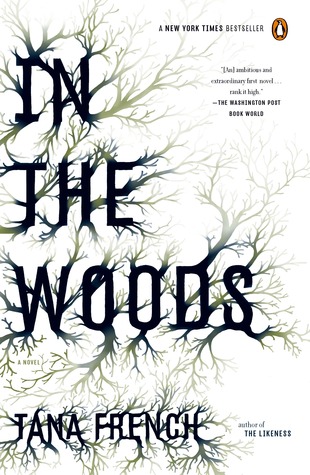
Review: In the Woods by Tana French

Reviewer's note:-Before I begin, let me state that 'In the Woods' has been reviewed in this space already but that was Scarlet's take. The following is mine. (The only thing evident in both reviews is how emotionally riveting we found this debut Tana French novel. Seriously, you must read this if you haven't.)


First published:- 2007

Read in:-November-December, 2013

Star rating:-

It's been a while since I have read a book that has left me so utterly devastated, a book entailing such a profound emotional investment that having finished it I feel a gaping emptiness within, a sense of loss. It feels like my heart has been simultaneously crushed into pulp under the weight of the tragedies that descend on the lives of a handful of characters and blown to smithereens. And I would never be able to pick up the pieces and glue them back together into a throbbing whole again.

I read In the Woods while on vacation, whenever I took breaks from watching wave after wave crash on to the shore with the familiar rip-roaring intensity of the sea. I read this even when I was too tired to stay up till late, lying on an unfamiliar bed with a sheet of dubious hygiene standards. I read this during prolonged car rides. And every time I had to tear my eyes away from its pages, I felt a pang of irritation.

As I made my way toward the bone-chilling climax of this narrative, awake at an unholy hour, I distinctly remember breaking out in a sweat on a cool December night to boot. Sleep became an alien entity and, come hell or high water, I knew I would not wrench myself away from this fantastic make-believe world of a small town and the sinister occurrences that tied the lives of its residents in the most twisted way possible. I longed to stay trapped in the eerie magic spell cast by the woods, under the ominous shadows of leafy canopies of pine and beech, caught up in a hazy daydream playing hide and seek with Peter, Jamie and Adam. My heart ached for the two children who never returned home from their beloved woods, who were never found again and the way the tragedy of their mystifying disappearance dealt a crushing blow to the life of their traumatized playmate who returned unharmed. It wept for Rob and Cassie and their missed chances.

This book isn't about crime and punishment, it isn't about the science of deduction or smooth-talking, fedora-sporting detectives smartly arriving at inference after inference and nabbing the culprit in style. I almost crave for the standardized simplicity of regular crime thrillers at this moment, the stories which conveniently compartmentalize the crime and the police procedure, the good guys and the bad guys. At least a book like that would not have left me feeling so desolate and bereft of any happy feeling. 

But this book took my breath away with its ability to instill so much life in each one of its characters that their distress became my own, with its ornate but never ostentatious prose and the way it deftly narrated a story infused with the dull shades of a sadness so affecting. Tana French foregoes all the spick and span categorizations here, thumbs her nose at the usual pigeon-holing. Instead with consummate skill, she outlines the faint traces of humanity in the most brutal impulses, acknowledges the messed up ways in which this bizarre drama of life plays out and how a neat tying up of all loose ends seldom happens in reality. More often than not, life is that merciless and cold. 

This book is about the labyrinthine pathways of our mind which treacherously conceal our most terrifying memories and how our subconscious prods us to replace the unpleasant truths with self-justifying falsities and even establishes our faith in them. It is about the seemingly innocuous, small cruelties of mundane everyday life that are capable of triggering much bigger disasters that destroy the lives of children and the unforgivable cruelties oblivious, ignorant children are themselves capable of.

I refuse to label this electrifying debut novel mere crime fiction because, in all earnestness, it is not. Rather, it is literature which delves deep into the causality of crime and meticulously brings out the humanity of all the people involved, literature capable of wringing out empathy from even the least sensitive reader. And it is an exploration of the convoluted workings of the human mind, of evil and barbaric urges lurking somewhere in its darkest nooks and crevices. It is a cerebral suspense thriller and, without a doubt, one of the best I have ever read. But it is also a beautiful, bittersweet story about people who carry on with their broken lives shouldering the unbearable burden of past trauma, an unforgettable human drama which left me emotionally drained, agitated to the extreme and yet gasping for more.


   photo C136E66569D294E4D5DA2D8124D4FF69.png

Friday, February 21, 2014

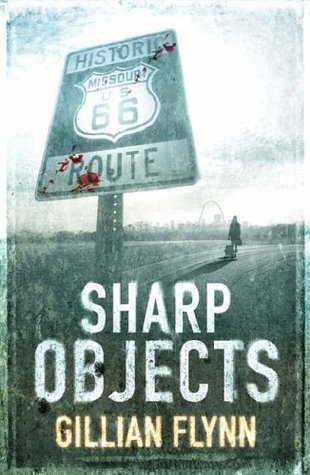
Review: Sharp Objects by Gillian Flynn

First published:-2006

Read in:- February, 2013

Star rating:-


When I had first come across rave reviews of Gone Girl, I was bowled over by the fact that there's after all a woman who is brave enough to try her hand at a genre rarely ventured into by women writers. And apparently, she excels at it too. Surely, she couldn't have hoodwinked hordes of unsuspecting readers into giving her books such high ratings.
So I had decided I'd devour Gillian Flynn's entire oeuvre starting with her first published work. 

Needless to say, that it is with obvious disappointment I'm giving this book only 2 stars. I had high hopes for Flynn's first published novel.

Sharp Objects comes off as a classic case of trying too hard. The set up feels too contrived, the world building, shabby and the writing, unimpressive and awkward. ('bucolicry' Ms Flynn? is that even a real word?) And to heap on to the negatives, Flynn rushes us through the scenery, the murders, the facts with such alarming speed that few things get time enough to make a powerful impact.

The eerie, secluded little town of Wind Gap never comes alive for the reader. All the characters appear to be caricatures of stereotypical suspects in a murder mystery novel. 
Even the central characters seem to be rather blurry outlines of real people instead of full-fledged human beings of flesh and bone. My mind failed at conjuring up even a single image of Wind Gap, its inhabitants or Camille and that's when I knew things were going downhill. After I had made some headway with the book, my attention kept drifting away and this doesn't usually happen with a thriller novel.(Proof of my steadily dwindling interest in thrillers maybe?)

Neither did I care about the murders nor did I think much of the disturbing imagery that Flynn shoves right in the reader's face from time to time. Even if you keep the somewhat macabre murders of pubescent girls aside, there are themes of self mutilation, sexual abuse, descriptions of horrific serial killings, slaughtering of pigs and chickens to make you cringe and wince as you read every alternate passage. Still I wasn't repulsed.
Instead what I felt acutely was Flynn's desperate desire to create a truly unsettling narrative. You can tell she is trying to offer you a blend of all things gory, disturbing and wicked just to titillate your senses. It's as if the central story became secondary to Flynn somewhere while she was writing this and only the deeply perturbing elements assumed primary importance.

Even the ending fails to pack in a punch, because if you have read a slew of whodunits at any point of time in your life, you will sort of guess the culprit. 
The only part which successfully creeped me out was the protagonist's tendency to inflict injuries on herself as a way to purge herself of emotions. But that one feeling doesn't help you sail through a book which is, otherwise, ceaselessly dreary and simply put, lacklustre in every way.

Hence, 2 very unsatisfied, very bored stars.

I am holding out hope for Gillian Flynn though. Maybe my opinion will change after reading Gone Girl.


   photo C136E66569D294E4D5DA2D8124D4FF69.png

Tuesday, February 18, 2014

Anaïs Nin, my beloved witch

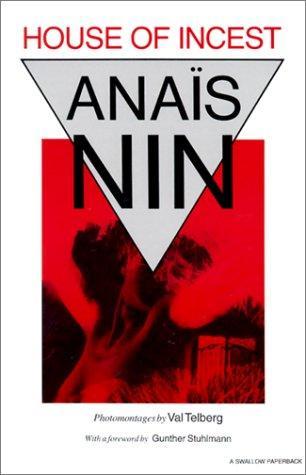
Anaïs Nin has been a favorite author for a while now. So today I'll just use this space to review two of her books at one go:-
House of Incest


First published:- 1936 (Nin's first work of fiction)

Star Rating:-

What do they say about pretty words strung together into passages pregnant with symbolism and implications, some of them beyond the grasp of a dilettante like me? How do they compartmentalize Anaïs Nin's writing? 
'Erotica' they like to call it, perhaps, putting focus on the sexual imagery Nin invokes with the flair of her pen. 

But I would rather not enclose Nin's genius inside the banal prison of a genre like erotica. Her words, like splotches of the most exotic water color, coalesce into an abstract painting of such acute beauty that one can only stare at the phantasmagorical picture that forms in front of the mind's eye, with a deep sense of wonderment. 

Her words are magic. Her words instill life into the seemingly lifeless form of a road stretching ahead. Her words transform a taboo subject like incest into a fathomable, even an acceptable reality of our existence and temporarily divorce us from the social conventions, of the material world, as we know them. Her words whisk us away to a secluded, floating world where only surreal landscapes of Nin's imagination sprawl far and wide in all their majestic splendour. And the reader can only be a besotted traveller enjoying a one-of-a-kind sojourn - soaking up all the incomprehensible loveliness of Nin's prose in small bursts.

"I felt only the caress of moving - moving into the body of another - absorbed and lost within the flesh of another lulled by the rythm of water, the slow palpitation of the senses, the movement of silk..
Loving without knowingness, moving without effort, in the soft current of water and desire, breathing in an ecstasy of dissolution.
I awoke at dawn, thrown up on a rock, the skeleton of a ship choked in its own sails."


Her words accord a kind of literary immortality to so many hackneyed humane emotions and sentiments.

"But Jeanne, fear of madness, only the fear of madness will drive us out of the precincts of our solitude, out of the sacredness of our solitude. The fear of madness will burn down the walls of our secret house and send us out into the world seeking warm contact. Worlds self-made and self-nourished are so full of ghosts and monsters."


Her words are exquisite poetry. 

____

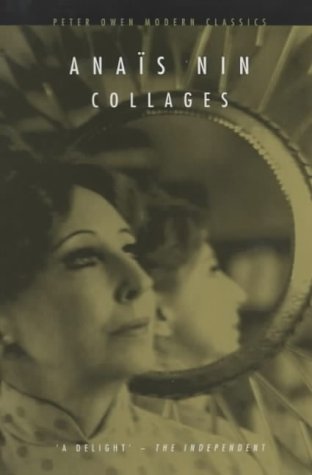
Collages


First Published:-1964

Star Rating:-


Anaïs Nin is my beloved witch, capable of making the nebulous frontiers between imagination and reality dissolve away into oblivion with one well-maneuvered flourish of her metaphorical pen, her personalized magic wand. Or I see her in my mind's eye, as a lovely but shabbily dressed seamstress, patiently weaving a patchwork quilt of exquisite beauty out of the gossamer strands of time. 

Does art imitate life or does the opposite hold true? 
Where does life begin? Where does it end? What lies in between? What does it all mean?
Anaïs Nin attempts to answer these hazy, unanswerable questions by giving us a snapshot of the perpetual movement of time and the phantasmagorical spectacle of humanity caught in its web, establishing without a doubt that there's no end, no beginning and no middle. Life is ad infinitum.

Dreams and reality collide in her writing, exploding in a dazzling array of fireworks illuminating the obscure part of our consciousness, giving us brief flashes of the realm in which the ultimate truth lies cocooned in the protective covering of the mundane, slumbering peacefully - the truth about life and beauty, love and lust, happiness and grief, the extraordinary and the common.

Collages is exactly what its title implies and much more than what our feeble imaginations can conceive upon the utterance of this word. It is not about a nation or a set of natives, a single protagonist or many, one life event or a set of discrete occurrences. Anaïs Nin renders perfect delineation unnecessary, makes clearly visible lines of divide vanish without a trace. Instead, vignettes, eerie and abstract, tangible and solid, merge and fall into each other, clumsily yet seamlessly, to create a surreal painting, a collage of the human consciousness holding the random admirer in thrall, glaringly all-encompassing in its wild, colorful abandon even though the viewer strives to make sense of it. But isn't life just like this baffling, bizarre work of art that Anaïs Nin begets? Comprehension stays forever out of reach. Even when we feel it floats mid-air at arm's length, attempts at trying to grasp it remain thwarted.

As Renate pours her beautiful, meaningless dreams into her empty canvasses, falls in and out of love with Bruce, drifting through space and time, touching the lives of many we get an impression of life's fluid grace and its capacity of encasing the infinite. The diseased, old man who shuns the company of his loved ones, preferring to live in a cave by the sea with a few seals as companions, the heart-broken French consul's wife who grieves for her broken marriage and vindictively contemplates finding a Turkish lover, the clairvoyant film critic who describes for Renate the scenarios written by struggling writers which never saw the light of the day, Nobuko who fights to free herself from the suffocating, rigid civility of the Japanese way of life - these are but a handful among the many myriad shades and facets of humanity shuttling in and out of Renate's life causing vague but perceptible upheavals. The quietly floating gondolas of Venice, the ochre-hued sand dunes of an African desert, the peaks of Peru and palaces of Marrakesh, upscale avenues of New York and streets of Arcadia, California all make fleeting appearances in this stunning collection of interlinked snippets, dismantling in the process all man-imposed barriers between nations and cultures and presenting to the reader an eerily arresting picture of life in all its glory and imperfection.

I don't care about Anaïs Nin being mostly recognized as a writer of literary erotica since I beg to differ on the subject of this categorization. I don't care about the fact that she shared an incestuous relationship with her father. But what I definitely care about is discovering and appreciating more of her splendidly assembled collages.


   photo C136E66569D294E4D5DA2D8124D4FF69.png
Related Posts Plugin for WordPress, Blogger...