Showing posts with label France. Show all posts

Wednesday, September 30, 2015

Review : So You Don't Get Lost in the Neighborhood by Patrick Modiano


First published:- October, 2014

Translated by:- Euan Cameron

Publisher:- Houghton Mifflin Harcourt 

Star rating:- 


Call this a book of mirages and mirrors that distort the contours of visible reality all the time. Call it a lament for the inevitability of change that erases all the landmarks to a place that anchors one to a past self. Call it a psychological thriller, a faux-noir in which people materialize out of thin air to serve as clues to lead the joyless protagonist to a truth too terrible for him to comprehend all at once. (Faux noir because Modiano ingeniously deploys its signature leitmotifs to subvert the genre. The token crook is merely a shady character, the token gangster's moll/seductive siren becomes a sympathetic confidante and the token mystery transforms into a disconcerting odyssey through the maze of time and memory.) But an adroitly spun yarn as this one transcends the imposed boundaries of any such labeling with ease and surprising grace.

One can tell the Nobel committee usually doesn't mess around at least when it comes to this greatest of honours reserved for literary achievement. Only pure artistry could have produced something as perfect as this - a combination of strategically placed expository bits, a dreamy, sublime narrative voice reflecting both a subconscious longing and antipathy for lost time, a melding together of reality and delusion, an overlapping of the worlds of 'was' and 'is', and a cautious but sure-footed unravelling of plot. The last time something this unambiguously postmodern in tone and form had brought me such pure reading pleasure was when I happily surrendered before Ali Smith's rhetorical playfulness in There But for The.

There, on the pavement, in the light of the Indian summer that lent the Paris streets a timeless softness, he once again had the feeling that he was floating on his back.

Author Jean Daragane's world is populated by ghosts - ghost-like individuals who hover over his reality to lead him to places and people he has forgotten and, in all likelihood, does not want to recall, the specter of self-written words that elude his feeble grasp on memory, ghost of a city's turbulent past intruding on the equanimity of the present, ghost of those nauseous years of the Occupation that one cannot shake off despite best efforts. And these myriad ghosts proliferate at the back of his mind to warp his sense of time, creating a stark dissonance between reality and memory that usher in a renewed sense of dislocation. In a way, he seems like a vagrant spirit himself, adrift in life like flotsam after a devastating tsunami, alienated from the rituals of work, love, relationships. But this deceptive placidity of the surface of his consciousness is disturbed by a phone call out of the blue which sets into motion a chain of fated meetings and ridiculous coincidences which eventually allow him to find a way back into his past, a journey he undertakes with considerable reluctance and disguised trepidation. I'll leave you to summon the curiosity to find out where this journey eventually leads him.

It would appear, he often used to say to himself, that children never ask themselves any questions. Many years afterwards, we attempt to solve puzzles that were not mysteries at the time and we try to decipher half-obliterated letters from a language that is too old and whose alphabet we don't even know.

Like a true master of the craft, Modiano only ever mentions the War in passing, subtly inserting roadsigns which point to the ineffaceable marks of damage on a Paris which itself appears like a figment of Daragane's imagination at times, as if it might flicker out of focus any moment to reappear in a pale imitation of an unrecognizable former avatar. But the memory of war lingers on in the desolation of rue de l'Arcade and the boulevard of Champs-Élysées witnessing the flow of time like a dispirited sentinel, in Daragane's uneasy perambulations through the courtyard of Louvre and the mist-laden autumn air of the rue de l'Ermitage. An amnesia sets in when the currents of time gradually whittle down the tangible reminders of a tragic event into unfamiliar forms but reality forgotten is never reality expunged. 

...And yet he now wondered whether he had not dreamed this journey, which had taken place over forty years ago.

Daragane's Paris is tied inextricably to the past just as he finds himself colliding with the vision of an abandoned, forgotten child navigating the unfamiliar nooks and corners of an unknown neighborhood, perhaps, pained and relieved in equal measure to have finally remembered that which he was so intent on forgetting. I could not have wished for a more befitting sense of closure for our traumatized narrator.


**with thanks to Netgalley and Houghton Mifflin Harcourt for an ARC**
__


Also posted on Goodreads & Amazon.

   photo C136E66569D294E4D5DA2D8124D4FF69.png

Friday, February 20, 2015

Review: The Fan-maker's Inquisition:A Novel of Marquis de Sade by Rikki Ducornet

First published:- 1999

Republished by:-Dzanc Books, Open Road Media

Star rating:-


For the past few weeks the subject of responsible use of freedom of expression and speech has dominated our public discourse. And this is not in the context of Charlie Hebdo. A group of Indian stand up comics had collaborated on a live 'roast' of two Bollywood actors (the very first of its kind in India) and posted the video on youtube - a performance peppered with sexual innuendos and a mind-boggling amount of profanity. The video went viral within minutes, inspired twitter hashtags, gave netizens a few good laughs, and 'offended' the usual suspects. A few days later, probably following the diktats issued by self-appointed guardians of Indian culture and values, the video was removed from youtube and criminal cases registered against the participants in this venture for 'obscenity'. 

Miscreants who vandalize churches, demolish mosques, rape women or launch into vitriolic diatribes against a specific religious community are allowed to function within the legal framework of the state but citizens who take to the streets to protest against the aforementioned atrocities are either water-cannoned or arrested with astonishing swiftness. Now it seems stand up comics, who are trying to inject some novelty into our painfully predictable entertainment industry which churns out lame potboilers by the dozen month after month, have secured a spot for themselves in the list of 'enemies of the state'. Law enforcement has its priorities right. 

Far fetched a parallel as it may seem, Rikki Ducornet's richly imaginative, Bohemian novel harps on the same double standards of moral policing. You can dismiss that glaring'erotica' label (not that I have any problems with this tag), dive in without hesitation and let Ducornet overwhelm your senses with her gossamer fine prose and her evocation of a turbulent Paris during the years of the Revolution. If you are looking for titillation and descriptions of sadomasochistic practices ala Sade, then let me forewarn you, the transgressions alluded to in Sade's monologues are not as frightfully repulsive as one might expect them to be. The only erotic similies I came across are of the following kind - 

..although the apple was as wrinkled and bruised as the clitoris of an old whore...

The plot weaves its way in and out of an imaginary Gabrielle, a fan-maker famous for her pornographic etchings and illustrations, and her patron Sade's points of view, stringing together their correspondence through letters during the time both were incarcerated for heresy by the Comité de surveillance while also including a parallel, semi-fictional narrative of the Catholic Church's barbaric suppression of indigenous pagan practices of Mayan people in the Yucatan peninsula during the Spanish Inquisition. Aside from all this there are various fascinating tidbits on Sade's upbringing and stories within stories which are aimed at highlighting the importance of unfettered freedom of thought.

A book is a private thing, citizen; it belongs to the one who writes it and to the one who reads it. Like the mind itself, a book is a private space. Within that space, anything is possible. The greatest evil and the greatest good.

The portions containing Sade's letters have him refuting the allegations levelled against him by the Comité by claiming most of what was regarded blasphemous in his work was simply the product of his virile imagination and that no sex act was ever performed without consent. The Marquis alternately laments the loss of his friend and confidante, Gabrielle and her lesbian lover Olympe de Gouges (an actual feminist figure from the Revolution) both of whom were put to death by the Comité, and chastises the hypocrisy of the Revolution which was systematically destroying the ideals of a civilized society in the name of upholding them.

Once the Revolution has gorged on the citizens of France and returned to her den to sleep for a century or two, what will happen to the triumvirate she whelped: Liberty, Equality, Fraternity-that vast heresy! That near impossibility! That acute necessity!

If you, like me, had not spared a thought for the infamous Parisian libertine till now then do pick up Ducornet's spirited defense of Sadeian ideology of unshackling one's life and art from hypocritical moral constraints. There's a good chance she may arouse your curiosity enough to want to take a peek into Sade's world of amoral creativity. In Gabrielle's own words - 

Sade offers a mirror. I dare you to have the courage to gaze into it.

____

Review also published on  Goodreads and Amazon.

**Thanks to Netgalley and Open Road Media for an advance reader's copy**

   photo C136E66569D294E4D5DA2D8124D4FF69.png

Tuesday, February 18, 2014

Anaïs Nin, my beloved witch

Anaïs Nin has been a favorite author for a while now. So today I'll just use this space to review two of her books at one go:-
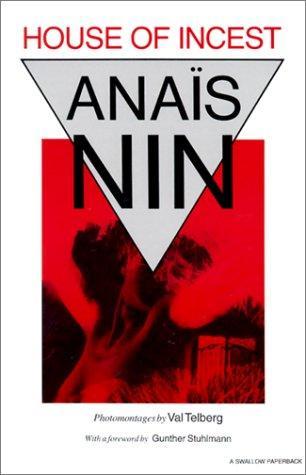
House of Incest


First published:- 1936 (Nin's first work of fiction)

Star Rating:-

What do they say about pretty words strung together into passages pregnant with symbolism and implications, some of them beyond the grasp of a dilettante like me? How do they compartmentalize Anaïs Nin's writing? 
'Erotica' they like to call it, perhaps, putting focus on the sexual imagery Nin invokes with the flair of her pen. 

But I would rather not enclose Nin's genius inside the banal prison of a genre like erotica. Her words, like splotches of the most exotic water color, coalesce into an abstract painting of such acute beauty that one can only stare at the phantasmagorical picture that forms in front of the mind's eye, with a deep sense of wonderment. 

Her words are magic. Her words instill life into the seemingly lifeless form of a road stretching ahead. Her words transform a taboo subject like incest into a fathomable, even an acceptable reality of our existence and temporarily divorce us from the social conventions, of the material world, as we know them. Her words whisk us away to a secluded, floating world where only surreal landscapes of Nin's imagination sprawl far and wide in all their majestic splendour. And the reader can only be a besotted traveller enjoying a one-of-a-kind sojourn - soaking up all the incomprehensible loveliness of Nin's prose in small bursts.

"I felt only the caress of moving - moving into the body of another - absorbed and lost within the flesh of another lulled by the rythm of water, the slow palpitation of the senses, the movement of silk..
Loving without knowingness, moving without effort, in the soft current of water and desire, breathing in an ecstasy of dissolution.
I awoke at dawn, thrown up on a rock, the skeleton of a ship choked in its own sails."


Her words accord a kind of literary immortality to so many hackneyed humane emotions and sentiments.

"But Jeanne, fear of madness, only the fear of madness will drive us out of the precincts of our solitude, out of the sacredness of our solitude. The fear of madness will burn down the walls of our secret house and send us out into the world seeking warm contact. Worlds self-made and self-nourished are so full of ghosts and monsters."


Her words are exquisite poetry. 

____

Collages


First Published:-1964

Star Rating:-


Anaïs Nin is my beloved witch, capable of making the nebulous frontiers between imagination and reality dissolve away into oblivion with one well-maneuvered flourish of her metaphorical pen, her personalized magic wand. Or I see her in my mind's eye, as a lovely but shabbily dressed seamstress, patiently weaving a patchwork quilt of exquisite beauty out of the gossamer strands of time. 

Does art imitate life or does the opposite hold true? 
Where does life begin? Where does it end? What lies in between? What does it all mean?
Anaïs Nin attempts to answer these hazy, unanswerable questions by giving us a snapshot of the perpetual movement of time and the phantasmagorical spectacle of humanity caught in its web, establishing without a doubt that there's no end, no beginning and no middle. Life is ad infinitum.

Dreams and reality collide in her writing, exploding in a dazzling array of fireworks illuminating the obscure part of our consciousness, giving us brief flashes of the realm in which the ultimate truth lies cocooned in the protective covering of the mundane, slumbering peacefully - the truth about life and beauty, love and lust, happiness and grief, the extraordinary and the common.

Collages is exactly what its title implies and much more than what our feeble imaginations can conceive upon the utterance of this word. It is not about a nation or a set of natives, a single protagonist or many, one life event or a set of discrete occurrences. Anaïs Nin renders perfect delineation unnecessary, makes clearly visible lines of divide vanish without a trace. Instead, vignettes, eerie and abstract, tangible and solid, merge and fall into each other, clumsily yet seamlessly, to create a surreal painting, a collage of the human consciousness holding the random admirer in thrall, glaringly all-encompassing in its wild, colorful abandon even though the viewer strives to make sense of it. But isn't life just like this baffling, bizarre work of art that Anaïs Nin begets? Comprehension stays forever out of reach. Even when we feel it floats mid-air at arm's length, attempts at trying to grasp it remain thwarted.

As Renate pours her beautiful, meaningless dreams into her empty canvasses, falls in and out of love with Bruce, drifting through space and time, touching the lives of many we get an impression of life's fluid grace and its capacity of encasing the infinite. The diseased, old man who shuns the company of his loved ones, preferring to live in a cave by the sea with a few seals as companions, the heart-broken French consul's wife who grieves for her broken marriage and vindictively contemplates finding a Turkish lover, the clairvoyant film critic who describes for Renate the scenarios written by struggling writers which never saw the light of the day, Nobuko who fights to free herself from the suffocating, rigid civility of the Japanese way of life - these are but a handful among the many myriad shades and facets of humanity shuttling in and out of Renate's life causing vague but perceptible upheavals. The quietly floating gondolas of Venice, the ochre-hued sand dunes of an African desert, the peaks of Peru and palaces of Marrakesh, upscale avenues of New York and streets of Arcadia, California all make fleeting appearances in this stunning collection of interlinked snippets, dismantling in the process all man-imposed barriers between nations and cultures and presenting to the reader an eerily arresting picture of life in all its glory and imperfection.

I don't care about Anaïs Nin being mostly recognized as a writer of literary erotica since I beg to differ on the subject of this categorization. I don't care about the fact that she shared an incestuous relationship with her father. But what I definitely care about is discovering and appreciating more of her splendidly assembled collages.


   photo C136E66569D294E4D5DA2D8124D4FF69.png
Related Posts Plugin for WordPress, Blogger...