Thursday, July 17, 2014

Review: Feminism is for Everybody by Bell Hooks

First published:-2000

Read in:- June, 2014

Star rating:-

Not until recently had I emerged out of the rock I was living under and located the @everydaysexism twitter account. Keeping an eye on their retweets for a little less than two weeks enabled me to discover that women are not only forced to endure the lecherous male gaze (often called 'stare rape' these days) on public transportation, made the object of innuendo-laced, denigrating remarks since puberty but also masturbated at in public without their consent (not even women over 60 had been spared) . How blissfully ignorant I was of this last facet of everyday sexual harassment! I went on a kind of mad rampage immediately, flooding my timeline with a deluge of tweets on the subject, appealing to more of my followers to follow the everyday sexism account. A day later when I had checked back in eagerly in the hopes of noticing any visible change - NOTHING. Not even one person among my followers (I have nearly 1600 which maybe just a handful but it's not a very teeny number either) had honored my request apart from the 3 who were already following them - all of them women or women's issues related accounts.

It was then that I realized, 'feminism' in the 21st century is actually like a hip, new item of home decor that you place on a wall cabinet among the other borrowed, trendy opinions you profess as personal philosophy, then forget about. Whenever some horrendous instance of brutality against a woman makes the morning news headlines, everyone's 'tch-tch-ing' fake concern for civilization resurfaces, spills over into the realm of their office lunch hour debates and after a while dies a natural death. Then they go back to the comfort of their tweleb status by posting the same old 'jokes' about dumb blondes, unreasonable wives, sluts, 'cunts', boobs and what have you, each of which are guaranteed to get at least 20+ retweets. 
Lulz just chill, we're all kidding here, getting our kicks out of reinforcing the same old stereotypes that have done considerable damage to society since the dawn of time. No harm done.

It is this same all-pervading reluctance of acknowledging the efficacy of a concept like feminism as a panacea for sexism, violence and all the other concomitant shit women face every single moment of their lives that forms the backbone of Bell Hooks's book.

She merely chooses to use 'white supremacist capitalist patriarchy' as a refrain so as to hammer this information into our brains. Yes the recurrence of this phrase gets dull after a while, yes it is somewhat annoying but no it is not irrelevant. Especially since Bell Hooks seems to support the branch of feminism which brings the concept of equality for everyone (including homosexuals) in all walks of life - sexual, economic, social and religious - under its envelope. 

She summarizes the inception and journey of the feminist movement through the decades - how it made a first appearance in the U.S. in the 60s with the waves of bra-burning (she is not against bra-burning btw), angry women who had major grievances against a domestic arrangement where they held little to no power, how initially they believed 'feminism to be the theory and lesbianism the practice', how it has undergone gradual improvement to evolve into the polished academic discipline that it is today, how it was seen as an anathema in the past and how it continues to face a steadily growing list of challenges - apathy of mass media being a major one. She deftly interweaves feminism with the idea of politics, class struggle, physical beauty, love, religion, marriage, reproductive rights, parenting, masculinity and race to present before us a realistic picture of what truly internalizing its precepts can mean for us and our future. 

But all the conventionally known preachings of the book aside, she makes another very pertinent point about stripping the verbiage of jargon from all the academic work on feminism to make them more accessible to students and laymen alike, and working together to raise awareness of how feminism isn't inherently 'anti-men' or 'anti-religion' or even simply restricted to serving the interests of women in civilization, how feminism is for everybody.

"Today in academic circles much of the most celebrated feminist theory is written in a sophisticated jargon that only the well-educated can read. Most people in our society do not have a basic understanding of feminism; they cannot acquire that understanding from a wealth of diverse material, grade school-level primers, and so on, because this material does not exist. We must create it if we are to rebuild feminist movement that is truly for everyone."

To come to the negatives, there are almost none except the monotonous drone in which Hooks drives home her points which makes the reading experience little less than enjoyable, the drabness of her prose and the way her repeated references to her own writings reek of self-importance. And to further account for that missing star, I have this teeny niggling doubt about her defining acts of 'domestic violence', even those carried out by women against other women and children, as'patriarchal violence'. She reckons some women have been so rigorously conditioned by the patriarchal world order based on principles of domination through violence and other acts of intimidation, that they re-enact the same in their daily lives while dealing with people inferior in status to themselves. Which I agree with but my limited knowledge of the world and its assorted contradictions tells me it's not just the men. Some primeval inclination towards violence and skewing the power balance in any relationship is embedded in the human psyche in general, irrespective of sex. 

But that aside, the overarching message one gets from Hooks's outlook is that the traditional notions of 'manhood' and'masculinity' have to be flushed down the toilet for feminism to even have a chance at victory. And there's no second guessing it.


   photo C136E66569D294E4D5DA2D8124D4FF69.png

Friday, July 11, 2014

Review: Enon by Paul Harding

First published:-June 7th 2012

Published by:-Random House

Star rating:- 

It is an ominous sign when your trusted, steady flow of empathy tapers off into a reluctant drip while you were making your way around the misfortunes encountered by a fictional parent rendered newly childless. Are you being too coldly practical, perhaps, mentally asking this grief-addled father to pick up the pieces of his heart and kickstart his life like a pre-programmed cyborg? Is your work-tired brain refusing to let you feel an intense pity for this man who resorts to tripping himself up on drugs to have a daily hallucinogenic rendezvous with his dead daughter?

I dearly wish I could nip such nagging doubts in the bud by answering all these questions with a 'no'. But I can't. My feelings for this book are as vague as the state of the protagonist's chaotic inner world post his daughter's demise.

The themes of trauma and tragedy permeate literature of any merit right down to its bones ever so often, that it's hard to come by a new treatment of the same old soul-crushing sadness. While some authors add an outer gloss of dignity and self-restraint to their psychologically broken characters, others deftly interweave unforeseen outwardly manifestations of repressed grief with the ennui of carrying on with the daily routine. And this is where Paul Harding does things differently. 

He kills Charlie Crosby's carefully organized world in an instant, shoving him right down the gaping hole of nothing. Charlie has no story to tell anymore, no purpose left in life except giving us prolonged glimpses of the tendrils of darkness that coil around his waking moments threatening to choke him to death. He only pulls us along for this turbulent ride as he traverses the distance between the edge of utter madness and a saner place, between losing himself in the futility of preserving any and every remnant of his daughter's short-lived earthly presence and finding his footing in the treacherous bog of loss. And this is fine really. But what is his justification for pushing away his co-mourner, his wife? 

There's only a thin line of difference between grieving for a loved one and internalizing that grief to the point where you begin using it as an anchor keeping you tethered to the reality that was stolen from you, to the extent the sadness which was gnawing away at your insides bit by bit became so fattened on your weaknesses that it pushed out every other thing from your head to make space for itself. And Charlie treads on this thin line barely holding on to his balance, often crossing over into the territory of no-man's land.


"I could not stop myself from stepping over the same dark threshold, night after night, trying to follow her into the country of the dead in order to fetch her back, even though she visited me in dreams and never left my waking thoughts."

I do not claim a kinship with most kinds of life-threatening sadnesses, especially a grief so fatal as the one entailing the loss of a child, not yet anyway. But I have lost a parent at 14. So I hope Paul Harding forgives me for judging Charlie Crosby the way I did.

Maybe I have never felt important enough to accord my grief a higher place over all the other more terrifying griefs - many of them unknown to me - which befall fellow humans and compete for priority every second in this mystifying drama of life. Maybe it's a personal foible to revere the ones who carry the ineffaceable marks of psychological damage, yet muster the courage to wake up every morning and put in their share of effort to keep the world's engines running. Maybe it's a puerile thing to care for tortured, emotionally scarred, righteous heroes like Rust Cohle who find an all-encompassing nihilism to be the answer to the inherent unfairness of life yet battle with that nihilism every moment with hope. 

Whatever the actual reasons maybe, I could not sympathize enough with this hapless father's 'magical realist' tendencies to keep his daughter frozen in the amber of his dope-induced daydreams. Even Harding's thoughtfully wrought, ornate sentences chronicling Charlie's memories of the small rural town of Enon, which witnessed the birth and death of his daughter, couldn't help me establish that intense emotional connection I was expecting to form with this story-without-a-story. In some of the narrative's most lucid yet hazy moments, during the course of Charlie's scarily accurate depiction of despair in its rawest form - the terror of waking up from a nightmare where your loved one was constantly slipping away from your grasp - I came close to developing a sense of solidarity with his pain. But then these moments of sporadic brilliance were interspersed with numerous other iterations of similarly-themed moments which gave rise to nothing other than indifference in me.

On occasions like these, I wish I could align my reviewing methods with those who never rate books but simply move on after recording their experiences with it. Because how do you rate a grief-stricken father's lament?
This is why I am trying to believe that the noticeable absence of 2 stars will only underscore my apathy for infinite extrapolations of the aftermath of tragedy, paraphrased again and again until the reader becomes too jaded to care, and not my disregard for mourning as the key resonant theme. Because the latter assumption couldn't be further from the truth.


P.S.:-I have a feeling my experiences with Harding's Pulitzer winning book, Tinkers will fare much better.
__

Review also posted on Goodreads and Amazon. 

**I received an ARC from Random House via Netgalley**

 photo C136E66569D294E4D5DA2D8124D4FF69.png

Saturday, July 5, 2014

Review: Law of Desire: Stories by Andrej Blatnik

First published:- 2000

About to be republished on (after being translated into English):- July 15th, 2014

Republished by:- Dalkey Archive Press

Star rating:-

Short stories are such a tricky thing to get right and such a hassle to review. 
Before you have even settled down into the comfort of one minor narrative, a new one with brand new settings is silently demanding your undivided attention. A tiny slip in your concentration could result in that elusive thread of some unnameable, intangible emotion that you are struggling to disentangle from the jumble of lives and internal monologues, zipping past you with the agile grace of an eel. 
And having turned over the last page, you are facing the difficult prospect of making out all the discordant notes from the individual stories and combining them into a common refrain which captures the general mood of the collection. Unless the author can profess to being at par with one of those world-renowned masters and mistresses of the short story format (Munro, Maupassant, Carver, Lydia Davis, Gogol and so on) who have got it down so pat that each one of their stories stand out and leave permanent markings etched on to the slippery sands of memory, he/she has an uphill task ahead. 

I can vouch for the fact that Andrej Blatnik's stories cannot be shoehorned into any known category of writerly acuity. There's no single overarching theme that strings the whole collection together. And not all the stories can be commended on their execution or even thematic clarity. While some of the short stories give off a surrealistic Italo Calvino-esque vibe by blurring the boundaries between real and absurd, some of the others remind me of Murakami with their efficient juggling of nameless, wryly witty narrators who shirk responsibilities, intriguingly secretive women and emotional isolation. The remaining deal with themes as varied as PTSD-afflicted, psychologically scarred young men returning from the battlefield, the beauty and terror of fatherhood, the tragedy of young children adjusting to a newly motherless household and even something as eerie and nihilistic as a runaway convict resigned to his fate of being turned into a human sacrifice in an African village.

"The man feels the open dome of the sky descending, embracing him, he senses the universe closing in, he smells the brittle tail of comets, the gravity of distant worlds brushes his cheek. Galaxies open up and beckon him in. The man knows: This is the beginning; this is just the beginning."

The stories seem to be weakly delineated on purpose, the characters having no qualities that make an impression worth remembering, their lives appearing to be hazy silhouettes that never truly come into focus, just remaining out of reach for you to draw your own conclusions, which is precisely how short stories should be. But there's something more which accentuates their uniqueness, a disorienting effect that Blatnik manages to induce in the reader - an all-too-familiar sorrow, a feeling of unfulfillment arising out of a failure to communicate, and the concomitant cruelty of everyday lives of people trapped in the labyrinth of the urban jungle.

So even though I had my mind virtually made up to go with a 3.5 stars rounded off to a 3, I am conceding another one in the hopes that an above-average rating will help this Slovenian writer gain a wider readership, especially now that he has been translated. He really does deserve all the attention he can get.

**I received an ARC from the Dalkey Archive Press via Netgalley**


Also published on Goodreads and Amazon.

   photo C136E66569D294E4D5DA2D8124D4FF69.png

Saturday, June 28, 2014

Review: Speedboat by Renata Adler

First published:- 1976

Republished:- March 19th, 2013 by NYRB

Read in:- June, 2014

Star rating:-

Much of life does not make a lot of sense in the moment it is occuring. Only in posterity, when we dwell on memories, are we able to see past happenings in a clearer light. The passage of time helps us tame the inveterate romanticism of first perceptions and lets the realization sink in that some things are just what they appear to be and further efforts at figuring out some deeper significance are going to remain futile forevermore. Scattered fragments of time spent with people in places glow like fireflies in the dark but the dots never connect. No hidden, congruous patterns emerge. Some moments stand out in the multitude and bring us pleasure, sorrow, mirth, intrigue or some other keenly felt emotion while the rest merge with the void and perish.

Renata Adler's writing is thoroughly deserving of all the accolades because of her earnestness at remaining faithful to dull realities, everyday mundane things that we eagerly discard in favor of the exaggerated glamour of tragedy or romance. Her fictional love interests are ordinary and unexciting, her protagonist is just another city girl in the endless sea of anonymous faces, and her sardonically narrated observations utterly devoid of the artistic grandeur found in the trademark melancholic novel on urban alienation. 

Just as the traditional narrative of the novel is subverted without any pretensions in 'Speedboat' which, true to life, refuses to stitch together ephemeral moments into a much bigger collage of the human consciousness, the short story format is also ingeniously shunned. Adler's aphoristic 'stories' (for lack of a more apposite term) are just what they are - anecdotes on events and conversations recounted somewhat dispassionately and left unexplained, minor departures from the cyclical nature of routine-bound life laid bare for the readers to dissect and derive their quota of 'reading between the lines'from. The random handsome, young man encountered on the subway on your way to work who monopolized your attention for the length of the journey, the quarter found in the backseat of a cab that you surreptitiously picked up after wrestling with your conscience for a while, the ailing woman on the verge of certain death in the hospital ward who said she was doing fine on being asked how she was - these are but some of the many discrete snapshots of our collective lackadaisical existence in the backdrop of any nameless metropolitan city of the world and not just Adler's New York.

"The idea of hostages is very deep. Becoming pregnant is taking a hostage-as is running a pawnshop, being a bank, receiving a letter, taking a photograph, or listening to a confidence. Every love story, every commercial trade, every secret, every matter in which trust is involved, is a gentle transaction of hostages. Everything is, to a degree, in the custody of every other thing."

Her depiction of idiosyncratic urban life as she knew it is one of the most life-like I have ever come across and, possibly, ever will.


   photo C136E66569D294E4D5DA2D8124D4FF69.png

Saturday, June 21, 2014

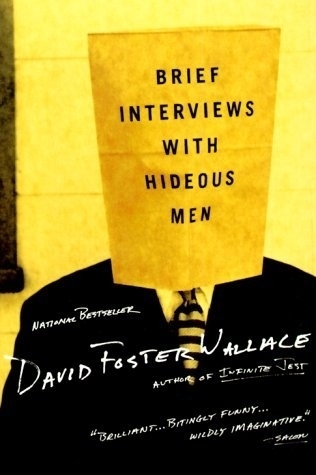
Review: Brief Interviews with Hideous Men by David Foster Wallace


First published:- 1999

Read in:- April, 2014

Star rating:-

To call these meanderings and sub-meanderings of a brilliant mind short stories, will be akin to putting a leash on DFW's creativity with the aid of conventional terminologies and thereby undervaluing the sheer inventiveness on display in this compelling collection. 
In course of my limited venturings into DFW's literary landscapes I have arrived at one crucial inference. That to read DFW is to transgress the very act of simply reading through and discover a newer way to commune with his chain of thoughts, to work your grey matter just a tad bit harder to truly grasp what he has intended for you to understand. And that's an exercise I am all too happy to engage in especially if it sharpens my senses and compels me to achieve a state of oneness with the narrative without sparing a second thought to any of my other parallel reads.
Reading him is like being given the unique opportunity to listen in on one of the greatest minds that ever existed speaking from some imaginary podium and letting that same mind direct my own to follow pathways that it didn't even know existed. It's like making yourself a part of the virtual reality he has recreated through his words and believing in the truth of it without trying to compartmentalize his writing.

Hideous men (and, occasionally, women) and the alarmingly convoluted inner workings of their still hideous minds string this collection together. Some of the 'short stories' are mere snapshots of eponymous interviews of seemingly disturbed individuals, ranging from hippie youths who have devised Machiavellian plans to seduce and subsequently ditch women with psychopathic precision to adolescents with elaborate masturbation fantasies creepy enough to make you involuntarily shudder, while some are little snippets which merely detail the secret inner lives of certain individuals which always remain carefully concealed behind an ingeniously orchestrated charade. Add some metafictional commentary inserted sporadically as footnotes of considerable length, in several of which the author even challenges the potential reader to weird pop quizzes, and you have a hazy idea of what this collection has to offer. But even so, I probably haven't even grazed the tip of the iceberg of DFW's gift for redefining narrative structures. 

Given that I am accustomed to more or less linear narratives, consisting of immaculately crafted sentences which put more emphasis on superficiality of actions and emotions, it is a bit of a surprise to find myself being drawn to a writer who sought to expose the raw core of every pretension. Sometimes while reading I was even tempted to flip a coin to decide whether he was being ironic or simply acknowledging some disturbing reality in a matter-of-fact tone.

"He ruled from that crib, ruled from the first. Ruled her, reduced and remade her. Even as an infant the power he wielded! I learned the bottomless greed of him. Of my son. Of arrogance past imagining. The regal greed and thoughtless disorder and mindless cruelty - the literal thoughtlessness of him."

The man's perspicacity is so palpable in everything he writes and his sincere attempts at perfect reconstruction of thought processes and the true motivations at work behind every human gesture so obvious, that I can't help but be charmed. The 5 stars are probably a dead giveaway of my veritable moony-eyedness. 

Belying expectations the footnotes did not annoy. The infinite digressions merely served to intensify my fascination with the way DFW's mind worked.
But can it be said that DFW left behind a body of work which can be given the label of 'proper literature'? The answer to the question depends on the way you choose to constrict your definition of 'proper literature' or whether you choose to constrict it at all. 

The man was a genius and his suicide only translates into a profound loss for all the good which remains in the world of publishing. And I doff my hat in honor of the creative freedom he refused to sacrifice while writing.


   photo C136E66569D294E4D5DA2D8124D4FF69.png

Wednesday, June 11, 2014

Review: Labyrinths: Selected Stories & Other Writings by Jorge Luis Borges


First published:-1962

Read in:- May, 2014

Star rating:- 

A university professor had once expounded on the supposed conflict between history and literature, the former bemoaning the irrelevance of the latter when it comes to tracing the contours of reality while the latter countering this accusation by deploying the well-known defense of 'there's no one way of looking at the truth'. 

Indeed. Why restrict ourselves to just the one way and the one reality? Why overlook the truth of infinite permutations and combinations of each eventuality and each one of them, in turn, forking off into myriad possibilities ad infinitum? Why seek neat compartmentalization of two disparate disciplines and prevent their intermingling to create new streams of thought? Why believe mathematics and literature to be so fundamentally apart that there can be no blending together of both without the results being distorted beyond intelligibility? 

The very fact that the known limits of what's considered intelligible are being breached every moment, has its roots in the reluctance of labyrinthine minds like Borges' to follow linear pathways. 

Mysticism, mathematics, arcana, philosophy, and literary criticism. A perfect blurring of the boundaries between fact and fiction leading to the creation of an entirely new entity which challenges the normative narrative form. And a moment of perfect lucidity arising out of a churning of all these elements. Where our imaginations come to a staggering halt, Borges' begins. 

I do not wish to squeeze out every last drop of meaning from these complex interpolations of a known truth into discrete bits of hitherto unknown logical conclusions by googling every reference I did not get. Instead I delight in Borges' perfectly synchronized demolition of all and any conventions associated with writing with an authorial preeminence, I gaze enthralled at the vision of clarity being birthed out of pure chaos. 

"In a birdless dawn the magician saw the concentric blaze close round the walls. For a moment, he thought of taking refuge in the river, but then he knew that death was coming to crown his old age and absolve him of labors. He walked into the shreds of flame. But they did not bite into his flesh, they caressed him and engulfed him without heat or combustion. With relief, with humiliation, with terror, he understood that he too was a mere appearance, dreamt by another."

I let my mind latch onto his even if for a little while and let it guide me into realms where only the divinity of thought reigns supreme in its many manifestations. 

And, for now, that is enough.


__

P.S.:-It's good to know where David Foster Wallace acquired his irksome yet awe-inspiring footnoting habit from.


   photo C136E66569D294E4D5DA2D8124D4FF69.png

Wednesday, June 4, 2014

Review: Their Eyes Were Watching God by Zora Neale Hurston


First published:-1937

Read in:- April, 2014

Star rating:-

Here is a woman who led a wretched life for years, doomed to stagnate in the drab depths of oblivion even after her death which had gone under the radar and generated no nostalgia-soaked, emotional obituaries. She lay in an unmarked grave in the Garden of Heavenly Rest, Florida, treated by her own contemporaries like an outcast because of a difference in perspectives, to be resuscitated and acknowledged as one of the foremost powerful voices that ever reverberated across the African-American literary landscape years later. And here is her creation, a 'coffee-and-cream' skinned Janie Crawford, a child born out of a possible rape, a sure forerunner to Toni Morrison's Sethe, Denver and Beloved or Alice Walker's Celie and Nettie. A mulatto woman in a white man's world, who grew aware of an identity not shackled by notions of race, skin color, and even gender, who could look beyond the small horizon carelessly conferred on her by an era which was bluntly apathetic to her kind, who could aspire to be free of a legacy of mere victimhood.
And here I am, trying to make sure I do not fuse Zora and Janie together, unable to decide how to love, revere and pity them at the same time.

I watched the young and carefree Janie, who bubbled over with an enthusiasm for life, eventually morph into the Janie who embraced the bittersweet realization of having loved and lost. My eyes traced her unsure footsteps from financial servitude to financial stability, from the daily battle of ignoring the sting of self-denial to grasping at a life free of emotional subservience. I loved the hapless, innocent Janie who consented to being passed over like property from her grandmother's ownership to her first husband's just as much I admired the Janie who found her salvation in Tea Cake's good-natured laughter after two marriages which had simultaneously stripped her of her last shred of self-esteem and caused her to listen to that stifled inner voice. And I felt a strange kind of happiness building up inside for the Janie who would not succumb to the temptation of self-loathing like the misguided Mrs Turner, the Janie who found the firm ground of self-awareness to tread on while the world of conflicting ideas rotated on its axis like ever.

Zora Neale Hurston had a rich dual voice - one of them fearlessly recounting the quirks characterizing the Black American community in the deep south still clinging on to the outer fringes of a white-dominated society intertwined with the lyrical, oneiric voice of a philosopher and a feminist, possibly one of the first among her kind. And it is this wholly harmonious union of these two voices which transforms this bildungsroman into a honeyed ballad of love and grief, of psychological bondage and emancipation.

"He looked like the love thoughts of women. He could be a bee to a blossom-a pear tree blossom in the spring. He seemed to be crushing scent out of the world with his footsteps. Crushing aromatic herbs with every step he took. Spices hung about him. He was a glance from God."

Janie never bore a grudge against her 'God' for making her path to fulfillment so long and arduous. She merely watched Him with hopeful eyes, lovingly accepting all He bestowed on her. And I watched Janie with a tear-strained smile.


   photo C136E66569D294E4D5DA2D8124D4FF69.png
Related Posts Plugin for WordPress, Blogger...