Wednesday, February 25, 2015

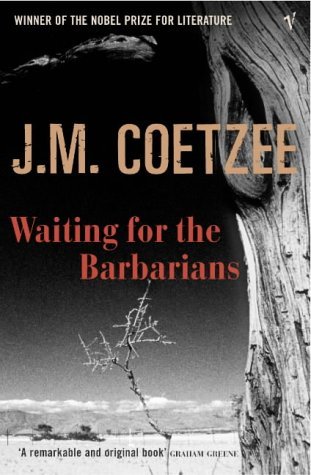
Review: Waiting for the Barbarians by J.M. Coetzee


First published:-1980

Star rating:-

It is impossible to read this and not be reminded of an almost genetically programmed inferiority complex, the burden of history only the descendants of the colonized have to bear. Despite those smug pronouncements of the 21st century being an era of a fair and equitable world and the hard battles won in favor of interracial harmony, there's the fact of your friend barely suppressing a squawk of alarm when you express your admiration for Idris Elba - no female I am acquainted with in real life has learned to wean herself away from the fixation with a white complexion. Scrub your skin raw till it bleeds but never fall behind in the race to make it whiter because that's the color the world approves of. You can fawn over Simon Baker's blonde, light-eyed glory but not over Elba's hulking, ruggedly handsome perfection; heaven forbid you prefer the latter over the former. The 21st century is yet to cast its magic spell over the standards of physical beauty. 

So if I, a citizen of a purportedly newer and better social order, can still feel the rippling aftershocks of the catastrophe called Imperialism from across the barrier of decades and centuries, what would a man like Coetzee have experienced, stranded in the middle of the suffocating sociopolitical stasis of Apartheid? Moral anguish? A bitter impotence? A premonitory sense of doom? Anger? 

Fiction, I believe, must have been his preferred method of exorcizing these demons. And purge these emotions he did through the composition of this slim little novel which can be aptly described as a most heart-wrenching lament on the condition of the world of his times. 

It may be true that the world as it stands is no illusion, no evil dream of a night. It may be that we wake up to it ineluctably, that we can neither forget it nor dispense with it. But I find it as hard as ever to believe that the end is near.

An anonymous magistrate stationed at a farthest corner of an unspecified Empire witnesses the death throes of its reign while recovering his own humanity at the loss of his position of power and influence. In the beginning he is convinced of his righteousness as a dutiful servant of the Empire who oversees the welfare his subjects with moderation but with the arrival of a bluntly tyrannical figure of authority whose methods differ vastly from his, he begins to question his own collusion in the maintenance of an unnatural order. Unable to stand as a mute witness to the horrendous abuse inflicted on innocent 'natives' on the false suspicion of their complicity with 'barbarians' or armed rebels who threaten the stability of the Empire, he clashes with the aforementioned administrator who undoubtedly represents the true face of any oppressor when divested of its sheen of sophistication. And thus begins his fall from grace culminating in a kind of metaphorical rebirth through extreme physical abasement. 

I was the lie that Empire tells itself when times are easy, he the truth that Empire tells when harsh winds blow. Two sides of imperial rule, no more, no less.

In the fashion of Coetzee's signature didacticism the novel is rife with allegorical implications but as much as these can be deeply thought-provoking, sometimes they also resemble conveniently inserted contrivances. Like the pseudo-erotic entanglement that develops between the ageing magistrate and a young 'barbarian' girl who is left maimed and partially blinded after a violent bout of interrogation is amply demonstrative of a colonizer-colonized arrangement - the one bereft of power to drive the relationship in a desired direction becomes dependent on the volatile benevolence of the other party. Or the mounting paranoia about the anticipated attack of the 'barbarians' who, much like Godot, fail to appear and remain a myth till the end although emerging as the key factor hastening the impending demise of Empire. All the layers of meaning and symbolism could send a dedicated literature student into paroxysms of pleasure no doubt.

With the buck before me suspended in immobility, there seems to be time for all things, time even to turn my gaze inward and see what it is that has robbed the hunt of its savour: the sense that this has become no longer a morning's hunting but an occasion on which either the proud ram bleeds to death on the ice or the old hunter misses his aim; that for the duration of its frozen moment the stars are locked in a configuration in which events are not themselves but stand for other things.

Wary as I am of Coetzee's often stilted world-building, my 5-star rating was an inevitability given my obsession with narratives containing a discernible vein of literary activism in harmony with notions of social justice. Here he also seems to have successfully reined in his pesky habit of turning his characters into sockpuppet-ish mouthpieces to tout his own passage-length worldviews. The narrator does occasionally morph into a pedagogue but his inner monologues never seem out of place given his unique circumstances. Besides it takes courage to acknowledge the fact of white man's guilt in a world which is yet to discard the rhetoric of 'white man's burden'.


   photo C136E66569D294E4D5DA2D8124D4FF69.png

Friday, February 20, 2015

Review: The Fan-maker's Inquisition:A Novel of Marquis de Sade by Rikki Ducornet

First published:- 1999

Republished by:-Dzanc Books, Open Road Media

Star rating:-


For the past few weeks the subject of responsible use of freedom of expression and speech has dominated our public discourse. And this is not in the context of Charlie Hebdo. A group of Indian stand up comics had collaborated on a live 'roast' of two Bollywood actors (the very first of its kind in India) and posted the video on youtube - a performance peppered with sexual innuendos and a mind-boggling amount of profanity. The video went viral within minutes, inspired twitter hashtags, gave netizens a few good laughs, and 'offended' the usual suspects. A few days later, probably following the diktats issued by self-appointed guardians of Indian culture and values, the video was removed from youtube and criminal cases registered against the participants in this venture for 'obscenity'. 

Miscreants who vandalize churches, demolish mosques, rape women or launch into vitriolic diatribes against a specific religious community are allowed to function within the legal framework of the state but citizens who take to the streets to protest against the aforementioned atrocities are either water-cannoned or arrested with astonishing swiftness. Now it seems stand up comics, who are trying to inject some novelty into our painfully predictable entertainment industry which churns out lame potboilers by the dozen month after month, have secured a spot for themselves in the list of 'enemies of the state'. Law enforcement has its priorities right. 

Far fetched a parallel as it may seem, Rikki Ducornet's richly imaginative, Bohemian novel harps on the same double standards of moral policing. You can dismiss that glaring'erotica' label (not that I have any problems with this tag), dive in without hesitation and let Ducornet overwhelm your senses with her gossamer fine prose and her evocation of a turbulent Paris during the years of the Revolution. If you are looking for titillation and descriptions of sadomasochistic practices ala Sade, then let me forewarn you, the transgressions alluded to in Sade's monologues are not as frightfully repulsive as one might expect them to be. The only erotic similies I came across are of the following kind - 

..although the apple was as wrinkled and bruised as the clitoris of an old whore...

The plot weaves its way in and out of an imaginary Gabrielle, a fan-maker famous for her pornographic etchings and illustrations, and her patron Sade's points of view, stringing together their correspondence through letters during the time both were incarcerated for heresy by the Comité de surveillance while also including a parallel, semi-fictional narrative of the Catholic Church's barbaric suppression of indigenous pagan practices of Mayan people in the Yucatan peninsula during the Spanish Inquisition. Aside from all this there are various fascinating tidbits on Sade's upbringing and stories within stories which are aimed at highlighting the importance of unfettered freedom of thought.

A book is a private thing, citizen; it belongs to the one who writes it and to the one who reads it. Like the mind itself, a book is a private space. Within that space, anything is possible. The greatest evil and the greatest good.

The portions containing Sade's letters have him refuting the allegations levelled against him by the Comité by claiming most of what was regarded blasphemous in his work was simply the product of his virile imagination and that no sex act was ever performed without consent. The Marquis alternately laments the loss of his friend and confidante, Gabrielle and her lesbian lover Olympe de Gouges (an actual feminist figure from the Revolution) both of whom were put to death by the Comité, and chastises the hypocrisy of the Revolution which was systematically destroying the ideals of a civilized society in the name of upholding them.

Once the Revolution has gorged on the citizens of France and returned to her den to sleep for a century or two, what will happen to the triumvirate she whelped: Liberty, Equality, Fraternity-that vast heresy! That near impossibility! That acute necessity!

If you, like me, had not spared a thought for the infamous Parisian libertine till now then do pick up Ducornet's spirited defense of Sadeian ideology of unshackling one's life and art from hypocritical moral constraints. There's a good chance she may arouse your curiosity enough to want to take a peek into Sade's world of amoral creativity. In Gabrielle's own words - 

Sade offers a mirror. I dare you to have the courage to gaze into it.

____

Review also published on  Goodreads and Amazon.

**Thanks to Netgalley and Open Road Media for an advance reader's copy**

   photo C136E66569D294E4D5DA2D8124D4FF69.png

Friday, February 13, 2015

Review: A Passage to India by E.M. Forster


First published:-1924

Star rating:-

Read in:-December, 2014

Make no mistake. This, to me, will always be Forster's magnum opus even though I am yet to even acquaint myself with the synopses of either Howards End or Maurice. Maybe it is the handicap of my Indian sentimentality that I cannot remedy on whim to fine-tune my capacity for objective assessment. But strip away a colonial India from this layered narrative. Peel away the British Raj too and the concomitant censure that its historical injustices invite. And you will find this to be Forster's unambiguous, lucid vision of humanity languishing in a zone of resentful sociocultural synthesis, his unhesitant condemnation not merely of racism, casteism, religion-ism and what other noxious, vindictive 'ism's we have had throughout the history of our collective existence but of the fatalistic human tendency of rejecting a simple truth in favour of self-justifying contrivances.

Yes there's the much hyped 'crime' analyzed in the broader context of presupposed guilt and innocence . There's the issue of race, class and privilege factoring into the ensuing judicial process. The ripples of the eventual fallout of this mishap disrupt the frail status quo that all parties on either side of the race divide were tacitly maintaining so far and pose crucial existential questions before people of all communities. 
Then there are hypocritical Englishmen who cannot choose between preserving the sanctity of the Empire's administrative machinery and upholding their own prejudices. And hypocritical Indians who righteously accuse the Englishmen of institutionalized hatred while stringently maintaining their own brand of intolerance. But greater than the sum of all these thematic veins is the connecting thread of Forster's sure-footed, measured prose which explores not only the inner lives of the central characters but tries to penetrate the heart of a nation-state in the making.

The India depicted here is a foreign country to me - a time and a place yet to be demarcated irreversibly along lines of communal identities that are presently dominating our political rhetoric. It is of little appeal to the newly arrived umpteenth Englishman but, nonetheless, presents itself as an amalgamation of unrealized possibilities. Not once did my brows knit together in frustration on the discovery of any passage or line even casting a whiff of Forster's bias against the people or the land. My senses were stretched taut all the time in an effort to detect any. Sure, Dr. Aziz is a little infantilized and his importance is sometimes reduced to that of a plot device used for manufacturing the central conflict while Adela Quested, Mrs Moore and Mr Fielding appear before a reader as upright individuals who stand for the truth. The other Indian characters seem to be defined by their general pettiness. But these imperfect characterizations can be more than forgiven in the light of what Forster does accomplish.

The song of the future must transcend creed.

There are times when the narrator's voice dissects the drama unfolding against unfamiliar Indian landscapes with a kind of fond exasperation and times when it dissolves into a withering regret for the way the engines of civilization continue to trundle along towards some catastrophic destiny without ever pausing for the purpose of self-assessment. And it is the profound clarity of Forster's worldviews and his sensitivity and forthrightness in deconstructing the enigma of the 'Orient' that elevates his writing even further.

Perhaps life is a mystery, not a muddle; they could not tell. Perhaps the hundred Indias which fuss and squabble so tiresomely are one, and the universe they mirror is one.

It's not the 'handicap of my Indian sentimentality' after all. Forster sought to extract the kernel of truth buried underneath layers of artifice and his craft could successfully flesh out the blank spaces between that which can be expressed with ease. Those are always worthy enough literary achievements in my eyes.


   photo C136E66569D294E4D5DA2D8124D4FF69.png

Thursday, December 11, 2014

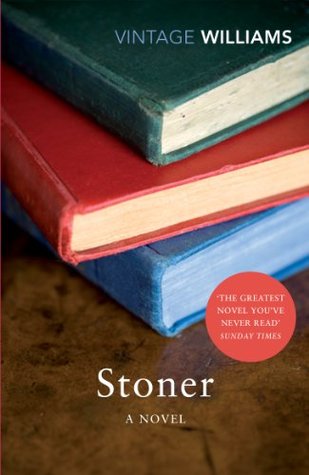
Review: Stoner by John Edward Williams


First published:-1965

Republished by:- Vintage Digital, 2012

Star rating:-

“Most men lead lives of quiet desperation and go to the grave with the song still in them.” - Henry David Thoreau

The triumph of this work lies in its self-effacing world-weariness, its tone of presupposed indifference even to the prospective reader's concerns. Like the inexorable stoicism of its protagonist in the face of misfortune and persecution, the narrative revels in its own lacklusterness, its state of diffused melancholy. 
William Stoner, first student and eventually English professor at (fictionalized) University of Missouri lives a life of flawed choices, unrealized potential and innumerable regrets, witnessing the world go through a period of tremendous sociopolitical ferment in the 20th century, and remaining invisible in the eyes of history. He breathes his last, just as silently, alone in a hospital ward, feebly flipping through the pages of a scholarly work. But do not for a moment think this deceptively drab synopsis encapsulates the essence of 'Stoner'. John Williams, through his luminous prose and by the aid of a vision which is as solemn as it is lucid, reminds us of the quotidian battles fought every moment anywhere by faceless individuals against the forces of oppression and moral laxity - that the fate of civilization is dependent on the capable or incapable shoulders of an individual.

He found himself wondering if his life were worth the living; if it had ever been. It was a question, he suspected, that came to all men at one time or another; he wondered if it came to them with such impersonal force as it came to him. The question brought with it a sadness, but it was a general sadness which (he thought) had little to do with himself or with his particular fate; he was not even sure that the question sprang from the most immediate and obvious causes, from what his own life had become.

An ode to literature? Yes. A story recounted with conviction and a quiet dignity? Undoubtedly. A sincere attempt at proffering acknowledgment on a seemingly inconsequential existence? That too. But more than anything else this is a literary toast raised in honour of those small, often unnoticed, acts of courage and compassion which somehow realign the moral order of the universe but are blotted out from memory and consciousness easily.
There is sadness here - boundless in depth and overwhelming in intensity - but hope glimmers occasionally too. Hope that the world may go to pieces and things may fall apart irrevocably yet a man may summon the strength to endure the tragedy of existence by discovering a true and unbreakable love. The currents of time weather away all past disappointments, longing, old grudges and anger. Only the love of the written word casts a glow in the eternal darkness.

A kind of joy came upon him, as if borne in on a summer breeze. He dimly recalled that he had been thinking of failure--as if it mattered. It seemed to him now that such thoughts were mean, unworthy of what his life had been. Dim presences gathered at the edge of his consciousness; he could not see them, but he knew that they were there, gathering their forces toward a kind of palpability he could not see or hear. He was approaching them, he knew; but there was no need to hurry. He could ignore them if he wished; he had all the time there was.

__

**much gratitude to Netgalley and Vintage Digital for providing a free e-copy as ARC**

Review also posted on Goodreads & Amazon.

   photo C136E66569D294E4D5DA2D8124D4FF69.png

Sunday, October 19, 2014

Review: Broken Harbour (Dublin Murder Squad, #4) by Tana French


First published:- 2012

Read in:- June, 2014

Star rating:-


There are certain things I pride myself on - the ability to read through a tremendous racket without losing my thread of concentration, the audacity to share my blasphemous distaste for pizzas with pizza worshippers who then proceed to shoot me death glares, and more pertinently, the way I don't balk at rating a piece of mainstream literature 5 stars if it has shown the grit to discard gimmickry and preserve that golden human touch. 

How ingeniously Tana French subverts the formulaic plotting of a 'psychological thriller', poking and prodding at the darkness we prefer to bury under the gloss of make-believe contentment until it becomes a threat of gargantuan proportions. How masterfully she paints this picture of a family marooned at the thin divide between normalcy and utter chaos, dangling precariously from the edge of oblivion. How mercilessly she concocts such a heart-wrenching tragedy where the lines between culpability and innocence are blurred to the point that both merge into a single entity, where the victims are just as unwittingly drawn to the dark side as the perpetrators and the ones entrusted with the task of rectifying the wrongs done. 

Sometimes the ugliness of visible reality is nothing but the tip of the iceberg and the truth is like a lightning bolt from the blue, capable of shattering the glass mansion of denial we prefer to live in. The truth runs much deeper, past the shallow defenses offered by skin and flesh, inexorably slicing through our bones.

"In that moment I thought of Broken Harbor: of my summer haven, awash with the curves of water and the loops of seabirds and the long falls of silver-gold light through sweet air; of muck and craters and raw-edged walls where human beings had beat their retreat. For the first time in my life, I saw the place for what it was: lethal, shaped and honed for destruction..."

'Broken Harbour' is about the proverbial monsters of our own creation lurking in the shadows biding their time to harm what we cherish the most, the slow disintegration of that 'good life' we have put together bit by bit and how sometimes cause does not precede effect. And it is a sad acknowledgement of the fact that a horrendous fate may lie in ambush for the sinless and unsuspecting. 

For the ones who steer clear of 'murder mystery novels' for their stereotypical compartmentalization of crime and detective work, I dare you to read this particular Tana French creation and remain unaffected.


 photo C136E66569D294E4D5DA2D8124D4FF69.png

Saturday, October 18, 2014

Review: The Likeness (Dublin Murder Squad, #2) by Tana French

First published:- 2008

Star rating:-

Read in:- March, 2014

"We had worked together seamlessly, she and I. I had drawn her to this house, this life, every bit as neatly and surely as she had drawn me."

Tana French knows how to conjure up the most charmingly creepy characters out of thin air like nobody's business - damaged individuals who go about life like sentient, breathing time bombs about to go off and leave a trail of wreckage consisting of wounded hearts and shattered illusions in the wake of their committed mistakes. Call this tale of blurred identities a flight of her fancy where the basic premise induces one eye-roll after another. Call this The Secret History redux. Call this anything at all. But a beautifully worded commentary on the unpredictability of human behavior will remain as unputdownable under any other name, all criticisms notwithstanding.

A murdered girl with a fake identity made up and used by an undercover cop and her superior years ago, and that same undercover cop destined to unravel the mystery of her murder by pretending to be the dead girl brought to life - who are we kidding here? All of this sounds ridiculous on several levels.

But hey it's Tana French! When she tells you a story, you deferentially suspend disbelief, snuggle into the comfort of your blanket, and read till you hear the first bird gleefully chirping outside your window signalling the onset of yet another morning.

'The Likeness' is a story about people who breach forbidden boundaries in search of the ultimate freedom, refuse to fit into some generic, pre-determined cog in the wheel of society and develop a hermetically sealed, secretive world of their very own where no outside forces are allowed to operate. And it depicts how this painstakingly achieved state of domestic harmony comes apart at the seams when the personal needs of an individual jeopardize the unity of the close-knit group. Thus in the same vein as its predecessor, 'The Likeness' ingeniously utilizes its characters and events to introspect on the fallout of human foibles. But it is important to note here that it is not much of a standalone mystery. It is essential that readers acquaint themselves with the happenings of the first book in the series to grasp the motivations behind our headstrong, kickass female protagonist's actions and the fragile state of her mind. 

It has been 6 months since the spectacularly eerie and depressing events of 'In the Woods' and Operation Vestal blew up in the face of Detectives Rob and Cassie, damaging their relationship beyond any hope of salvation, and leaving them with emotional scars that run much deeper than they care to admit to themselves. Cassie has moved from the Murder Squad to Domestic Violence, Rob is stuck in some other unknown branch of the police department, both no longer on speaking terms. In the midst of this irredeemable mess, a baffling murder case surfaces where the victim resembles Cassie down to her last lock of hair and carries an alias Cassie had used years ago on an undercover drug bust and gotten rid of later on. With no leads to follow and the mystery over the girl's true identity steadily deepening, Cassie decides to revisit her undercover roots (much to the chagrin of her gentle and considerate detective boyfriend Sam O'Neill) by masquerading as the victim, who somehow survived the assault, and returning to the secluded Whitethorn House with its assortment of 4 other inhabitants who are all PhD students of Trinity like Lexie, the murdered girl. Cassie aka Lexie's return under extraordinary circumstances triggers a set of curious events which, in turn, reveal alarming aspects of the lives of the 5 students whose closeness not only hints at something inexplicably disturbing but reveals darker sides of their past lives.

To be fair, this installment of the Dublin Murder Squad series is slightly underwhelming compared to Ms French's brilliant debut. None of the occurrences narrated are as bone-chilling or spooky and an awareness of the wafer thin nature of the logic presented creeps in once in a while. The very Secret History-ish list of ensemble characters (Daniel is Henry, Justin is Francis, Rafe is a cross between Charles and Bunny while Lexie and Abby have shades of Camilla in themselves) evoke a keen sense of déjà vu and the ending disappoints since the emotional aftermath of the crime(s) is much less affecting here compared to the climax of 'In the Woods', which begs the question why I have still rated this 4 stars despite the flaws. 

A good way to answer this question will be to put my finger on French's accurate reconstruction of that feather light feeling of not being tethered to worldly considerations yet and that firm, transient belief in the fact that we'll always remain young and invincible, forever unyielding to civilization's ruthless demands - the wonderful friendships of student life which slip right through our grasp and melt away into oblivion like treacherous mirages as 'real life' hurls one gauntlet after another our way. And it is this thoughtful portrayal of that unavoidable tragedy, of having to grow up and grow out of the optimism of youth, that all of us eventually experience at some point of time which tugs at the heartstrings the most and transforms 'The Likeness' into more of an homage to the intrigue and vigor of youth from just a preternatural murder mystery.


   photo C136E66569D294E4D5DA2D8124D4FF69.png

Monday, October 6, 2014

Review: The Secret Place by Tana French

First published:- August, 2014

Published by:-Viking Adult

Star rating:- 


Few other books have conjured up the ghost of my teenage years as successfully as this one, dredged up the hazy remembrance of that first, most agonizing heartbreak, the subsequent amateurish cynicism summoned up to preclude the hassle of emotional hangups and the feeling of having only just the foggiest notion of how the world works.

It is awe-inspiring how Tana French continues to incorporate such authentic sociocultural commentary into narratives which are usually taken to be written for the sole sake of providing cheap thrills. So blame her if I end up sounding like a smitten fangirl every time I review a book of hers. She is just that good even when she is writing out a logically fallacious scenario.

The teenage girls of 'The Secret Place' are much more than what C-grade teenybopper flicks and stereotype-riddled YA books make them out to be. They are capable of as much cruelty as kindness, as much self-sacrifice as vindictive selfishness. Here, the conniving, bitchy and backstabbing blonde isn't a cardboard cutout 'mean girl' symbolizing pure evil just as the archetypal good girls aren't as puritan. And a private boarding school turns into a zone of ineluctable conflict of interest where the realm of the personal frequently dovetails into that of the collective forming the intricate web of high school politics which implicitly governs the place.

...a place like this is riddled with secrets but their shells are thin and it's crowded in here, they get bashed and jostled against each other; if you're not super-careful, then sooner or later they crack open and all the tender flesh comes spilling out.

More impressive is how the four girls who lie at the heart of the mystery do not let their budding sexualities define their lives, or even sacrifice individuality on the altar of some contrived requisites of 'coolness' which teenagers are prone to do since rarely do they know any better at that age. Instead, they defy odds to carve out a private utopia for themselves, a clique which doesn't require the glue of some common ideology to survive - a secret place neatly tucked away in an obscure corner of their minds where they can be wholly unabashed of the unflattering sides to their personalities, sure of the fact that they will have each other's backs even when the world goes to pieces. 

...the whole point of the vow was for none of them to have to feel like this. The point was for one place in their lives to be impregnable. For just one kind of love to be stronger than any outside thing; to be safe.

In a way, the narrative of friendship and loyalty in the aftermath of a terrible crime is reminiscent of an earlier book in the series -The Likeness - which in turn was inspired by Donna Tartt's The Secret History. So fans of any of the former will be sucked right in even if they may have reservations about stories involving teenagers, specially teenage girls who are forever being dumbed down by writers looking to make a quick buck. Ms French here, true to her gift for impeccable characterization, adds many dimensions to their personalities. 

As the common refrain goes, calling books of the Dublin Murder Squad series mere 'crime novels' is almost like an outrageous insult. And this one's certainly no exception in this regard. There are two parallel 'before' and 'after' narratives devoted to uncovering the truth of the same murder. A story of the tragic collapse of a close-knit group of teenage girls who, even while trapped in the complicated tangle of sexual politics, fight to ward off influences which threaten to destroy their fortress of solitude. A celebration of the bond of friendship, how powerful and all-consuming an affair it can be and how unpredictably it can turn dangerous and even life-threatening. And, in the end, a poignant tribute to those charged years of adolescence, a unique phase of our lives we look back on with equal parts terror and fondness.

They are a forever, a brief and mortal forever, a forever that will grow into their bones and be held inside them after it ends, intact, indestructible.
**I received an ARC from Viking Adult via Netgalley**
___

Also posted on Goodreads and Amazon.

 photo C136E66569D294E4D5DA2D8124D4FF69.png
Related Posts Plugin for WordPress, Blogger...