Showing posts with label Man Booker Winners. Show all posts

Monday, August 25, 2014

Review: Moon Tiger by Penelope Lively

First published:-1987

Star rating:-

Read in:- December, 2013


Claudia Hampton speaks to me of wars fought in distant lands, of the ever-persistent forward march of humanity in the quest for collective betterment, of stories unknowingly buried forever in the catacombs of time and never unearthed, of the people we carry in our hearts wherever we go, of the history of the world intertwined with our own. Claudia tries to make sense of the cacophony of voices inside her head and outside, of conflicting opinions colliding violently creating sparks that burn down empires and turn to rubble the foundation of regimes. Claudia tells me a story of the past melded with the present. 

Claudia's history of the world isn't one-sided. She accedes, to all the players involved, their right to speak for themselves, to say that which has been coldly snubbed by the opinionated historian of the past. Claudia does not look at past events through the lenses of established notions, of opinions passed off as indisputable facts. Larger than life heroes are reduced to the status of mere mortals in her eyes, violent uprisings become a trigger for devastating tragedies instead of turning points in the history of a nation's struggle for liberty. Images of a world war become indiscernible from the images of her lover who dies fighting in it and the entailing heartbreak she could never purge from her memories no matter how hard she tried. The unyielding bond she shares with her brother Gordon, her rival, her biggest critic, her most devoted admirer, and in the end her lover, remains intact even after he is no longer there to provoke her, to argue with her relentlessly, to urge her on towards becoming a more refined version of herself. 

"For there are moments, out here in this place and at this time, when she feels that she is untethered, no longer hitched to past or future or to a known universe but adrift in the cosmos."

Claudia never became what others wanted her to be, stubbornly trudging along a path forged by none but herself. She loved the daughter born out of wedlock dearly, but from afar, without the grand show of affection expected of any mother. And as she lies in that hospital bed, her life force slowly ebbing away, a frail old woman of 76, misunderstood by the ones dearest to her, my heart weeps for the grief that she kept carefully hidden from everyone, a secret she carried to her grave. But I bid her farewell with a smile, soothed by the knowledge that her life was, after all, a life well-lived.


  photo C136E66569D294E4D5DA2D8124D4FF69.png

Sunday, March 16, 2014

Review: The God of Small Things by Arundhati Roy


First published:- 1997

Read in:- January, 2014

Star rating:- 


As I stand just outside the compound with the untended garden, an uninvited, random visitor, the darkened Ayemenem House resembles a haunted mansion, belying the truth of the lives it once nurtured with maternal protectiveness in its cozy interiors. Derelict. Abandoned. Forgotten.
But I remember, you see. I remember the lives lived, and the loves which were birthed by circumstances, loves which breathed for a while before perishing on the altar of conformity. 
I remember Chacko and Sophie Mol. Ammu and Velutha. Rahel and Estha. 

And, most of all, I remember You. You, the painter of this portrait of a family's downward spiral into oblivion. You, the creator of this life-sized painting of a city and a nation, and all of human civilization in turn.
I see You as an iconoclast, persistent in your demand for liberties we are too submissive to dream of acquiring. You ask for things so heedlessly, so powerfully. The right to love whom we want and how much we want. The right to be equal. The right not to be discriminated against. The right not to be left languishing in solitude, battling painful memories. The right not to lose, at any cost, one's faith in the goodness in human beings.
You are the rebel we never considered becoming. We do not have courage like yours, you see. 
(Your opinions aired on national television are so often misinterpreted. Deliberately. Craftily.)

The sun, inside of You that refuses to be subdued by the drear of political machinations, by the evil lurking in the human heart, by the sham of 'development' perpetrated under the helpful charade of inexistent liberty, equality, fraternity, by every one saying 'No no no, you ask for too much. The world cannot ever be a fair place.', sent a little light my way.
That light gives me hope. Your Small God gives me hope.

He augurs that the overlooked small, mundane cruelties will only snowball into a tragedy of life-altering proportions later on, a gigantic boulder hurtling down the slope of a mountain crushing everything in its path into an unrecognizable gory pulp of flesh and blood. Small God's wrath will eventually consume Big God's apathy and reduce it to mere cinders.
I hope your Small God is right.

You speak the esoteric language of children, whose inner worlds are but their own, beyond the reach of the sharpened claws of the Love Laws - worlds which are free and infinite, where fables, dreams and terrifying realities churn into a nonsensical lovely mass, worlds untethered to earthly considerations. The two-egg twins' interlinked worlds, which stubbornly rejected the continued tyranny of the cycle of injustices perpetuated outside, were the same.
Their combined muteness throbbed with the dull ache of longing, loss and irreparable damage. Their collective passivity stood out as a blistering denouncement of humanity always coming second to zealously preserved blind prejudices. And You spoke through Rahel and Estha's silence which rung much louder than a giant church bell chiming away nearby.

We stew in our own insecurities and the irrelevance of small personal outrages, unable to take a step forward, helpless captives in the iron grip of the status quo of the world. While You, Ms Roy, take up your pen and fearlessly hail The God of Human Dignity, Empathy and Love - The God of Small Things.

So in this space, I thank that God for the Arundhati Roys of the world.


   photo C136E66569D294E4D5DA2D8124D4FF69.png

Monday, October 28, 2013

Review : Life & Times of Michael K by J.M. Coetzee

**Winner of the Man Booker Prize in 1983.**
Star Rating:- 

Ask me to pronounce verdict on a work of literature flaunting self-indulgent wordplay, 
revelling in its own brand of avant-gardism which stops short of making a powerful statement on our troubled times and my response to it is likely to be lukewarm. 
Ask me to judge a book dissecting the greater human quandary with keen insight but in stilted prose, and my reaction is likely to be more or less the same. 

But give me a story capable of dismantling all the divides of race, culture, political/religious indoctrination, time and space, encompassing all the inner contradictions of our existence into a compelling commentary on human follies that elicits a very visceral, emotional response, and my being won over is practically guaranteed.

Reading Michael K's tale took me on one such heart-breaking metaphorical journey. At the culmination of which I realized that pitying the innocence of Michael Ks of the world who are repeatedly squashed like bugs under the bootsoles of the 'system' is but a foolish thing to do. Instead, I pitied the ones who are incapable of recognizing true misery when they see it, the ones who fail to identify the root cause of all human conflict and its futility, who pride themselves on their achievements which are, sometimes, nothing but grave mistakes in the greater scheme of things.

Inspite of being born with genetic deformities and other crucial handicaps like the absence of a privileged background, Michael K is a fortunate being in my eyes. Someone who doesn't baulk at staring truth right in the eye, a venerable hero stranded in the midst of cowards. He can summon the moral strength to shun the comforts of life, deprived of which each one of us are bound to wither away and die the pathetic death of an unwatered plant. He can seek refuge in the heart of the inhabitable mountains, combat starvation by feasting on insects and the cherished pumpkins he cultivates with the tender care of a mother. He is brave enough to eschew the path prescribed by the ones positioned on the top most echelons of the social hierarchy. He doesn't know which side to choose during a war. So he chooses life over death, physical misery over psychological enslavement, creation over destruction. Simply put, he deserts the company of men to embrace humanity.

"You are precious, Michaels in your way; you are the last of your kind, a creature left over from an earlier age, like the coelacanth or the last man to speak Yaqui. We have all tumbled over the lip into the cauldron of history: only you, following your idiot light, biding your time in an orphanage, evading the peace and the war, skulking in the open where no one dreamed of looking, have managed to live in the old way, drifting through time, observing the seasons no more trying to change the course of history than a grain of sand does. We ought to value you and celebrate you, we ought to put your clothes and your packet of pumpkin seeds too, with a label; there ought to be a plague nailed to the racetrack wall commemorating your stay here."

He understands the one thing that others are too cowardly or too ignorant to acknowledge. That laying the groundwork for a future way of life through ruthless violence blunts the human intellect to the point where one is only aroused by the urge to draw blood, inflict fatal injury and the application of reason loses its appeal.
Michael doesn't understand what a war is, so he struggles to flee the myriad horrors of it, clinging to the last shred of his dignity and his self-made definitions of right and wrong. As everything falls apart in the cities, in the labour camps, swallowed up by the chaos brought about during war, Michael busies himself with creating and rebuilding life in the countryside.

Thus, Michael is nothing but a representation of that slumbering voice of reason within each one of us, the voice of the dissenter, the voice of the one putting up a passive but stubborn resistance against the absurd, inhumane demands of society. And that is precisely the reason why this world needs more silent revolutionaries like him. 

P.S.:- My only grouse with Coetzee is his pedagogical compulsion to launch into a lengthy discourse expounding on hidden meanings, instead of having faith in the perceptive reader to grasp underlying implications. That caused me to take away that 1 star.

 photo C136E66569D294E4D5DA2D8124D4FF69.png

Wednesday, October 16, 2013

Eleanor Catton wins the Man Booker

Way to win an award in style, woman. Not only is Eleanor Catton the youngest Booker winning author in history (at 28) but she has also won the award for the longest novel in Booker history.

At 832 pages, The Luminaries is the longest novel to be ever awarded the Man Booker Prize.


Aww someone is all smiles. 


Quoting from The Telegraph:-

"Catton, 28, beat competition from Colm Tóibín, NoViolet Bulawayo, Jhumpa Lahiri, Ruth Ozeki and the favourite, Jim Crace, to be awarded the £50,000 prize by the Duchess of Cornwall at a ceremony in Guildhall in London.The author began The Luminaries, her second novel, aged 25, and has eclipsed the previous youngest recipient of the award, Ben Okri, who won aged 32 in 1991."

Well heartiest congratulations to Ms Catton. Now I may have to read this after all.

 photo C136E66569D294E4D5DA2D8124D4FF69.png

Tuesday, August 20, 2013

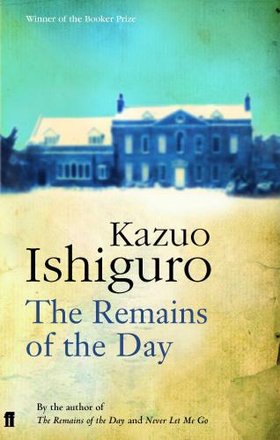
Review : The Remains of the Day

(Orginial review posted on Goodreads:- November 24, 2012)

When I had merely read about 30 or so pages of this book, I must confess I was debating whether or not to
continue with it, given the unbearably slow pacing of the plot.
And then when I had finally reached the end, I couldn't help but feel immensely thankful to my own better judgement against giving it up. Since by that time I had been reduced to a pathetic, blubbering mass of emotions and tears, teetering on the verge of a major breakdown and marvelling at the writer's remarkable achievement at the same time.

The Remains of the Day is Kazuo Ishiguro's ode to England - its bygone glories, numerous idiosyncrasies and fallacies.
Through the life of Stevens, the protagonist and an uptight butler to a distinguished Lord, Ishiguro takes us on a journey of a nation through two wars which crippled it financially and relegated it to the sidelines of international politics as another nation slowly rose to take its place. But it is not merely the tale of a tottering Britain but also a human drama centering around themes such as self-discovery, lasting regret, nostalgia, unfulfilled love and the enduring desire to start over anew.
Stevens is not merely a symbol of the inimitable sophistication that defines English culture but also an emblem of the undeniable hollowness of it. Of the unalterable mistakes committed in the course of a long and eventful journey - be it the journey of life of a man or one nation.

Even though the verbosity of Ishiguro's prose may tend to make the narrative monotonous from time to time, it is never too big an impediment to navigate around. In fact it is the elegant language which catapults this novel into the league of classic English literature. Besides the unhurried, tender nuances of Ishiguro's story-telling do not deserve any less.

Oh yes he most certainly deserved the Man Booker for this.

5 out of 5 stars.
Related Posts Plugin for WordPress, Blogger...