Showing posts with label Modern Classics. Show all posts

Wednesday, June 4, 2014

Review: Their Eyes Were Watching God by Zora Neale Hurston


First published:-1937

Read in:- April, 2014

Star rating:-

Here is a woman who led a wretched life for years, doomed to stagnate in the drab depths of oblivion even after her death which had gone under the radar and generated no nostalgia-soaked, emotional obituaries. She lay in an unmarked grave in the Garden of Heavenly Rest, Florida, treated by her own contemporaries like an outcast because of a difference in perspectives, to be resuscitated and acknowledged as one of the foremost powerful voices that ever reverberated across the African-American literary landscape years later. And here is her creation, a 'coffee-and-cream' skinned Janie Crawford, a child born out of a possible rape, a sure forerunner to Toni Morrison's Sethe, Denver and Beloved or Alice Walker's Celie and Nettie. A mulatto woman in a white man's world, who grew aware of an identity not shackled by notions of race, skin color, and even gender, who could look beyond the small horizon carelessly conferred on her by an era which was bluntly apathetic to her kind, who could aspire to be free of a legacy of mere victimhood.
And here I am, trying to make sure I do not fuse Zora and Janie together, unable to decide how to love, revere and pity them at the same time.

I watched the young and carefree Janie, who bubbled over with an enthusiasm for life, eventually morph into the Janie who embraced the bittersweet realization of having loved and lost. My eyes traced her unsure footsteps from financial servitude to financial stability, from the daily battle of ignoring the sting of self-denial to grasping at a life free of emotional subservience. I loved the hapless, innocent Janie who consented to being passed over like property from her grandmother's ownership to her first husband's just as much I admired the Janie who found her salvation in Tea Cake's good-natured laughter after two marriages which had simultaneously stripped her of her last shred of self-esteem and caused her to listen to that stifled inner voice. And I felt a strange kind of happiness building up inside for the Janie who would not succumb to the temptation of self-loathing like the misguided Mrs Turner, the Janie who found the firm ground of self-awareness to tread on while the world of conflicting ideas rotated on its axis like ever.

Zora Neale Hurston had a rich dual voice - one of them fearlessly recounting the quirks characterizing the Black American community in the deep south still clinging on to the outer fringes of a white-dominated society intertwined with the lyrical, oneiric voice of a philosopher and a feminist, possibly one of the first among her kind. And it is this wholly harmonious union of these two voices which transforms this bildungsroman into a honeyed ballad of love and grief, of psychological bondage and emancipation.

"He looked like the love thoughts of women. He could be a bee to a blossom-a pear tree blossom in the spring. He seemed to be crushing scent out of the world with his footsteps. Crushing aromatic herbs with every step he took. Spices hung about him. He was a glance from God."

Janie never bore a grudge against her 'God' for making her path to fulfillment so long and arduous. She merely watched Him with hopeful eyes, lovingly accepting all He bestowed on her. And I watched Janie with a tear-strained smile.


   photo C136E66569D294E4D5DA2D8124D4FF69.png

Saturday, October 12, 2013

Review: The Wind-Up Bird Chronicle by Haruki Murakami

If I were to use only one word to describe this book, I would type the word 'brilliant' a million times with each letter in CAPITALS and fill up the entire word length of this particular space.

In all its sensitivity, emotional depth and keen understanding of the complications of the human mind, this is a stellar work of literature and a tour de force in itself. I cannot go ahead and say it is Murakami's magnum opus (it is not his longest novel), since I haven't finished with all his translated works and besides he is only 63 and I expect him to keep writing books for as long as it matters, each one better than the last. But I'm forced to admit that of the 7 Murakami books I have had the fortune to read so far, this one stands out as the most gripping, most cerebral yet compassionate commentary on loneliness and human misery. 

In this particular novel, Murakami stitches together a handful of seductively beautiful vignettes to form a magnificent larger than life image, that does not only represent a story of a particular individual but recounts the tales of many. Seemingly unconnected at first, these numerous subplots coalesce together in a solid clincher of an ending - a humongous task but performed with elan by the masterful surrealist.

It is a story of a marriage which is falling apart slowly but steadily, a moving depiction of the horrors inflicted on humanity during Japan's occupation of Manchuria and the forgotten battle of Nomonhan, a mystery thriller, an exploration of the inherent darkness within each one of us and a man's path to self discovery all combined into one.

Newly out of work, Toru Okada is leading a peaceful life with his wife Kumiko when his carefully organized world starts to crumble bit by bit. His wife goes missing without a hint, the sociopathic brother-in-law he despises with a passion is emerging as a compelling figure in Japanese politics and he begins encountering queer characters one after the other, each of whom seem to be twisted individuals but guide him towards solving the mystery of his wife's sudden disappearance. And thus begins a most intriguing tale of Okada's journey through an intricate labyrinthine path stretching across time and space, the real and the surreal, where he goes through a set of bizarre but enlightening experiences.

It is difficult for me to say anything more about the plot simply because it is impossible to summarize a Murakami novel or to express all the emotions a reader goes through in such a short review. Honestly I could write a whole damn book if I'm to review every aspect of one particular Murakami novel.

All this time I had subconsciously developed an intense desire of knowing Murakami's opinions on Japan's infamous role in World War II. This book surprised me pleasantly by giving me exactly that and I'm not disappointed with his view. 
Instead of taking a stand, Murakami describes a few scenes of extreme violence with precision and calculated neutrality and pushes the reader to form his/her own opinion. He does not try to absolve the Japanese of the unmentionable crimes they committed against the Chinese but at the same time offers a very human perspective of the trail of death and devastation. For example, when a Japanese veterinarian, serving as the director of a zoo in Manchukuo is being made to watch the gruesome killing of 4 Chinese rebels with bayonets, Murakami sums up his feelings in the line:-

'He became simultaneously the stabber and the stabbed.'
I don't think he could have created a more moving picture of the ruthlessness of war or the unimaginable horrors it spawns. If the Japanese were ruthlessly brutal, so were the rest - the Soviets, the Mongols and every single human being who killed or tortured another in the name of war. He also hints at the accountability of those at the helm of matters, seated somewhere in their immaculately decorated offices, dressed in dapper suits, making decisions which alter the course of humanity for the worse and bring about disastrous consequences for the rest to face.

This is perhaps the only Murakami novel which has a very strong element of mystery at heart and which ends with a satisfactory resolution of sorts. 


Final rating :- 5 stars and no less. Hell, I could've given it a 10 stars out of 5 if possible.

P.S:- So Murakami didn't win the Nobel this year either, but that's okay because in the heart of every devoted Murakami lover, he has been given the Nobel a million times over already.


 photo C136E66569D294E4D5DA2D8124D4FF69.png

Tuesday, September 3, 2013

Review: Perfume: The Story Of A Murderer by Patrick Suskind

(Original review posted on Goodreads: Oct 7, 2012)


Perfume is a book in a league of its own. It’s unconventional, terrifying and creepy; yet at the same time, dazzling, mesmerizing and strangely hypnotic. Whether I hate it or love it is irrelevant (and honestly, I’m still not sure), because I know that this is a great book. I knew that five minutes after I started reading.

Perfume is a very bizarre tale about a very bizarre murderer, who kills not for sadistic pleasure or monetary gains, but simply in the pursuit of achieving his dream – creating the best perfume in the whole of France, which, quintessentially, is the scent of an adolescent beautiful virgin. But what sets this book apart, aside from the brilliant narration, is the fact that the story solely focuses on Grenouille – his life, his obsession, his single-minded devotion to his craft. No thoughts are spared for the victims or the actual killings; it’s only the scent-induced high that matters.

Grenouille is a character you are supposed to hate. The author never tries to bring about any semblance of humanity in him. In fact, he introduces Grenouille as ‘a gifted abomination’; ‘a tick waiting to bore and bite into animal flesh’. Yet, as much as I loathed him, there were times when I caught myself feeling sorry for him. And it unsettled me because for a long time, I couldn’t figure out why I would feel that way since the book projects Grenouille as nothing less than a monster. But there’s something about how fanatically devoted he is to his passion, how his whole life is centered around scent, that's eerily touching.

The narration is brilliant, as long as Grenouille stays in the picture. Once or twice, however, the author shifts focus to other people, like the perfumer who mentors Grenouille in Paris. And that is when I felt the narration slip a little, going off on tangents. The pace of the book also drops towards the middle.

However, the end more than made up for all that. The story truly came alive in the last 15 chapters and it gripped me with an infectious mix of thrill and paranoia that made it impossible to put the book down. And OMG, the end!! I never saw it coming. It was jaw-dropping, shocking, and very, very clever. In fact, if I had to rate just the concluding chapters, I would give them a 5-on-5.

The writing is exceptionally good. The words are brilliantly chosen, and put together in a way that gives them a dreamlike quality, especially when the author describes scents. And obviously, he does that a lot.

Perfume made my skin crawl and left me reeling. But it also left me spellbound at the sheer ingenuity of Patrick Suskind’s vision. Equal parts creepy and creative, Perfume might not be a book for everyone but it is a great piece of literature regardless.

4 out of 5 stars


Saturday, August 31, 2013

Review : Slaughterhouse-Five by Kurt Vonnegut

(Original review posted on Goodreads:- April 30th, 2013)

Neither does a war bring glory nor does a win in one ensure the moral infallibility of one
ideology over a conflicting one. Because essentially, war justifies countering genocide with more genocide. We all know that, right?
But nope, we don't. We only think we do. And that is what Kurt Vonnegut wishes to tell his reader, in a calm, detached and emotionless voice in Slaughterhouse Five.
He informs us, quite matter-of-factly that we don't know the first thing about a war and proceeds to explain to us what it really is, by fashioning a narrative as abstruse, disjointed and meaningless as war itself.
I must make a confession despite how morbid this may sound. I have a thing for war books because it's endlessly fascinating to read about the two World Wars which helped define our identity as a civilization in the last century. And despite the horrendous nature of crimes against humanity that were committed in both, these two wars held up a mirror in front of us where we could recognize our own failings as human beings and rectify our mistakes.
Which is why I agree with Tan Twan Eng's views on World War II:-,
"Moments in time when the world is changing, bring out the best and the worst in people."

But Vonnegut neither eulogizes war nor seeks to make our hearts bleed for the unimaginable loss and suffering it brings. Instead, he gives the traditional perspective on war a new twist by giving us a prolonged glimpse into the mind of a war veteran who neither considered himself a hero nor a coward. 

Billy Pilgrim's life or the way he viewed his own life in retrospect, was as chaotic and nonsensical as the war he fought in. It is the sheer absurdity of the concept of war that takes center stage in this highly experimental novel - how we carry on with our broken lives with a perverse sense of humor in the face of mindless cruelty and utter madness.

5 out of 5 stars.
Photobucket

Tuesday, August 20, 2013

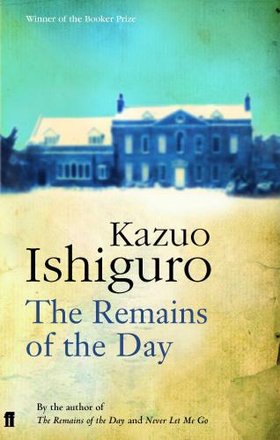
Review : The Remains of the Day

(Orginial review posted on Goodreads:- November 24, 2012)

When I had merely read about 30 or so pages of this book, I must confess I was debating whether or not to
continue with it, given the unbearably slow pacing of the plot.
And then when I had finally reached the end, I couldn't help but feel immensely thankful to my own better judgement against giving it up. Since by that time I had been reduced to a pathetic, blubbering mass of emotions and tears, teetering on the verge of a major breakdown and marvelling at the writer's remarkable achievement at the same time.

The Remains of the Day is Kazuo Ishiguro's ode to England - its bygone glories, numerous idiosyncrasies and fallacies.
Through the life of Stevens, the protagonist and an uptight butler to a distinguished Lord, Ishiguro takes us on a journey of a nation through two wars which crippled it financially and relegated it to the sidelines of international politics as another nation slowly rose to take its place. But it is not merely the tale of a tottering Britain but also a human drama centering around themes such as self-discovery, lasting regret, nostalgia, unfulfilled love and the enduring desire to start over anew.
Stevens is not merely a symbol of the inimitable sophistication that defines English culture but also an emblem of the undeniable hollowness of it. Of the unalterable mistakes committed in the course of a long and eventful journey - be it the journey of life of a man or one nation.

Even though the verbosity of Ishiguro's prose may tend to make the narrative monotonous from time to time, it is never too big an impediment to navigate around. In fact it is the elegant language which catapults this novel into the league of classic English literature. Besides the unhurried, tender nuances of Ishiguro's story-telling do not deserve any less.

Oh yes he most certainly deserved the Man Booker for this.

5 out of 5 stars.
Related Posts Plugin for WordPress, Blogger...